


Six Formative Assessment Techniques Primary Teachers Can Use This Week

Formative assessment is any quick, low-stakes check a teacher uses during a lesson to see what pupils actually understand, then acts on right away. The single habit worth building this week: pick one moment in a lesson where understanding could go two ways, check it with something as simple as a mini-whiteboard or exit ticket, and have your next move already decided before you ask the question. The IES review backs this up with real evidence, and the EEF’s Embedding Formative Assessment work shows how to make it stick school-wide.
TL;DR:
Teacher-led checks are most effective when planned around a specific decision point where student understanding could diverge significantly.
Using simple routines like mini-whiteboards, traffic lights, or exit tickets can provide instant, class-wide insights with minimal time investment.
Focusing on one well-designed question at the right moment, with pre-planned responses, yields more impact than complex, multiple routines.
Pupil self and peer assessments work best after teacher-led routines are automatic, helping foster ownership without increasing workload.
Small class sizes enable immediate follow-up and correction during the lesson, significantly improving the effectiveness of formative assessment.
Table of Contents
What Formative Assessment Looks Like in a Primary Classroom
Formative assessment is not a test, a grade, or a report card comment. It is the small, in-the-moment glance a teacher takes at where pupils actually are, so the next few minutes of teaching can shift to meet them. Summative assessment, by contrast, measures what pupils learned after the fact. A spelling test at the end of the unit is summative. Noticing mid-lesson that half the class has the wrong idea about regrouping in subtraction, and adjusting your explanation on the spot, is formative.
The features that make a check genuinely formative are simple: it happens during instruction, it costs little time to run or mark, and it leads to an immediate decision. Here are six strategies that meet all three.
Mini-whiteboards. Ask a question, have every pupil write an answer, and hold boards up together. You see the whole class in one glance and sort responses into “ready to move on” and “needs support” before the next activity begins.
Traffic lights or thumbs. Pupils signal green, amber, or red (or thumbs up, sideways, down) on their confidence with a task. Pair reds with a quick follow-up question to check the signal matches reality, since confidence and accuracy do not always line up.
Exit tickets. One or two questions on a slip of paper at the end of a lesson. Sort the pile into three piles overnight and use that sort to plan tomorrow’s starter.
Hinge questions with ABCD cards. A single multiple-choice question, built so each wrong answer reveals a specific misconception, asked at a genuine turning point in the lesson. Pupils hold up a lettered card and you read the room instantly.
Peer assessment routines. Pupils check a partner’s work against two or three simple, visible success criteria rather than grading it.
Self-assessment check-ins. A pupil rates their own understanding against the same criteria the teacher is using, building the habit of self-monitoring early.
Low-work strategies like these give a teacher class-wide information in seconds, without a single book to mark that evening.
Building a Formative Check Into a Lesson Plan
The workload problem with formative assessment usually isn’t the check itself. It’s not knowing what to do with the answer once you have it. Fix that by planning your response before the lesson starts, not after you’ve seen the data.
Find the decision point. Look at your lesson plan and mark the one spot where pupils genuinely could go two different ways: understand the concept or not, and where your next steps would differ depending on which.
Design the check around that point. Write success criteria first, then build a question or task that would clearly separate pupils who’ve met them from those who haven’t.
Pre-plan three responses. Before you ask the question, decide what you’ll do for each outcome: move the whole class on, pull a small group aside for two minutes right there in the room, or flag names for reteaching in a later session.
Make wrong answers diagnostic. A hinge question only works when each incorrect option points to a specific, predictable misconception rather than a random slip. If option B could only be chosen through a genuine misunderstanding of place value, you know exactly what to teach next when three pupils pick it.
Group fast. Have a low-key signal ready, like moving to a rug corner or a specific table, so the same-lesson small group doesn’t eat five minutes of transition time.
Pro Tip: Write your three responses directly onto the lesson plan next to the check itself. If the plan doesn’t say what happens after the thumbs go up or down, the check becomes a formality instead of a decision point.
Putting Students in Charge of Their Own Progress
Formative assessment scales faster when pupils aren’t just being checked on, they’re doing some of the checking themselves. Start by explaining the learning intention and success criteria in plain, short language a nine-year-old could repeat back to you: not “demonstrate understanding of narrative structure” but “your story has a beginning, a problem, and an ending that solves it.”
Two routines make this concrete without adding to your marking pile:
Two-criteria peer checks. Give partners exactly two things to look for in each other’s work, no more. Three or four criteria and pupils start guessing rather than checking.
Two stars and a wish. Pupils (or partners) name two things done well and one thing to improve, using the same success criteria the teacher set.
Handing pupils these roles does two things at once: it cuts down how much formative checking falls solely on you, and it builds the kind of ownership that keeps motivation up when a task gets hard.
What the Research Actually Shows
Formative assessment has a positive effect on academic achievement overall, often showing larger effects in math than in reading or writing, according to the IES review of rigorous studies.
That single finding should shape where a busy teacher spends limited planning time. Math lessons, with their clearer right/wrong decision points, are the easiest place to build a hinge question or mini-whiteboard check that pays off quickly. The same review found that effective cycles tend to be short, from within a single lesson up to about four weeks, and share three features: a clear target, a check on where pupils currently stand, and a decided next step.
Effects also varied depending on who was doing the assessing. Teacher-directed checks, where the teacher designs and interprets the data, showed the most consistent results. That doesn’t rule out peer and self-assessment, but it does suggest starting with teacher-led checks before layering in student-led ones. The EEF’s Embedding Formative Assessment program adds a school-level lesson here too: formative assessment sustains itself better, and produces steadier modest gains, when it’s introduced through professional development rather than left to individual teachers to figure out alone.
Where Formative Assessment Goes Wrong
Most formative assessment routines don’t fail because teachers pick the wrong strategy. They fail because the strategy quietly turns into something it was never meant to be.
Don’t let checks become evidence for a filing cabinet. The moment a mini-whiteboard answer gets recorded for a tracking spreadsheet instead of acted on that lesson, it’s stopped being formative.
Watch for lazy distractors. A hinge question with one obviously silly wrong answer and two plausible ones only tests half your class. Every option needs to represent a real misconception.
Keep rubrics tiny. A five-point success criteria list sounds thorough but pupils stop reading past the second line. Two or three criteria, used consistently, beat five used once.
Pick two strategies and commit. Trying to run six different formative routines in one week is how the whole habit collapses by half-term.
Pro Tip: Choose one whole-class strategy (mini-whiteboards work well) and one student-led routine (two stars and a wish), then run both for two straight weeks before adding anything new. Consistency, not variety, is what makes formative assessment stick.
How Astor Puts This Into Practice
Small class sizes change what formative assessment can look like day to day. In an Astor International School classroom, a hinge question doesn’t just tell a teacher that four pupils are confused, it tells them exactly which four, and there’s room to pull them aside for two minutes without the rest of the class losing momentum. That’s the practical payoff of small-group teaching: the gap between noticing a misconception and fixing it shrinks to the same lesson, not the same week.
If you’re building this habit in your own classroom, start with one routine this week rather than all six. Explore how Astor structures learning outcomes and success criteria across its curriculum for ideas on framing goals pupils can actually repeat back.
The Editorial Take: Skip the Overhaul, Start With One Question
The advice most teachers get about formative assessment is to build a whole new system: color-coded trackers, weekly data reviews, a folder for every pupil. The research doesn’t actually support that. What it supports is smaller and less glamorous: one well-built question, asked at the right moment, with a decision already made about what happens next.
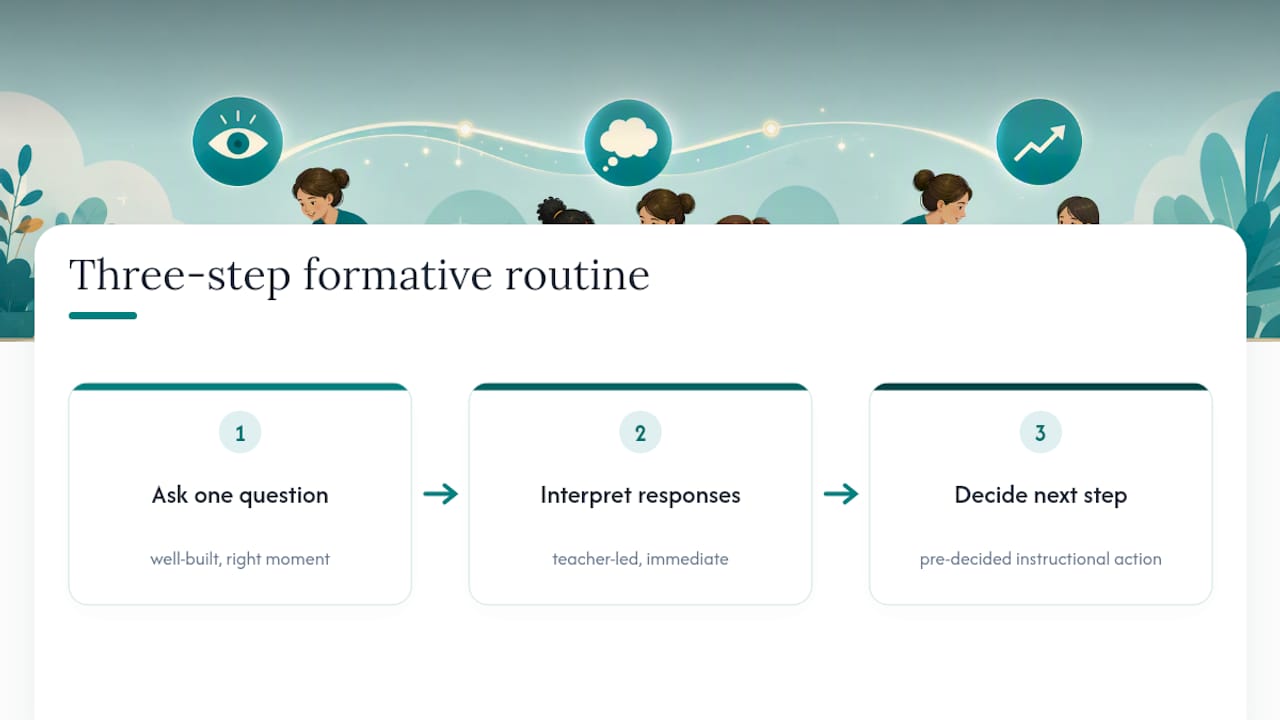
Where conventional advice overreaches is in treating every subject and every routine as equally valuable. They aren’t. Math lessons with clear right and wrong answers give you the cleanest formative data, and teacher-directed checks outperform pupil-led ones in the early stages of building this habit. Start there. Add peer and self-assessment once the teacher-led routine is automatic, not before.
If you take one thing from this guide, make it this: stop planning formative assessment as a separate activity and start planning the response to it. A check without a pre-decided next step is just a quiz with better branding.
— Elena
Try This Yourself, or Let Astor Show You How
If you’re a parent watching your child’s teacher run these checks and wondering what a school looks like when this becomes daily habit rather than a training-day slide, that’s worth seeing firsthand. Astor’s small class sizes mean a hinge question doesn’t just flag a misunderstanding, it gets addressed in the same lesson, because there’s rarely a group larger than a handful of pupils needing the same small-group follow-up. That immediacy is hard to replicate in a class of thirty.
An international school and preschool campus in Singapore serve children from 1.5 to 12 years old, with inquiry-based learning and enrichment across arts, sports, and languages built around small classes. If formative assessment done well is part of what you’re looking for in a school, explore how success criteria and learning outcomes are structured across Astor’s curriculum and get in touch to arrange a visit.
Sources
For the full evidence base, read the IES review on elementary formative assessment and the EEF’s implementation guidance. For ready-to-use classroom prompts, the Assessment for Learning Strategy Bank offers printable examples worth adapting.
Recommended
Comments