


Start Tours 6–9 Months Early: Holland Village Preschool Shortlist

For families near Holland Village, Astor International Preschool is the strongest starting point if you want small class sizes and a genuine mix of outdoor and classroom learning close to home. Astor caps classes at approximately twenty children and offers outdoor learning spaces on its Holland campus. Book a campus tour or request the fee schedule before you shortlist anywhere else.
TL;DR:
Astor’s Holland campus offers small class sizes around 15 children, with outdoor learning spaces, making it suitable for families prioritizing a low student-to-teacher ratio.
Most private and international preschools, including Astor, provide smaller cohorts and curriculum flexibility but at higher fees compared to MOE Kindergartens, which are limited and highly subsidized.
To verify proximity and availability, use official maps and local directories rather than relying solely on center claims, especially since center footprints and vacancies can change frequently.
When touring, focus on asking specific questions about curriculum, outdoor access, staff ratios, and licensing, and request documented fee breakdowns to compare net costs accurately.
For urgent or upcoming enrollments, start tours six to nine months in advance, preparing essential documents and exploring trial days to assess the center’s fit for your child’s needs.
Table of Contents
Holland Village Preschool Guide: What’s Nearby and How to Map It
Holland Village sits in one of Singapore’s more tightly packed residential pockets, and that density shows up in the childcare options around it. You’ll find MOE Kindergartens (MKs) operating on subsidized fee structures, small private and international preschools with boutique class sizes, larger anchor operators with multiple branches across the island, and a scattering of home-based playgroups that operate more informally. Each category serves a different kind of family, and knowing which one you’re looking at before you book a tour saves a lot of wasted afternoons.
MOE Kindergartens exist to give Singaporean and permanent resident families a MOE-curriculum experience at fees pegged below market rate. The Ministry of Education explains the MK model as a deliberate alternative to private preschools, with priority given to children of citizens and lower household incomes. If you qualify, an MK is often the most affordable route, but seats near Holland Village are limited and demand tends to outstrip supply well before the intake year starts.
Private and international preschools, including Astor’s Holland campus, tend to offer smaller cohorts, more curriculum flexibility, and higher fees in exchange. These centers are where most expat families and Singaporean parents seeking non-MOE pedagogy end up looking first.
Finding what’s actually around you takes more than a Google search. OneMap is Singapore’s official mapping tool and the fastest way to confirm a center’s exact address, walking distance, and travel time from your block, rather than relying on a center’s own claim of being “near Holland Village.” Local directories like KakiList’s Holland Village listing, which catalogs 284 providers in the broader area, help you cross-check names you find elsewhere and spot centers you might have missed.
A few practical things to keep in mind as you map your options:
Holland Village sits in the Central zone, so some private centers apply a travel or zone surcharge for families located further out. That surcharge doesn’t always apply to families living within the immediate Holland Village catchment, so ask directly.
Campus footprints in this part of Singapore are smaller than in the suburbs, which affects how much outdoor space a center can realistically offer.
Anchor operators often have branches nearby but not directly in Holland Village itself, meaning “near Holland Village” can stretch to a 10 or 15-minute drive.
Vacancy at popular centers changes month to month, so a map search today doesn’t guarantee availability by the time you call.
Once you have a shortlist of five or six names pulled from OneMap and local listings, the real comparison work starts.
What Should You Look for in a Holland Village Preschool?
Picking a preschool is less about finding the “best” one on a list and more about matching a center’s approach to your child’s needs and your family’s daily rhythm. A center that’s perfect for a bilingual household with two working parents might be entirely wrong for a family that wants a slower, play-heavy morning schedule. Start with fit, not prestige.
Pro Tip: Visit at drop-off or pickup time, not mid-morning during a quiet lesson block. You’ll see how staff actually manage transitions, which tells you more than any brochure.
Here’s a practical order to work through when you’re comparing centers:
Teacher qualifications and ratios. Ask directly for the student-to-teacher ratio in the specific age group your child will join, not a school-wide average, and ask how long the lead teachers have been with the center.
Licensing and quality markers. Confirm the center is licensed through the Early Childhood Development Agency and ask whether it holds SPARK certification, which signals the center has met ECDA’s quality benchmark for curriculum, staff, and administration.
Daily schedule and outdoor access. In a dense area like Holland Village, ask exactly how much time each day is spent outdoors and whether that happens on-site or requires a walk to a nearby park.
Logistics and red flags. Check operating hours against your work schedule, ask about sibling or waitlist priority, and watch for vague answers about staff turnover or unclear fee breakdowns during the tour.
Documents worth asking to see on a tour include the center’s ECDA license certificate, a sample weekly schedule, and a full fee breakdown that separates tuition from materials, meals, and enrichment. Centers that hesitate to hand these over, or that only offer verbal fee ranges, are worth a second look before you commit a deposit.
Family goals matter just as much as institutional credentials. If you’re raising a bilingual child, ask how many hours per week are dedicated to the second language and whether it’s taught by a native speaker. If you’re an expat family planning to move again in a few years, ask how the curriculum aligns with international primary school pathways, since a mismatch here can mean a rocky transition later.
Building a Holland Village Shortlist Without Chasing a “Best Of” List
There’s no single ranked list that tells you the right preschool for your child, because the right answer depends entirely on what you’re optimizing for. Instead of hunting for a “best preschools in Holland Village” ranking, sort your options into three practical buckets and pick from each one.
Subsidized MOE or anchor-operator centers. Best for citizen and permanent resident families prioritizing cost, comfortable with a larger cohort and a standardized MOE-aligned curriculum.
Private or international small schools, including Astor’s Holland campus. Best for families who want smaller class sizes, more curriculum flexibility, and a program built around inquiry or play rather than a fixed national syllabus.
Outdoor-strong centers slightly further from the MRT. Best for families willing to trade a few extra minutes of travel for larger playgrounds or nature-based programming, since central real estate rarely leaves room for sprawling outdoor space.
Once you know which bucket matters most to your family, the shortlisting rule is simple: pick one center for curriculum fit, one for proximity or immediate availability, and one for cost and scheduling flexibility. Book tours for all three in the same week if you can. Comparing them back to back, while the details are still fresh, makes the differences between a play-based morning and a structured inquiry-based one much easier to spot than if you space the visits a month apart.
Resist the urge to let proximity override everything else. A center five minutes closer isn’t worth much if its curriculum doesn’t match what you actually want for your child. Use the tour to test your assumptions: ask the same five questions from the checklist above at each stop, and write down the answers immediately afterward, because centers start to blur together after the third visit.
How Far Ahead Should You Start the Admissions Process?
Popular centers near Holland Village, particularly small international schools with limited seats, often fill their intake months before the term starts. Start touring at least six to nine months ahead of your target enrollment date if you have a specific center in mind, and treat any center offering immediate availability as a signal worth double-checking rather than dismissing outright.
Here’s a realistic sequence to follow:
Build your shortlist and book tours six to nine months before your intended start date, prioritizing centers with waitlists first since those move slowest.
Bring the right documents to every tour. Have your child’s birth certificate or passport, immunization records, and proof of address ready, since many centers ask for these at the point of application, not just enrollment.
Ask about trial days. Several private centers offer a paid trial day or week, which is worth the small cost if you’re torn between two finalists.
Check sibling and resident priority policies. If you have another child already enrolled, or you live within the immediate catchment, ask how much that priority actually moves you up a waitlist.
Decide on a clear rule for offers. If a center you rated highly on fit offers you a spot, take it. If it’s a backup option, holding a place for two to three weeks while you wait on a preferred center is usually reasonable, but check the center’s own deposit deadline first.
Waitlists near Holland Village move unevenly. A center might have a long wait for the toddler group but open seats in the K1 or K2 years, so it’s worth asking about availability across every age band, not just the one you need right now.
What Do Preschool Fees and Subsidies Actually Cost?
Net cost is what matters, not the sticker price a center quotes on its website. The ECDA Basic Subsidy reduces monthly childcare fees for Singaporean children enrolled in licensed centers, with the exact amount depending on household income and the type of center. MOE Kindergartens sit at the lower end of the fee spectrum by design, since they’re subsidized directly, while private and international preschools set their own rates independent of that subsidy structure.
When you’re comparing quotes, ask every center for the same breakdown so you’re not comparing a bare tuition number against another center’s all-in figure. Common extras to ask about include:
Materials fees, charged annually and often separate from tuition
Meal plans, which some centers bundle and others bill separately
Enrichment classes such as language, art, or sports add-ons
One-time admission or registration fees due at signing
Transport, if the center offers a bus service and you plan to use it
A simple request that works with almost any center: ask for a “total annual cost” figure that folds in tuition, meals, materials, and any enrichment you’d realistically use. That single number is the only fair way to compare a subsidized MK against a private preschool with a higher headline fee but fewer add-ons.
Quick fact: ECDA’s own guidance for parents frames the subsidy system as income-tiered rather than flat, which means two families at the same center can pay meaningfully different net fees depending on household income and citizenship status. Confirm your own eligibility directly through the ECDA subsidy guidance rather than assuming a quoted “subsidized rate” applies to your household.
Astor’s Holland Preschool: A Closer Look at the Campus
Astor’s preschool campus in the Holland area runs on genuinely small class sizes, averaging around 15 children with a cap near 20, paired with the inquiry-based International Primary Curriculum rather than a fixed rote syllabus. The Holland campus runs two playgrounds, giving children a genuine mix of outdoor and classroom learning within a footprint that’s still manageable for a small central-zone site.
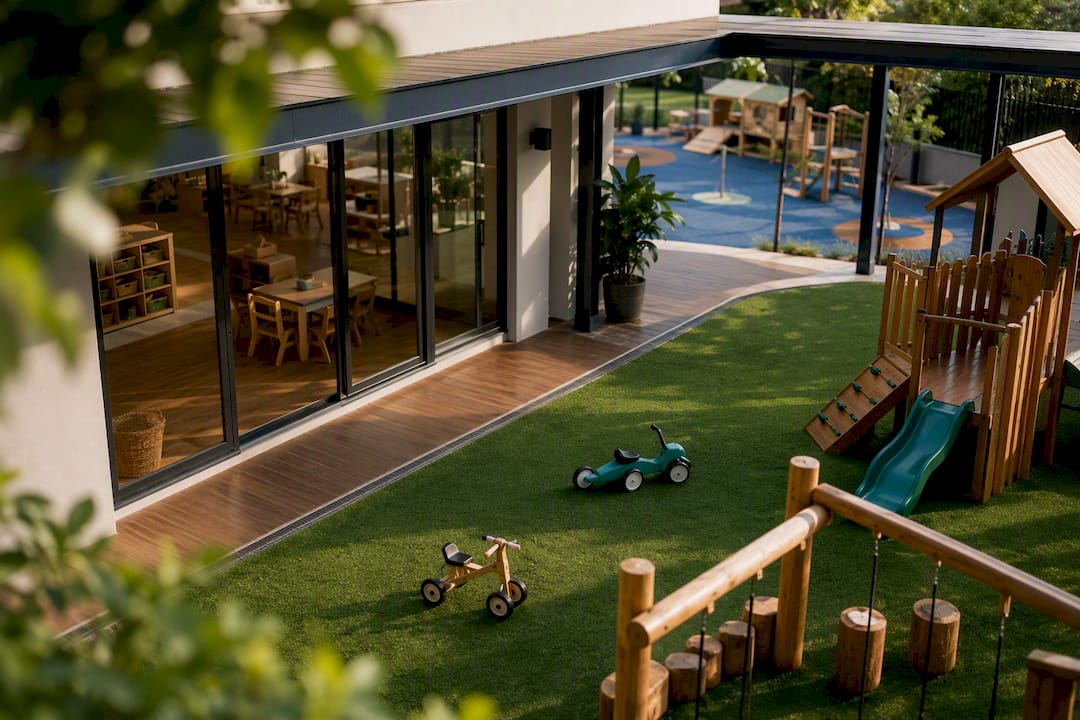
Against the checklist covered earlier, Astor’s Holland campus fits families prioritizing low ratios and curriculum flexibility over a larger, more standardized program. If daily outdoor access and a smaller cohort matter more to you than proximity to the MRT down to the last minute, this is worth putting on your shortlist alongside your proximity and cost picks.
This section draws on verified details from Astor’s own campus and fee pages. Parents wanting deeper specifics, class photos, or a walkthrough of a typical day should book directly through the Holland campus tour page or check current fee options before comparing numbers against other centers.
What Do Parents and Authorities Actually Say About Nearby Preschools?
Formal government ratings for individual preschools don’t exist in Singapore the way school rankings do at the primary level. What you have instead is a mix of ECDA licensing status, SPARK certification where a center has pursued it, and aggregated parent feedback on independent local directories.
Aggregator sites like WhereCrowded’s Holland Village guide compile parent reviews and ratings across the area’s centers, giving you a rough reputation signal before you commit to a tour. Treat these the way you’d treat restaurant reviews: useful for spotting patterns, like repeated praise for a center’s outdoor time or repeated complaints about communication, but not a substitute for visiting yourself.
The most reliable signal remains a direct conversation with current parents at the center, if you can arrange one during a tour. Ask the front-desk staff whether they can connect you with a parent volunteer or point you to a parent chat group for the center. Most established centers, including smaller international ones, are happy to facilitate this because it builds trust faster than any review site can.
When you do read aggregated reviews, weigh recency heavily. A center that gets consistently praised for its teachers turning over frequently a year ago may look completely different today. Cross-reference anything you read on a review site against what you see and hear on your own visit, and don’t let a single glowing or negative review outweigh your own tour experience.
Does Your Child Need Special Needs Support at Preschool?
Every ECDA-licensed preschool in Singapore, including centers around Holland Village, is required to make reasonable efforts to support children with mild developmental or learning needs, though the depth of support varies enormously between centers. Some private and international preschools build in dedicated learning-support staff or small-group intervention as a paid add-on; others rely on referring families to external therapists and adjusting classroom routines informally.
If your child has a diagnosed need, whether that’s a speech delay, sensory processing difference, or an attention-related diagnosis, ask specific questions rather than a general “do you support special needs.” Ask how many children with similar needs the center currently supports, whether staff have specific training, and whether support happens within the regular classroom or in a separate pulled-out session.
Fee structures for this kind of support vary just as much as the support itself. Some centers price learning support as a monthly add-on, ranging broadly depending on intensity and whether it’s one-on-one or small-group. Get this pricing in writing before enrollment, not as a verbal estimate during the tour, since it can materially change your total annual cost.
If a center can’t clearly answer how many children currently receive learning support, or seems to be improvising an answer on the spot, that’s worth noting. A center confident in this area usually has a ready answer, because it’s a question they field often.
How Should You Prepare for a Holland Village Preschool Tour?
Walk into every tour with the same five questions from the earlier checklist, and write the answers down immediately, because after visiting three or four centers in a week, details blur fast. Bring a notebook or your phone, and don’t be shy about asking to see the actual classroom your child would join rather than a model room used for tours.
Ask about the specific outdoor schedule for Holland Village campuses in particular, since space constraints in this part of the city mean outdoor time can vary widely between centers that look similar on paper. A center with two on-site playgrounds delivers something meaningfully different from one relying on a walk to a public park fifteen minutes away, especially on a rainy week.
Ask to see a full fee breakdown on paper, not a verbal summary, and specifically request the “total annual cost” figure covering tuition, meals, materials, and any enrichment you’d realistically use. Ask how transport and travel surcharges work if you live outside the immediate catchment, since Central zone pricing patterns aren’t always obvious from a center’s public rate card.
Finally, ask what a typical first month looks like for a new child. Good centers have a clear settling-in process, whether that’s a shortened first week or a buddy system with an existing student. Vague answers here often mirror vague answers everywhere else.
An Editor’s Honest Take on the Holland Village Search
Most parents I’ve seen research this decision spend too much time comparing curriculum philosophies on paper and too little time watching how a classroom actually runs at 8:45 on a Tuesday morning. The glossy brochure language, “inquiry-based,” “child-centered,” “holistic,” tells you almost nothing about whether your specific child will thrive there.
My honest advice: book three tours in the same week, ask the same five questions at each, and trust what you see over what you read. Proximity matters less than parents assume once you factor in a genuinely engaged teacher and a class size small enough for your child to actually be known. A ten-minute longer commute is a small price for the right fit; a wrong fit costs you far more in a mid-year switch.
If something here didn’t answer your specific situation, that’s worth raising directly with the centers on your shortlist. Every family’s trade-offs look a little different up close.
— Elena
Book a Tour or Get a Fee Quote from Astor’s Holland Campus
If proximity, small classes, and genuine outdoor time are all on your checklist, Astor’s Holland campus is worth a direct look rather than another round of aggregator scrolling. Families choosing between MOE Kindergartens and private centers often find the deciding factor is flexibility, and Astor offers two fee structures built for exactly that: Option A, FLEXI FEES at $17,580 SGD per year, and Option B, FIXED FEES at $23,650 SGD per year, so you can pick the structure that matches your cash flow rather than being locked into one model.
If you need care sooner than a full preschool enrollment allows, Astor also runs summer camps at $108 SGD per day or $488 SGD per week, a practical bridge while you finish touring and deciding. Book a campus tour to see the two playgrounds and meet the teaching team in person, or request the full fee breakdown through the fees page before you make your final call.
Sources
Before you commit to any center, verify licensing and subsidy details directly rather than relying on a center’s own claims.
FAQ
Which Preschool Is Considered the Best in Singapore?
There’s no single official ranking of “best” preschools in Singapore, since ECDA licenses centers rather than ranking them. Fit depends on your child’s needs and your family’s priorities, but centers with SPARK certification, low teacher ratios, and strong parent feedback on sites like WhereCrowded are a reasonable starting filter.
Which Preschool Pays the Most in Singapore?
Preschool staff compensation isn’t something individual centers publish, so there’s no reliable public ranking of which preschool pays teachers the most. If you’re evaluating a center as a parent, teacher tenure and turnover are a more useful proxy for staff satisfaction than salary speculation.
What Is the Best Age for a Child to Start Preschool?
Most children in Singapore start some form of preschool between one and three years old, though there’s no single “correct” age since it depends on family circumstances and the child’s readiness. Many parents use the transition to a playgroup or nursery class around one to two years as a gentle first step before a full-day program.
What Is the Most Popular Preschool Curriculum?
Play-based learning remains the most widely used approach across Singapore’s preschools, often blended with structured elements from frameworks like Montessori, Reggio Emilia, or inquiry-based programs such as the International Primary Curriculum used at Astor’s Holland campus. The right choice depends on whether your family prioritizes structured skill-building or child-led exploration.
Recommended
Comments