

How to navigate school choices for expat kids in Singapore

Choosing the right school for your child in Singapore is one of the most meaningful decisions you will make as an expat parent. The city-state offers world-class education, but its system comes with distinct pathways, eligibility rules, and timelines that can feel genuinely overwhelming when you are new to the country. Miss a deadline or misunderstand an eligibility phase, and your options narrow quickly. This article walks you through a clear, step-by-step process, from understanding your real options to executing a successful application, so you can move forward with confidence rather than anxiety.
Table of Contents
Understanding your options: Local vs international school paths
Step 1: Gather requirements and eligibility for each pathway
Step 2: Evaluate fit — curriculum, language, commute, and family plans
Step 3: Execute the admissions process and avoid common pitfalls
Why optimizing your education decision is about clarity, not control
Explore supportive expat-friendly schooling: Next steps with Astor
Key Takeaways
Point | Details |
Clarify your options | Understand the major differences between Singapore’s local and international schools before making a decision. |
Track eligibility and key dates | Stay on top of MOE’s phased admissions process and international school timelines to avoid missing your window. |
Match school fit to family needs | Compare curriculum approach, language needs, commute, and plans for relocation when shortlisting schools. |
Prepare for admissions complexity | Collect all required documents, watch for phase-specific rules, and expect some uncertainty especially for expat allocations. |
Emphasize clarity over perfect control | You can’t control every outcome, but a methodical approach reduces stress and improves decision quality for your children. |
Understanding your options: Local vs international school paths
Before you can make a step-by-step plan, you need to grasp your real options. Singapore offers two broad pathways for families: the Ministry of Education (MOE) mainstream system and international schools. Each has a very different structure, and the right choice depends on your family’s circumstances, not just your preferences.
The MOE mainstream system is built around structured bilingual learning and national examinations. The most significant of these is the PSLE at Primary 6, which determines secondary school placement. Students study English alongside a designated Mother Tongue language, typically Mandarin, Malay, or Tamil. This system is rigorous, well-resourced, and deeply respected globally. However, it is primarily designed for Singapore Citizens (SC) and Permanent Residents (PR), and access for international students is limited and competitive.
International schools, on the other hand, offer curricula such as the International Baccalaureate (IB), British curriculum, American curriculum, or Australian curriculum. These programs are designed with international study outcomes in mind, making them highly portable if your family relocates again. You can explore more about international school facts and how these systems compare before making your shortlist.
Here is a quick comparison to help you visualize the key differences:
Factor | MOE mainstream | International school |
Curriculum | Singapore national curriculum | IB, British, American, Australian |
Language requirement | Bilingual (English + Mother Tongue) | Varies; often English-medium |
Key exam | PSLE at end of Primary 6 | Varies (IGCSE, IB Diploma, etc.) |
Portability | Low (Singapore-specific) | High (globally recognized) |
Cost | Subsidized for SC/PR | Higher fees; no government subsidy |
Eligibility for expats | Restricted; competitive for international students | Generally open to all nationalities |
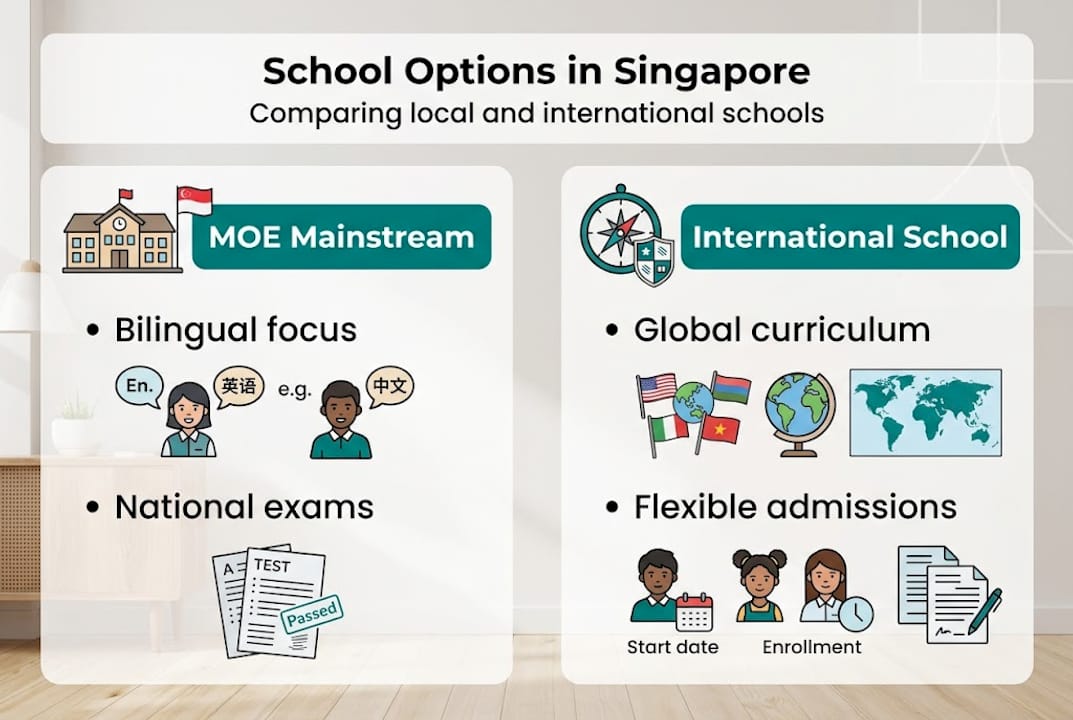
When thinking about MOE and international curricula, consider how each system aligns with your child’s learning style, your expected length of stay in Singapore, and where your family may relocate next. A child who thrives in a structured, exam-oriented environment may adapt well to the MOE system. A child who needs more flexibility, language support, or a familiar curriculum may flourish in an international school.
Key factors to weigh as you compare your options include curriculum approach and philosophy, bilingual requirements and language support available, school fees and financial planning, your expected mobility over the next three to five years, and the social and cultural environment your child needs to feel settled and confident.
Pro Tip: Before you shortlist schools, write down your family’s realistic relocation timeline. If you expect to move again within two to three years, a portable international curriculum will save you significant stress during the next transition.
Step 1: Gather requirements and eligibility for each pathway
Once you understand the schooling models, your next step is to clarify what you will need, and when, to pursue each option. This preparation phase is where many families lose time or miss opportunities. Starting early and staying organized makes all the difference.
For families with Singapore Citizens or Permanent Residents, MOE runs phased P1 registration from July to August each year. The phases are structured by eligibility, meaning a child’s citizenship status, whether a sibling already attends the school, and home address all influence which phase you register in and how competitive your placement will be. Missing your eligible phase means waiting for the next available window, which could significantly delay your child’s schooling.
For international students, the process is separate and follows a distinct timeline. You will need to submit an indication of interest form during a specified window, and MOE will then email you regarding whether a Primary 1 (P1) place can be offered. This process runs after SC and PR placements are completed, so international families should not assume the same July to August timeline applies to them.
Here is a summary of key documents you will need to gather regardless of pathway:
Document | Purpose |
Birth certificate | Proof of age and identity |
Passport (child and parents) | Nationality and residency verification |
Proof of residential address | Influences school allocation for MOE |
Prior school records or transcripts | Required by most international schools |
Vaccination records | Health compliance for enrollment |
Employment pass or visa documentation | Confirms legal residency status |
When selecting an international school, contact each school’s admissions team directly to request their specific document checklist. Requirements can vary, and some schools have waiting lists that make early inquiry essential.
Here is a numbered checklist to keep your preparation on track:
Confirm your child’s citizenship and residency status in Singapore.
Identify which MOE phase applies to your child, or confirm the international student process.
Download and complete all required forms well before the deadline.
Gather and certify all supporting documents.
Track submission deadlines for each school on your shortlist in a shared calendar.
Follow up with each school or MOE to confirm receipt of your application.
Important: Missing a registration phase or deadline in the MOE system is not recoverable in the same school year. International families in particular should note that the indication of interest window is time-limited and non-negotiable.
Step 2: Evaluate fit — curriculum, language, commute, and family plans
Now, with your requirements ready, it is time to measure each option against what matters most to your family. This is where many parents get stuck because the decision feels enormous. Breaking it into clear comparison factors makes it much more manageable.
Think of this step as a constrained optimization exercise. You are not looking for the perfect school in the abstract. You are looking for the best fit given your real constraints: MOE eligibility rules and timelines for mainstream options, or school-specific admissions processes for international and private schools. Within those constraints, you compare fit factors such as curriculum approach, language support needs, commute tolerance, and your expected length of stay.
Here are the core fit factors every expat family should evaluate:
Curriculum approach. Does the school’s teaching philosophy match how your child learns best? Some children thrive with structured, knowledge-based curricula. Others need more inquiry-based or project-led learning. A holistic education guide for expat parents can help you identify what your child needs before you visit schools.
Language support. If English is not your child’s first language, or if your child has had limited exposure to the local Mother Tongue language, language support becomes a critical factor. International schools often offer English as an Additional Language (EAL) programs or more flexible language pathways, which can ease a child’s transition enormously.
Commute and logistics. Singapore’s traffic and public transport mean that a school located far from your home or workplace can add significant daily stress. A 45-minute commute each way for a six-year-old is tiring and can affect their engagement and wellbeing. Factor in realistic travel times, not just map distances.
Class size and learning environment. Research consistently shows that small class sizes benefit children by enabling more personalized attention and stronger teacher-student relationships. This is especially important for children who are new to a country, navigating a new language, or adjusting to a different school culture.
Exit exams and future pathways. Consider where your child will likely continue their education. If secondary school or university in a specific country is your goal, work backward from that destination to ensure the curriculum you choose today aligns with those future requirements.
Expat-specific variables. These include your family’s expected length of stay, the likelihood of another relocation, after-school care needs, and whether your child has siblings who need to attend the same or nearby school.
Pro Tip: Avoid choosing a school based solely on its reputation or league table ranking. A school that is genuinely right for your child, one where they feel seen, supported, and curious, will always outperform a prestigious school where they struggle to fit in.
Step 3: Execute the admissions process and avoid common pitfalls
With your shortlist and fit factors set, let us move through the actual admissions and registration mechanics. This is where preparation pays off, and where families who have done their homework avoid the most common and costly mistakes.
For families pursuing the MOE mainstream pathway, the phased registration process requires you to act in your specific eligibility window. Do not wait to see what happens in an earlier phase. Prepare your documents and be ready to submit the moment your phase opens.
For international students, the process is distinct and important to understand clearly. International students register during Phase 3 after SC and PR allocations are complete. You must first submit an indication of interest form during a specified window. MOE will then email you to confirm whether a P1 place can be offered and how to complete registration. This email is critical. Missing it or not acting on it promptly can result in losing the offered place.
Here are the key steps to execute your admissions process successfully:
Submit your application or indication of interest on time, with all required documents attached and verified.
Confirm receipt with the school or MOE within 48 hours of submission.
Respond to any offer promptly. Offers often have short acceptance windows, particularly for international school placements.
Complete post-offer actions such as paying registration fees, submitting health records, and attending orientation sessions.
Keep copies of everything you submit, including confirmation emails and payment receipts.
Remember: For MOE placements, school transfers are processed online and a school nearer to your residential address may be offered based on available vacancies. Parents cannot indicate a preferred school. This is a common source of frustration for families who assume they can choose.
Common pitfalls to avoid include submitting incomplete documents, which causes delays or disqualification; misunderstanding which eligibility phase applies to your child; missing the MOE email for international students because it went to a spam folder; and assuming that international school admissions work the same way as MOE registration. Each school has its own process, timeline, and requirements. Treat each application as its own project.
For additional guidance on navigating this process, international school admission tips offer practical, Singapore-specific advice. If you are also thinking about future transitions, resources on preparing for future admissions can help you plan the full educational journey.
Why optimizing your education decision is about clarity, not control
After completing the admissions steps, it is easy to focus on outcomes and feel anxious about whether you made the right call. But here is what experience teaches us: the families who navigate Singapore’s school system most successfully are not the ones who found the perfect school. They are the ones who accepted the system’s constraints and focused on making clear, informed choices within them.
Singapore’s school system is deliberately structured around distance, phase, and eligibility. That is not a flaw. It is a design. Trying to control every variable will exhaust you. What you can control is your preparation, your clarity about what your child needs, and your willingness to adapt if the first placement is not ideal.
We have seen many families arrive in Singapore convinced that only one school will do. When that school is full or out of reach, the stress is enormous. But when families shift their focus to fit rather than prestige, and to process rather than outcome, they almost always find a path that works beautifully for their child. Reading why parents choose small schools like Astor often reveals this shift in thinking clearly. Flexibility and clarity, not control, are the real tools for a confident education decision.
Explore supportive expat-friendly schooling: Next steps with Astor
If you are ready for a school choice that understands the expat experience, here is how Astor can help. Astor International School in the Tanglin area of Singapore is a small but mighty school for children aged 5 to 12, recognized as both the best small school and the best affordable international school in Singapore. Small class sizes mean every child is truly seen and supported, and our international curriculum is designed to travel with your family wherever life takes you next.
For younger children aged 1.5 and above, Astor International Preschool in Holland offers a nurturing blend of outdoor and classroom learning across two playgrounds. When you are ready to take the next step, book a virtual tour with our founder to experience our community firsthand. Our admissions team is here to guide you through every step of the process with warmth, clarity, and genuine care.
Frequently asked questions
What are the key admission deadlines for local and international primary schools in Singapore?
For local schools, P1 registration runs July to August in eligibility-based phases. For international students, the indication of interest window must be completed before October, after which MOE sends placement emails.
Can I choose any primary school for my child as an expat in Singapore?
No. MOE assigns schools to international students based on vacancies after citizen placements are complete, so families cannot select a preferred school directly.
How does the Singapore school system’s language requirement affect expat children?
Bilingual requirements are structured in the MOE mainstream system, which can be challenging for expat children unfamiliar with the designated Mother Tongue language. International schools typically offer more flexible language support options.
What is the PSLE and why does it matter for expat families?
The PSLE is taken at Primary 6 and determines a child’s secondary school placement and academic track in Singapore’s mainstream system. Expat families should consider whether this exam aligns with their long-term educational goals before enrolling in the MOE pathway.
Is it possible to transfer schools after starting Primary 1?
Yes. MOE’s transfer process assigns a new school based on your residential address and available vacancies. Parents cannot select their preferred school during a transfer, so plan your residential location carefully from the start.
Recommended
Comments