


How to select an international school in Singapore

Choosing the right international school in Singapore is one of the most consequential decisions you will make as an expat family. It affects your child’s academic confidence, social wellbeing, and ability to thrive through your posting. Knowing how to select an international school goes well beyond scanning rankings or touring impressive campuses. It requires you to weigh curriculum fit, total costs, commute realities, and your child’s individual needs in a market with over 80 international schools competing for your attention. This guide gives you a practical, step-by-step framework to make a confident, personalized choice for children aged 5 to 12.
Table of Contents
Key Takeaways
Point | Details |
Prioritize curriculum fit | Choosing a curriculum that matches your child’s learning style and future plans is the most critical factor in school selection. |
Start applications early | Apply at least 12 months before your target start date to increase your chances of acceptance and avoid waitlists. |
Budget comprehensively | Include tuition, fees, transport, and extras in your budget to avoid unexpected costs. |
Limit commute time | Choose a school within a 45-minute daily commute to protect your child’s energy and extracurricular participation. |
Evaluate fit post-admission | Monitor your child’s adjustment and academic progress to confirm the school is the right match or consider changes if needed. |
Understanding your priorities before school search
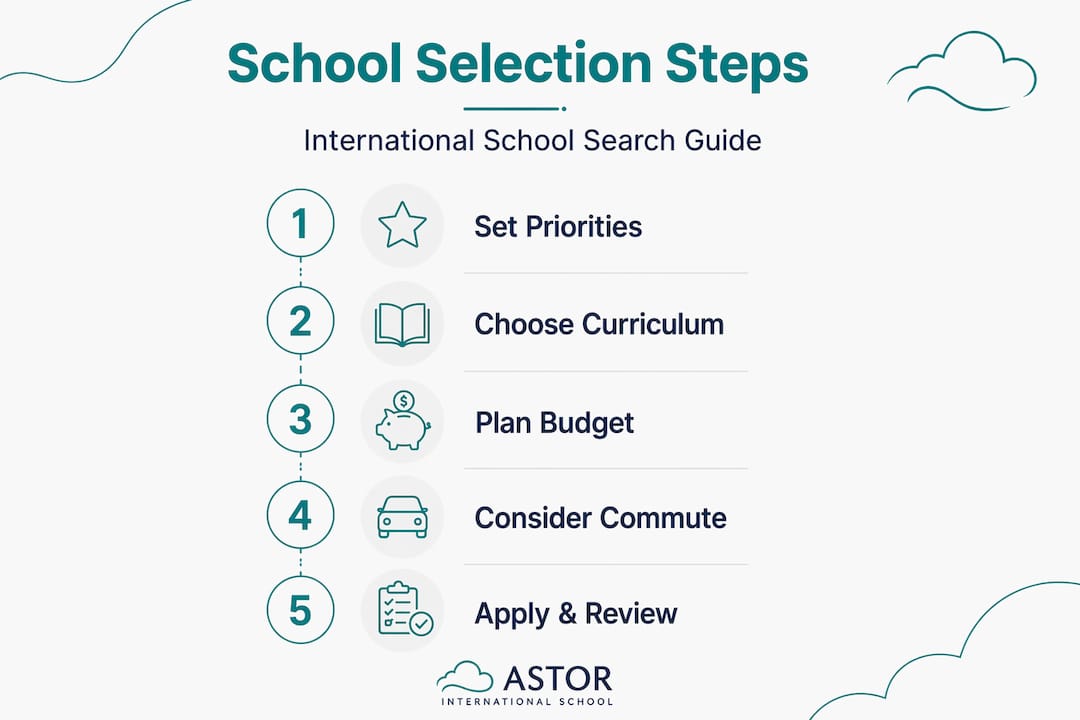
Before you open a single school brochure, sit down as a family and rank what matters most. According to tips for selecting international schools, the most effective approach is to build a clear priority list before you are swayed by beautiful campuses or a prestigious name. ExpatSchoolGuide recommends a “start with priorities” approach where families rank curriculum, budget, and other factors before comparing schools side by side.
Here is a practical starting list to rank for your family:
Curriculum continuity — Does the school continue what your child already studies?
Total annual budget — What can you genuinely afford once all costs are included?
Length of stay — Are you in Singapore for two years or indefinitely?
Class size and pastoral care — How much individual attention does your child need?
Commute and logistics — Is the school location realistic for your daily life?
Non-academic factors are just as important as academic ones. A child who spends 90 minutes a day on a school bus arrives home exhausted, with little energy left for homework or play. Small class sizes can be the single biggest factor in a nurturing, personalized experience, especially for children between 5 and 12 who are still building academic confidence and social skills.
Pro Tip: Create a simple scoring sheet with your top five priorities and weight each one from 1 to 10. Score every school you visit against it. This removes emotion from the final decision and gives you a clear comparison at a glance.
With clear priorities set, you can now explore curriculum options that best fit your child’s learning and your family’s plans.
Choosing the right curriculum for your child
Curriculum is the anchor of your school search. Curriculum fit matters because most Singapore international schools follow one of four main frameworks: International Baccalaureate (IB), British (IGCSE and A Levels), American (Advanced Placement), or Indian CBSE. Each has a different philosophy, a different assessment style, and a different end destination.
The table below gives you a quick comparison to frame your thinking:
Curriculum | Best suited for | University destination | Portability |
IB (PYP/MYP/DP) | Internationally mobile families | Global | Very high |
British (IGCSE/A Levels) | UK-bound or stability-focused | UK, Commonwealth | Moderate |
American (AP) | US-bound families | USA, Canada | Moderate |
Indian CBSE | India-bound or Indian nationals | India | Lower internationally |
If your family expects to relocate again within five years, IB is the most portable curriculum because universities worldwide recognize it. For families settled in Singapore with a clear UK or US university target, the British or American tracks offer more focused academic preparation.
The importance of curriculum continuity is often underestimated. Switching a child from a British curriculum in the UK to an IB school in Singapore mid-primary may feel manageable, but at ages 9 to 12, assessment styles and subject sequencing differ enough to create real gaps. Choosing a school whose curriculum directly mirrors your child’s previous learning avoids unnecessary catch-up and preserves their confidence.
For school choices for expat kids, your child’s learning style also matters. IB’s inquiry-based learning suits curious, independent learners. The British curriculum tends to be more structured and content-driven. Knowing your child’s natural approach to learning helps you select the right environment, not just the right credential.
Pro Tip: Ask each school’s admissions team which specific year group your child would enter based on their current curriculum. A year-group mismatch of even six months can affect a child’s confidence dramatically during the first semester.
Once you understand which curriculum aligns with your family’s needs, consider your budget and the true costs of schooling.
Budgeting beyond tuition fees
Many families arrive in Singapore expecting tuition fees to be their main expense, and then experience sticker shock when the full bill arrives. Tuition in Singapore ranges from SGD 30,000 to 55,000 annually at mainstream international schools, but that is only the starting point.
Posted tuition excludes extras like bus fares, meals, and capital levies, which can add 10 to 15% or more to your total annual cost. Below is a realistic cost breakdown to build into your family budget:
Cost item | Estimated annual range (SGD) |
Tuition fees | 30,000 to 55,000 |
Capital levy or building fund | 2,000 to 5,000 |
Registration or enrollment fee (one-time) | 1,000 to 3,000 |
School bus transport | 2,400 to 4,800 |
Lunch program | 1,200 to 2,400 |
Uniforms and books | 800 to 1,500 |
Extracurricular activities | 1,000 to 3,000 |
The true annual cost at a mid-range international school can easily reach SGD 45,000 to 70,000 per child once all items are included. If you have two or more children, ask specifically about sibling discounts, as some schools offer meaningful reductions for the second or third child.
One item families often overlook is the refundable security deposit, typically equal to one to two months of tuition. This is held by the school and returned when your child leaves. It is not a cost, but it does require upfront capital you should factor into your relocation budget.
Pro Tip: When requesting a fee schedule from a school, ask for a complete cost sheet that includes capital levies, transport, and lunch rather than just the base tuition. This makes comparing school admission tips and shortlisting financially transparent from the beginning.
With your financial parameters in place, factor in practical considerations like your child’s daily commute and school location.
Considering location and daily commute impact
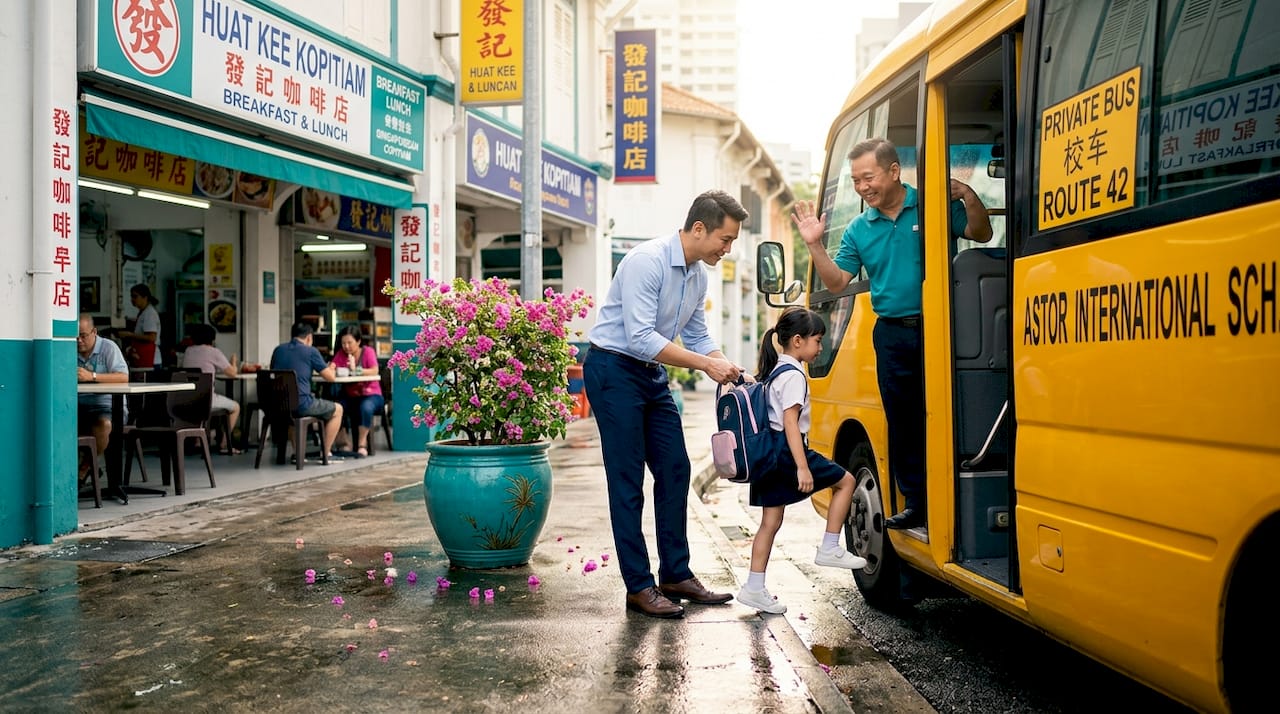
Location is not just a convenience issue. It directly affects your child’s energy, mood, and ability to participate fully in school life. A daily commute over 45 minutes each way can reduce children’s energy for homework and extracurricular activities, which matters most for primary-aged children who need time for play and rest after school.
When evaluating location, consider these practical factors:
School bus availability — Does the school offer a bus route near your home, and is it reliable?
Bus cost and schedule — Early pick-up times can disrupt sleep for young children.
MRT and taxi access — Is the school reachable by public transit in an emergency?
Housing flexibility — If you have not yet finalized housing in Singapore, let your school shortlist guide your neighborhood choice.
Many experienced expat families in Singapore do it the other way around: they shortlist two or three schools first, then choose housing in between them. This approach eliminates a long commute before it starts and opens up areas like Holland Village, Tanglin, and Buona Vista, which sit close to a strong cluster of international schools.
After-school activities are a major part of your child’s social development and confidence building. A 45-minute bus ride home may mean missing sports practice, art clubs, or reading groups because the bus departs before activities end. Before you enroll, ask the school exactly what tips for school selection they recommend for families living outside a 30-minute radius.
Preparing and navigating the application process
The international school admission process in Singapore is competitive, and timing is everything. Here are the key steps to follow in order:
Start 12 months in advance. Apply roughly 12 months ahead of your intended intake, as popular schools maintain slow-moving waitlists that can stretch beyond a year.
Gather your documents early. Prepare passport copies, immunization records, two years of school reports (translated into English if needed), and recent passport-sized photos.
Expect assessments for your child. Entrance assessments are standard, typically covering English reading, writing, and math appropriate to your child’s year group.
Apply to three to five schools concurrently. Waitlists are unpredictable. Applying to only one school is a genuine risk.
Maintain regular contact with admissions offices. Schools often give priority placement to families who demonstrate consistent interest and responsiveness.
Understand the student pass requirement. International students in Singapore require a Student’s Pass issued by the Immigration and Checkpoints Authority. Your school’s admissions team will guide you through this process, but build two to four additional weeks into your timeline for processing.
Sibling priority is a real advantage. If you have an older child already enrolled, most schools extend priority placement to younger siblings. Mention this early in your international school admission tips conversation with the admissions office.
Evaluating school fit after admission
Admission is not the finish line. It is the beginning of a different kind of evaluation. Give your child at least one full school term before drawing conclusions about fit. The first four to six weeks are almost always an adjustment period, and temporary social or academic discomfort does not mean the school is wrong.
Watch for these signals during the first term:
Academic engagement — Is your child curious about what they are learning, or consistently disengaged?
Social wellbeing — Are friendships forming naturally, even slowly?
Pastoral support — When issues arise, does the school respond quickly and with care?
Your child’s own voice — Children as young as seven can articulate what feels right and what does not. Listen.
If the school is not working after a full term, a change is possible. Switching schools mid-year requires careful planning to maintain curriculum continuity, particularly in upper primary years when subject sequencing matters more. Involve your child in the conversation. A child who understands why they are moving and who has some input into the next choice adjusts far more quickly than one who feels the decision was made without them.
Regular communication with class teachers and the school counselor is one of the most underused tools available to expat parents. Schedule a check-in meeting at the end of the first month, not just at formal parent-teacher conferences.
A fresh look at international school selection for expat families
Here is an uncomfortable truth we have seen play out repeatedly: the most common mistake expat families make is treating school selection like a brand exercise rather than focusing on curriculum continuity. They chase reputation, glossy open houses, and impressive facilities, and then discover six months in that their child is academically lost because the curriculum transition was never properly managed.
School selection should be treated as part of your entire relocation system, not a standalone decision. The school you choose determines where you should live, how much transport you spend, and how much energy your child has left at the end of a school day. These are not separate decisions. They are one system.
The families who navigate this best use a data-driven approach: a priority ranking built before they visit a single school, a realistic budget that includes every line item, an application calendar that starts 12 months out, and a willingness to navigate school choices with their child’s voice included from the start. Understanding school type insights for your child’s age group gives you the right frame for every comparison you make.
Bigger is not always better. Some of the most confident, curious, and well-supported children we see come from smaller boutique international schools where every child is truly seen. Class size, teacher continuity, and pastoral warmth are not secondary features. For children aged 5 to 12, they are often the primary driver of whether a school year is a great one or a difficult one.
Explore Astor International School for tailored education in Singapore
If personalized education and curriculum continuity are high on your priority list, Astor International School is worth exploring. Located in the Tanglin area of Singapore, Astor is a small but mighty school recognized as both the best small school and the best affordable international school in Singapore. Small class sizes mean your child is known by name, supported individually, and encouraged to grow with confidence every day.
Astor’s curriculum is aligned with international standards, and its enrichment classes give children aged 5 to 12 meaningful opportunities to discover and develop their strengths beyond the core syllabus. For expat families seeking a nurturing environment where the school genuinely knows your child, Astor offers the kind of personal attention that makes transitions smoother and learning more engaging. With your school selection journey now guided by this article, Astor is a confident next step to explore.
Frequently asked questions
How early should I start applying to international schools in Singapore?
Start your application at least 12 months before your intended start date, because popular schools have slow-moving waitlists that can delay entry by a full academic year.
Which curriculum is best if we expect to move again in a few years?
The International Baccalaureate (IB) curriculum is the right choice, as IB is the most portable framework for internationally mobile families and is widely recognized by schools and universities across more than 150 countries.
What costs besides tuition should I budget for?
Plan for enrollment fees, capital levies, uniforms, transport, meals, and extracurricular activities, which together can add 10 to 15% or significantly more to your base tuition fees depending on the school.
How important is commute time when choosing a school?
Very important. A daily commute over 45 minutes reduces your child’s energy, study time, and ability to participate in after-school activities, which are all critical for their wellbeing and development.
Can my child switch international schools mid-year if needed?
Yes, mid-year transfers are possible, but switching mid-year requires careful planning to preserve curriculum continuity, especially in upper primary years where subject progression is more structured.
Recommended
Comments