


Why Small Teacher Student Ratio Matters for Your Child
When you’re choosing a school for your child, the question of why small teacher student ratio matters can feel surprisingly hard to answer. The numbers get thrown around, but the real story goes deeper than just class size. A small ratio means every child gets seen, heard, and genuinely supported. It means a teacher can notice when your child is struggling with fractions or feeling anxious about a new friend before it becomes a bigger problem. This guide walks you through exactly how a low student ratio shapes learning, emotional growth, and your child’s long-term confidence in the classroom.
Table of Contents
Key Takeaways
Point | Details |
Personalized attention matters | Small ratios allow teachers to tailor instruction to each child’s pace and learning style. |
Emotional support is immediate | Teachers in smaller groups can intervene in real time when children need behavioral or emotional guidance. |
Academic gains are proven | The Tennessee STAR study showed students in classes of 13–17 outperformed those in larger groups. |
There is a threshold effect | Ratios below 18:1 produce substantial benefits; modest reductions at higher numbers rarely move the needle. |
Teacher well-being impacts students | Less stressed teachers stay longer and teach better, creating continuity and stability for your child. |
Why small teacher student ratio transforms personalized learning
The importance of teacher student ratio becomes clearest when you watch what actually happens in a room. In a class of 28 students, a teacher has roughly 90 seconds of individual attention to offer each child per hour. In a class of 14, that doubles. That shift changes everything about how learning is delivered.
Smaller classes improve math and reading scores significantly, and the effect is strongest when small classes are in place from Kindergarten through 3rd grade. This is the window when foundational habits like reading fluency, number sense, and learning confidence are formed. Missing the window is costly.
The advantages of low student ratio extend well beyond test scores. When a teacher has fewer children to monitor, she can spot a child who has been staring at the same page for ten minutes. She can pull that child aside, figure out the confusion, and reroute the lesson. In a larger class, that child often stays lost, then falls further behind, and the gap widens quietly over years.
Here is what the research tells us about how small class sizes improve learning at the practical level:
Increased one-on-one time. Students get 50% more direct teacher contact in smaller classes, fundamentally changing how much personalized feedback each child receives.
Earlier identification of difficulties. Teachers in smaller groups can detect learning challenges weeks or months earlier than their counterparts managing larger cohorts.
Higher participation rates. Children speak more, ask more questions, and engage more deeply when they are not competing with 25 other hands in the air.
Better support for diverse learners. Children with different learning styles, language backgrounds, or additional needs receive adapted instruction far more consistently.
Pro Tip: When touring a school, ask not just for the average class size but for the actual teacher-to-child ratio during core instruction time. These numbers can differ significantly depending on whether teaching assistants are counted.
The Tennessee STAR study, which tracked more than 7,000 students, remains one of the most cited pieces of evidence in education research. Students placed in smaller classes of 13 to 17 students consistently outperformed peers in classes of 22 to 25 across reading and mathematics. The gains were especially pronounced for students from lower-income backgrounds, showing that the educational advantages of small classes are also an equity issue.
Emotional and social benefits for young children
For children between 18 months and 5 years, the teacher student ratio effects go far beyond academic preparation. This is the period when children are learning how to regulate emotions, resolve conflict, take turns, and trust adults. Those skills cannot be taught from a distance. They require a teacher who is present enough to respond in the moment.
Teachers can act as emotional co-regulators in smaller settings. That phrase has real meaning. When a toddler melts down or a five-year-old shoves another child, a co-regulating teacher does not simply redirect or discipline. She moves in close, names the feeling, models a calmer response, and guides the child back to regulation. That process takes time, proximity, and attentiveness. None of it is possible when one adult is managing 20 small children simultaneously.
“The best learning happens when every child is truly seen and supported. In a small group, a teacher does not just observe children. She knows them.”
The small group learning benefits in early childhood settings are also structural. Smaller classes reduce peer conflict and create more predictable social environments. When there are fewer children in a space, the number of social variables a young child has to navigate drops. The classroom becomes safer, calmer, and more consistent, which is exactly the kind of environment where curiosity and confidence grow.
The 15:1 ratio is considered optimal for elementary grades to support both individual attention and relationship-building. For early childhood settings with children under five, many specialists recommend even lower ratios. Private schools typically maintain ratios of 10 to 15 students per teacher, compared to public school averages that often exceed 20 or 25. That gap is not incidental. It reflects a deliberate investment in child development.
How teacher well-being connects to your child’s progress
This is the piece most parents overlook, and it matters more than you might expect. Teacher quality is the single greatest in-school factor affecting student outcomes. And teacher quality is not fixed. It fluctuates with workload, stress, and sustainability.

Smaller ratios reduce teacher burnout and increase retention. When a teacher is not managing behavioral chaos, chasing down absent work, or struggling to remember the names and needs of 30 students, she can focus her energy on actually teaching. She plans more thoughtful lessons. She gives more meaningful feedback. She shows up every day with patience still intact.
Here is how the positive cycle works when you have a sustainable teacher student ratio:
Teacher retains energy for instruction. Less time spent on crowd management means more time on learning conversations and individual support.
Relationships deepen over time. A teacher who is not overwhelmed builds genuine trust with each child, and that trust accelerates learning.
Teacher stays longer. Lower burnout means less turnover. Your child benefits from consistent relationships rather than meeting a new teacher each year.
Instruction quality stays high. Rested, supported teachers adapt their methods, try new approaches, and respond to feedback from parents and students.
Pro Tip: Ask a school how long their current teachers have been on staff. High retention is a quiet but powerful signal that the teaching environment is healthy and the ratios are manageable.
Manitoba teachers have identified class size and the growing complexity of student needs as their top concerns. Teachers today are increasingly asked to provide trauma-informed care, mental health support, and individualized learning plans alongside core instruction. That is only realistic when the ratio is small enough to make it human.
What parents should actually look for
Understanding the impact of small teacher student ratio is one thing. Knowing how to evaluate it when choosing a school is another. Here is a practical breakdown to guide your research.
Ratio vs. class size: the difference is real
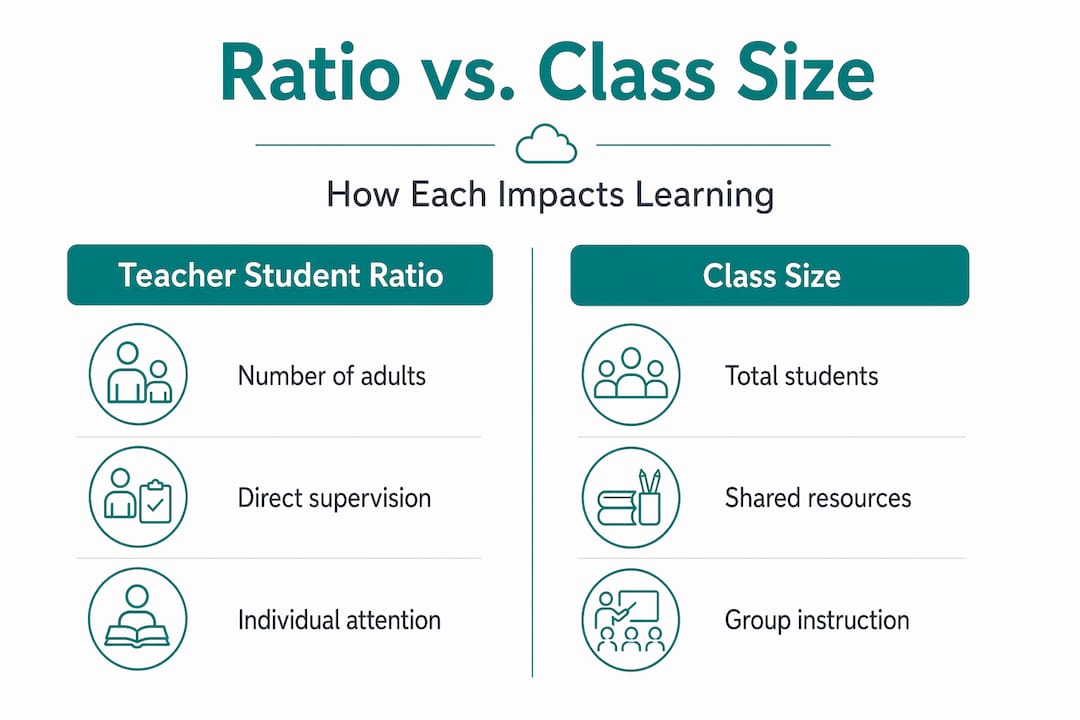
Ratio and class size are not the same number. A class of 18 students with two teachers has a ratio of 9:1. A class of 18 with one teacher has a ratio of 18:1. Both have the same class size. Only one offers the attention your child needs. Always ask how many qualified adults are present during core instruction, not just how many children are enrolled per class.
The threshold effect matters more than marginal reductions
Cutting class size from 30 to 28 rarely produces meaningful change. The small class benefits for students become substantial when the ratio falls below 18:1, and even more pronounced below 15:1. Schools that reduce from 25 to 22 students as a reform measure are improving conditions for teachers, but the educational impact for children is limited. Look for schools that are already below the meaningful threshold.
Here is a quick comparison to help frame your school search:
Setting | Typical ratio | Key implication |
Large public school | 25:1 to 30:1 | Limited individual attention; reactive support |
Mid-size private school | 18:1 to 22:1 | Marginally better; still above the benefit threshold |
Small international school | 10:1 to 15:1 | Personalized learning and proactive support possible |
Specialist or therapeutic school | 6:1 to 10:1 | Deep individualized care for complex needs |
Questions worth asking every school
When you visit a school, these questions cut through the marketing language:
What is the teacher-to-child ratio during morning core instruction?
Are teaching assistants included in that number? What are their qualifications?
How does the school identify and support children who are struggling?
What is the average length of teacher tenure at this school?
You can also explore how teachers shape learning in small class environments to understand what good practice looks like before your visit. The more informed your questions, the more revealing the answers will be.
For parents of children in the 1.5 to 5 age range, also check the outdoor and physical learning ratio. Playground time is not downtime. It is where social and motor development happens, and it requires active adult supervision and engagement. A small school with strong foundational values will maintain nurturing ratios across all parts of the school day, not just formal classroom hours.
My perspective on why this matters more than ever
In my experience working with schools and families across different educational systems, I’ve found that parents often underestimate just how much the ratio shapes everything else they care about. They want engaged teachers. They want their child to feel confident. They want problems caught early. They want their child to love school. Every single one of those outcomes is harder to achieve when one adult is responsible for 25 or 30 children.
What I’ve also seen, though, is that not all small schools use their ratios well. A low ratio without intentional teaching practice is just a smaller chaotic room. The ratio creates the potential for better education. Whether that potential is realized depends on how teachers are trained, supported, and empowered to use that closeness.
My honest take: if I were choosing a school for a young child today, the ratio would be my first filter, not my last. You can find schools with beautiful facilities and impressive curricula everywhere. Schools where every child is genuinely known by their teacher? Those are rarer, and they’re worth seeking out.
— Elena
How Astor approaches small group learning
At Astor International School in Singapore, small class sizes are not a marketing line. They are the structure around which everything else is built. Awarded best small school in Singapore, Astor keeps its learning environment intimate by design, giving teachers the space to truly know every child. The International Primary Curriculum at Astor is specifically structured for small group inquiry and project-based learning, where every child participates meaningfully rather than observing from the back of the room. For younger children at the Holland preschool, the same philosophy carries through, with outdoor and classroom learning supported by attentive staff across both playgrounds. If you are ready to see what personalized learning looks like in practice, Astor is a school worth visiting.
FAQ
What is a good teacher student ratio for primary school children?
15:1 is widely considered optimal for elementary grades, balancing individual attention with healthy peer interaction. Ratios below 18:1 consistently produce stronger academic and social outcomes than larger class sizes.
Does class size matter more than teaching quality?
Teaching quality remains the stronger single factor, but the two are deeply connected. Lower ratios reduce burnout and allow teachers to apply their skills more fully, meaning that good teachers become even more effective in smaller groups.
When does a small teacher student ratio matter most developmentally?
The impact is greatest during the early years. Research shows that the academic advantages are strongest when small classes are in place from Kindergarten through 3rd grade, the window when foundational literacy and numeracy habits are established.
How is teacher student ratio different from class size?
Class size is the number of students enrolled in a class. Teacher student ratio accounts for all qualified adults present during instruction. A class of 18 students with two teachers creates a 9:1 ratio, offering significantly more attention than the same 18 students with one teacher.
Does a small ratio help children with emotional or behavioral challenges?
Yes, significantly. In-the-moment behavioral support is only possible when a teacher can observe and respond to each child closely. Small ratios allow teachers to act as emotional co-regulators, guiding children back to calm rather than reacting after a situation has escalated.
Recommended
Comments