

What Is International Preschool? A Singapore Parent's Guide
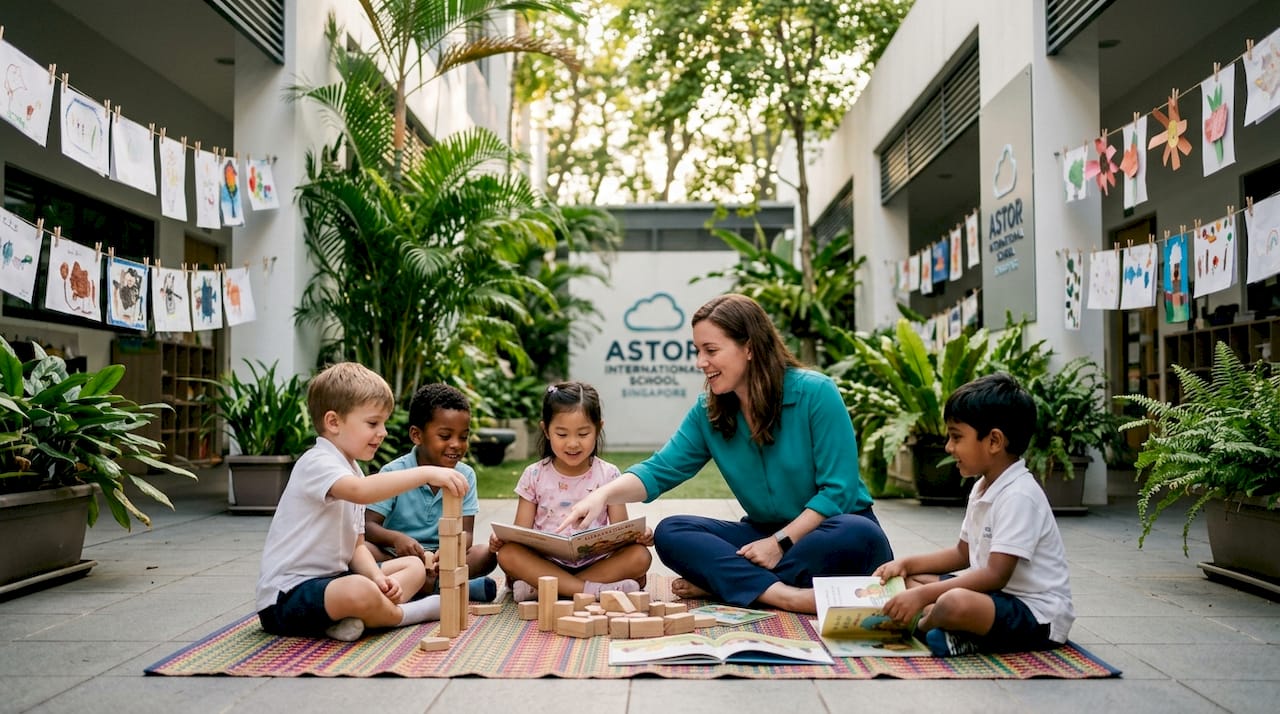
If you are weighing your early education options in Singapore, understanding what is international preschool and how it differs from local childcare is the first real step toward making a confident choice. Many parents arrive at this question carrying assumptions — that international means expensive and exclusive, or that it simply means instruction in English. The reality is more thoughtful and more nuanced than that. This guide walks you through the definition, the curriculum options, the social environment, and the practical admissions details you need to know before you decide.
Table of Contents
Key takeaways
Point | Details |
International preschool definition | International preschools follow global frameworks like IB PYP or EYFS, prioritizing inquiry, play, and social development over academic acceleration. |
Curriculum diversity | Popular curricula include IB PYP, EYFS, and IPC, each emphasizing child-led learning, creativity, and cultural awareness. |
Age cut-off matters | Singapore international schools use a strict 1 September age cut-off, so confirming your child’s eligible year group before applying is critical. |
Social and emotional benefits | Children gain cultural empathy, adaptability, and collaborative skills that support smooth transitions into international primary school. |
Apply early | Demand for spots at quality international preschools in Singapore is high, and early applications significantly improve your child’s chances. |
What is international preschool and how is it defined
The international preschool definition starts with curriculum and philosophy, not nationality. An international preschool is an early childhood setting that follows a globally recognized educational framework, uses English as the primary language, and brings together children and educators from diverse cultural backgrounds. The focus is on nurturing the whole child rather than drilling academic skills early.
What sets these schools apart is their teaching approach. Instead of structured, teacher-led instruction, international preschools follow a co-construction model where educators first observe what captures each child’s curiosity and then design learning experiences around those genuine interests. A child fascinated by insects might spend a week exploring life cycles through stories, outdoor observation, and art. Learning feels natural because it is natural.
Class sizes are typically smaller than at local childcare centers, and the teaching teams are often diverse and specifically trained in child-led curriculum design. This matters enormously at the preschool stage, when a child’s confidence, curiosity, and sense of belonging are still forming.
Here is what most quality international preschools in Singapore have in common:
Globally recognized curriculum frameworks such as IB Primary Years Programme, Early Years Foundation Stage, or International Primary Curriculum
Inquiry-based, play-centered learning that follows the child’s pace and interests rather than rigid milestones
English as the primary medium of instruction, introduced naturally and immersively without formal testing
Emotional and social development treated as core outcomes, not optional extras
Multicultural classrooms where children interact daily with peers and teachers from around the world
Small class sizes that allow teachers to give genuinely personalized attention
Pro Tip: When you visit an international preschool, watch how teachers interact with children during free play. If educators are observing, listening, and joining in at the child’s level rather than directing the activity, that is a strong sign the school walks its philosophy.
International vs. local preschools in Singapore
Singapore has excellent local preschool options, and choosing between them and an international program genuinely depends on your family’s priorities. Understanding the differences helps you make the right call, not just the prestigious one.
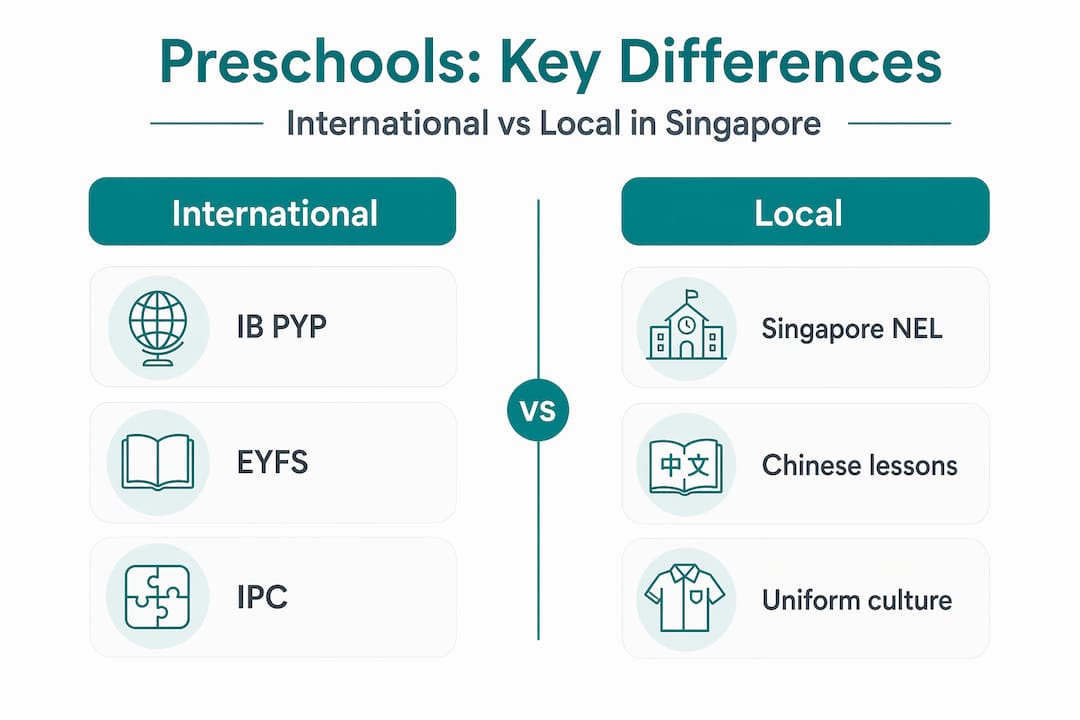
Feature | International preschool | Local/mainstream preschool |
Curriculum framework | IB PYP, EYFS, IPC, or similar global frameworks | MOE Kindergarten framework or SPARK-accredited curricula |
Teaching philosophy | Child-led, inquiry-based, play-centered | More structured, often teacher-directed with literacy and numeracy focus |
Language of instruction | English primary, with additional languages introduced gently | English and Mandarin bilingual as standard |
Class size | Typically smaller, sometimes as few as 8 children per group | Larger classes, typically 20-25 children |
Cultural environment | Multicultural, international student and staff mix | Predominantly local community |
Cost | Higher fees, reflecting smaller ratios and specialized staff | More affordable, subsidized options available |
Best suited for | Families planning international school pathways or seeking global outlook | Families prioritizing bilingual education and local community connection |
The social environment is one of the most meaningful differences. In an international preschool, your child will likely sit beside classmates from Japan, Germany, India, and the UK on the same morning. That exposure builds cultural empathy and communication skills that go far beyond what any lesson plan can teach explicitly.
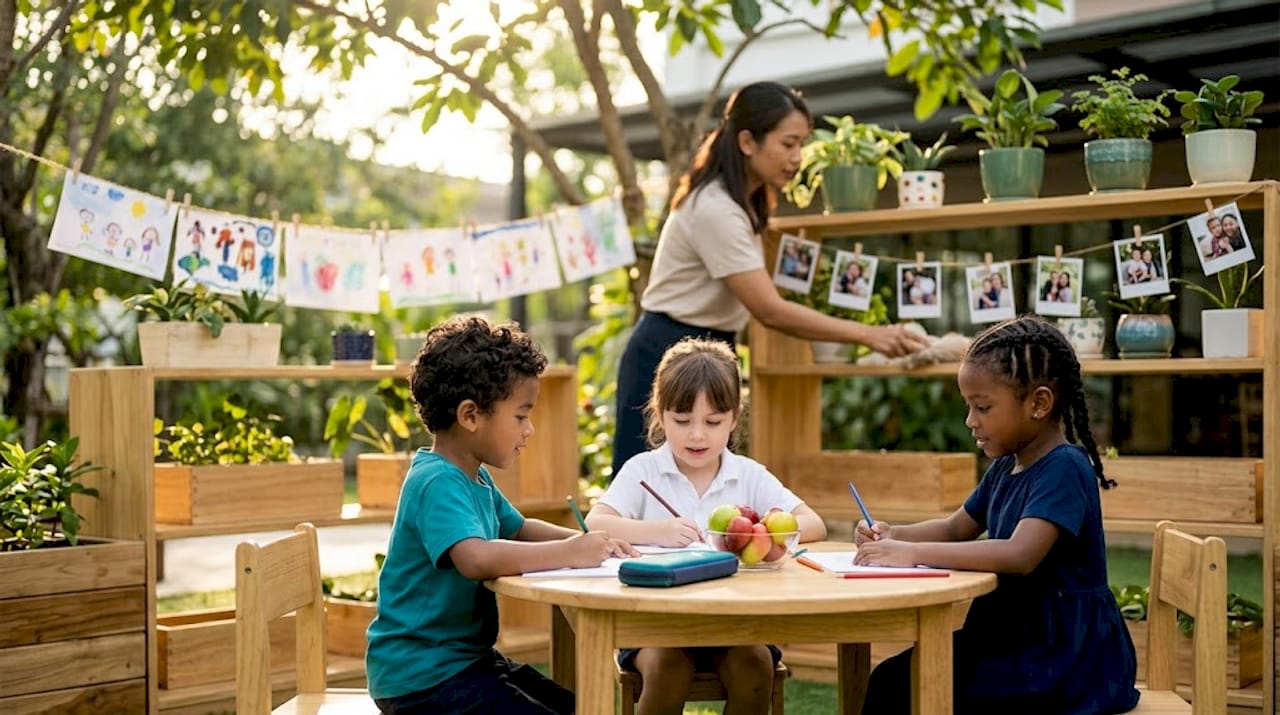
Pro Tip: Consider your child’s likely primary school pathway when choosing a preschool. If you are planning to enroll in an international primary school, attending an international preschool with a compatible curriculum framework gives your child a significant head start in adjustment and confidence.
You can also explore a detailed breakdown of your options in this preschool curriculum guide, which covers the key frameworks available to Singapore families.
Popular international preschool curricula explained
One of the most confusing parts of the research process is sorting through curriculum names and understanding what they actually mean for your three or four year old. Here is a clear breakdown of the most common options.
IB Primary Years Programme (IB PYP)
The IB PYP is offered by schools authorized by the International Baccalaureate Organization. At the preschool level, it emphasizes six transdisciplinary themes such as “Who We Are” and “How the World Works.” Children explore these themes through projects, storytelling, outdoor discovery, and collaborative play. The goal is to build curious, reflective thinkers from the very start.
Early Years Foundation Stage (EYFS)
The EYFS originates from the British education system and focuses on seven areas of learning including communication, physical development, and personal and social development. It is widely used in international preschools across Southeast Asia and is particularly common among British curriculum schools in Singapore. Learning is play-led and child-centered throughout.
International Primary Curriculum (IPC)
The IPC curriculum takes a thematic, cross-subject approach that connects learning areas in meaningful ways. A unit on “Flight,” for example, might weave together science, art, history, and language simultaneously. It is designed to promote international mindedness and foster understanding, independence, and cooperation in a multicultural setting.
Reggio Emilia and play-based influences
Many international preschools also draw from the Reggio Emilia approach, which views children as capable, creative thinkers who construct meaning through their environment. You will recognize this influence in schools with rich, open-ended art spaces, natural materials in classrooms, and teachers who document children’s learning journeys visually.
Understanding which curriculum best fits your child’s temperament is more useful than choosing based on reputation alone. A highly social, expressive child may flourish in a Reggio-influenced setting. A child who enjoys structured discovery might thrive with IB PYP.
Practical admissions advice for Singapore parents
Navigating registration for international preschool in Singapore requires planning well ahead. Here is a straightforward process to follow.
Confirm your child’s year group. Singapore international schools use a strict 1 September age cut-off for the 2026-27 academic year. Children who turn four before 1 September 2026 are eligible for the relevant entry year. Many parents relocating from countries with different cut-off dates miscalculate this and face delays. Check this before you do anything else.
Research your shortlist early. Quality international preschools in Singapore fill up quickly, especially the smaller boutique schools with low student-to-teacher ratios. Start your research at least 12 months before your desired start date.
Schedule school tours. Most preschools offer open house visits or guided tours. Use these to observe classroom dynamics, ask about daily routines, and get a feel for the culture. What you observe in 30 minutes tells you more than any brochure.
Prepare for assessments and interviews. Some schools include informal observation sessions or family interviews as part of admissions. These are not about testing your child academically. They are about understanding your child’s personality and ensuring a good fit.
Review fees carefully. International preschool fees in Singapore vary widely, with some programs charging approximately $2,000+ quarterly. Factor in registration fees, uniforms, activity costs, and any term deposits when comparing options.
Submit your application with complete documentation. Typical requirements include birth certificate, passport copies, immunization records, and sometimes previous school reports if applicable.
Pro Tip: When visiting preschools, bring your child along if possible. Notice how staff greet and interact with your child in those first few minutes. A school that feels warm and welcoming to your child on a first visit is likely to feel that way every single morning.
For more support with the process, this guide to international school admission tips is worth bookmarking.
Social and developmental benefits of international preschool
The benefits of international preschool extend well beyond academics. The non-cognitive skills children develop in these environments, including adaptability, cultural empathy, and collaborative problem solving, are often the ones that matter most in later school life and beyond.
Children who grow up learning alongside peers from different countries develop a natural ease with difference. They learn to listen across language gaps, negotiate with someone whose cultural assumptions differ from their own, and celebrate diversity rather than feel uncertain about it. These are not small things.
“The goal of international preschools is to nurture global citizens by exposing children early to diverse cultures and languages, fostering essential 21st-century life skills.”
Smaller group sizes also mean children receive more genuine attention. A teacher who knows each child’s specific interests, communication style, and emotional triggers can respond with real care rather than classroom management. That personalized attention builds confidence in a way that a large group setting rarely can.
My honest take on choosing an international preschool
I have spoken with many Singapore parents going through this process, and the same pattern appears again and again. Families spend enormous energy comparing curriculum names and school rankings, then realize too late that they never asked the most important question: does this environment actually suit my child?
In my experience, curriculum framework matters less at the preschool stage than the quality of the people in the room. A warm, observant teacher in a modest school will do more for your three year old’s confidence and curiosity than the most prestigious IB program with an indifferent classroom culture.
I also see parents underestimate the admissions timeline. The families who secure spots at their preferred schools almost always started the process earlier than they thought necessary. The families who miss out almost always say the same thing: “I didn’t realize how quickly things moved.”
Choosing the right school comes down to alignment. Align the curriculum with where your child is headed academically. Align the teaching philosophy with how your child actually learns. And trust what you observe when you visit in person.
— Elena
Discover Astor International Preschool in Holland
If you are ready to take the next step, Astor International Preschool in Holland Village offers exactly the kind of nurturing, curiosity-driven environment this article describes. Part of the Astor education network, this small but purposeful preschool combines outdoor and classroom learning across two playgrounds, with the kind of personalized attention that only a genuinely small setting can offer.
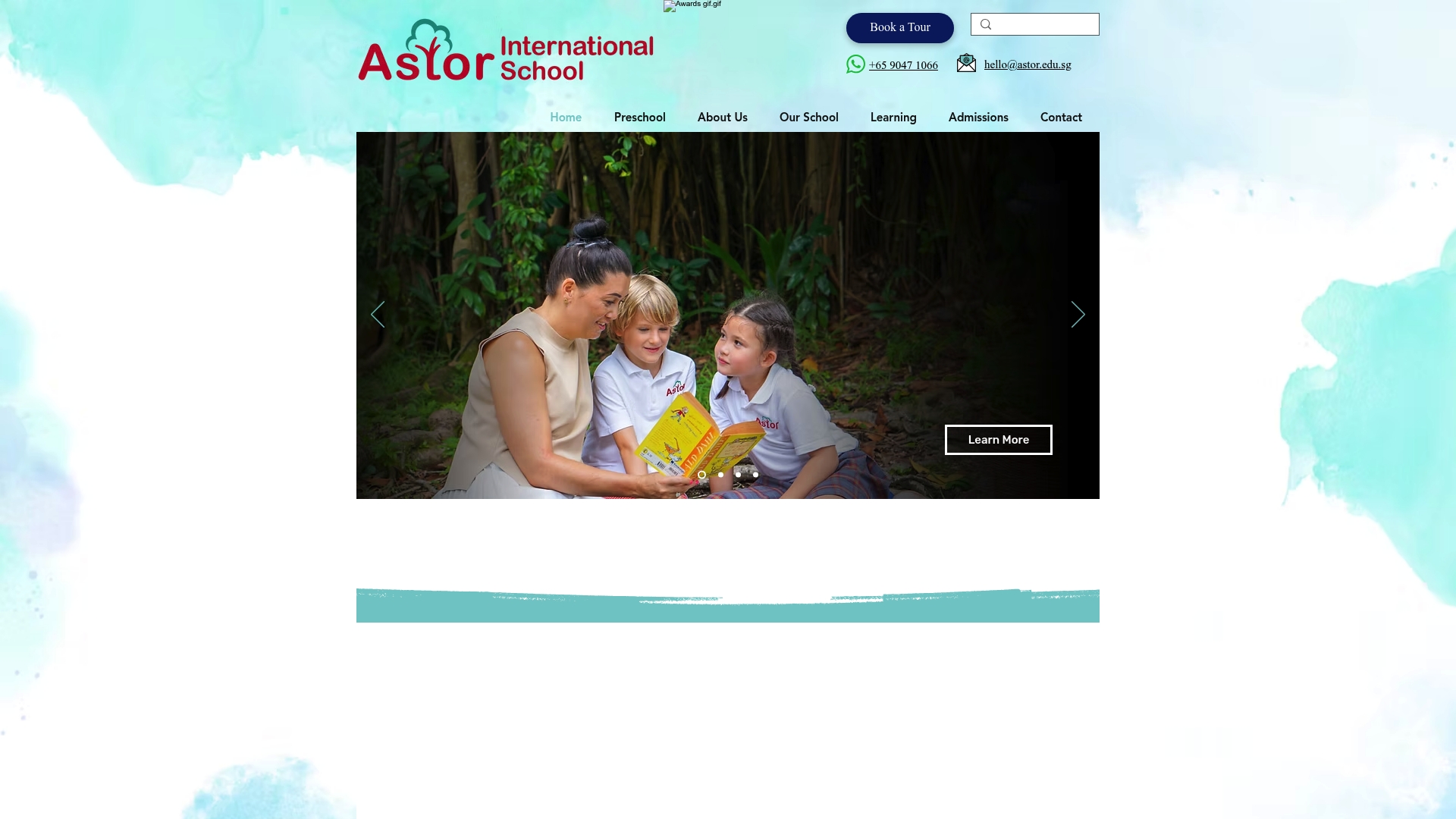
Astor International School, located in the Tanglin area, has been recognized as both the best small school and the best affordable international school in Singapore. The network uses the IPC curriculum, which means your child’s preschool experience connects meaningfully to primary school learning. Whether you want to explore the IPC curriculum in detail or simply come and see the space for yourself, booking a preschool school tour is the easiest way to find out if Astor is the right fit for your family.
FAQ
What is the definition of an international preschool?
An international preschool follows a globally recognized curriculum framework such as IB PYP, EYFS, or IPC, uses English as the primary language of instruction, and operates in a multicultural environment prioritizing social, emotional, and inquiry-based learning over early academic acceleration.
Why enroll in international preschool instead of a local one?
International preschools are particularly well suited for families planning an international primary school pathway, expat families, or parents who want their child to develop cultural empathy and global awareness from an early age alongside strong English language fluency.
What age can my child start an international preschool in Singapore?
For the 2026-27 academic year, children who turn four before 1 September 2026 are eligible for entry. Singapore international schools apply this 1 September cut-off strictly, so confirming your child’s eligible year group before applying is a necessary first step.
How do I choose the right international preschool in Singapore?
Consider your child’s temperament, your family’s long-term school pathway, the teaching philosophy, class size, and fees. Visiting shortlisted schools in person and observing how teachers interact with children gives you the clearest picture of whether the culture is the right fit.
What curricula do international preschools in Singapore follow?
The most common international preschool curricula in Singapore include the IB Primary Years Programme, the Early Years Foundation Stage, and the International Primary Curriculum. Each promotes internationalism and global citizenship through child-led, inquiry-based learning methods.
Recommended
Comments