


Map the 5 Inquiry Cycle Stages to Research and Classroom Templates
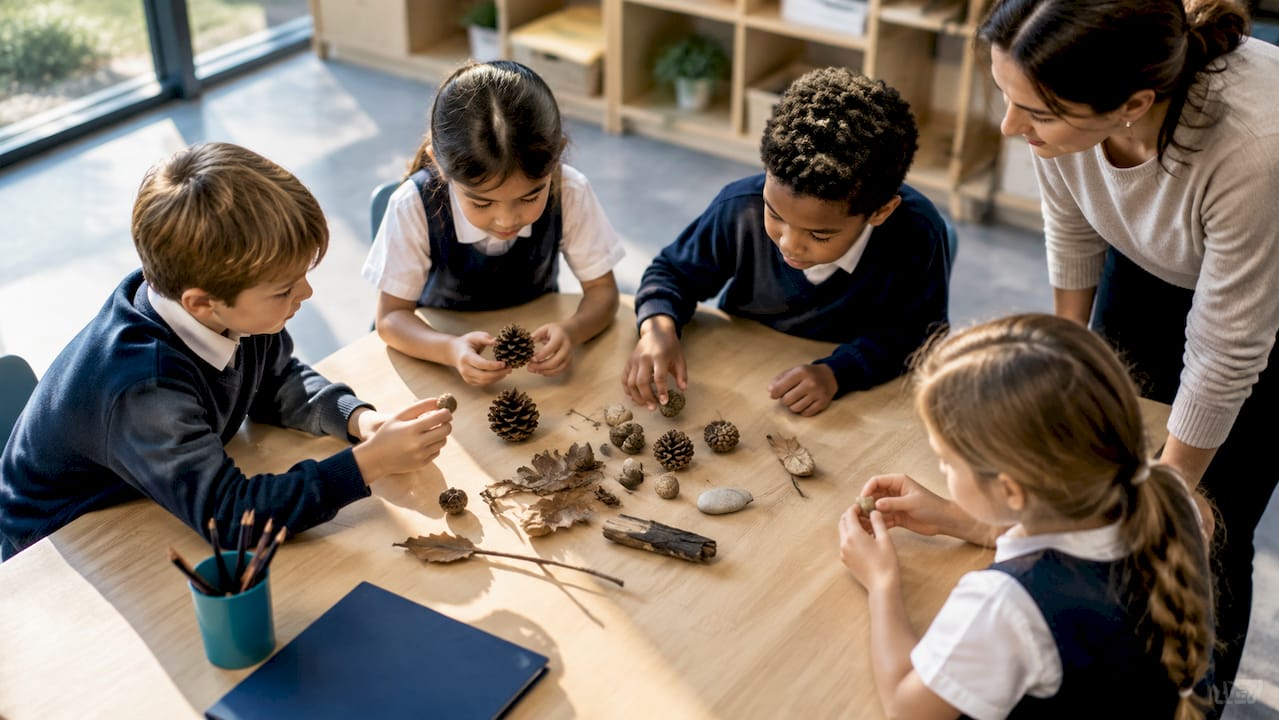
The inquiry cycle is a flexible sequence of learning phases that moves students from curiosity to genuine understanding and, ideally, to action. Most classrooms use practitioner labels like Tuning In, Finding Out, Sorting Out, Going Further, Making Conclusions, and Taking Action. These map closely to research-backed models like Pedaste et al.'s five phases and the Teaching Science as Inquiry framework, which we’ll unpack alongside classroom-ready examples.
TL;DR:
The inquiry cycle is iterative, with stages frequently looping back when new questions or evidence emerge during investigation.
Teachers should adapt their guidance based on student articulation and understanding, rather than following a fixed sequence rigidly.
Short, focused inquiry activities can be completed in a single week for young learners, while longer units allow more in-depth exploration and repeated cycles.
Assessment methods should align with each phase, such as observation during early stages and journals or exit tickets during later ones.
Small class sizes enhance individualized scaffolding, making inquiry-based learning more effective and allowing teachers to better monitor student progress.
Table of Contents
What Are the Stages of an Inquiry Cycle?
Think of the inquiry cycle less like a recipe and more like a trail map. It shows you the terrain and the likely path, but it does not dictate every step in order. Kath Murdoch, whose model shapes how many primary schools structure inquiry, is explicit that the cycle is meant to be revisited, not marched through once and closed.
Teacher instruction and classroom conversation run through every phase rather than sitting in their own box. The Teaching Science as Inquiry model calls this an encircling element, one that supports learners at each turn instead of appearing only at the start or finish.
A stage transition works well when children can articulate what they now know and what they still wonder. That is your signal to move forward.
Stages loop back naturally when new questions surface mid-investigation.
The teacher’s role shifts from prompting to guiding to stepping back as ownership grows.
A “finished” stage often reopens once new evidence complicates the picture.
The Five Practitioner Stages, One by One
Each phase asks something different of learners and teachers alike. Here is what actually happens in the classroom, stage by stage.
Tuning In. Learners surface what they already believe or wonder about a topic. A teacher might use a wonder wall, a KWL chart, or a quick provocation object passed around the circle. The teacher’s job here is diagnostic: listening for gaps, misconceptions, and genuine curiosity rather than correcting answers on the spot. Assessment at this stage is informal. A simple thumbs-up scale on confidence or a one-line journal entry (“I think…” / “I wonder…”) gives you a baseline to compare against later.
Finding Out. Students gather information through texts, interviews, experiments, or observation. This is where research routines matter most: teaching children how to judge a reliable source, how to take notes without copying verbatim, and how to ask a follow-up question rather than stop at the first answer. A short activity: give pairs three sources on the same question and have them list one fact each source confirms and one it contradicts. Assessment tip: check note-taking samples for evidence of synthesis, not just collection.
Sorting Out (Making Meaning). This is where scattered facts turn into patterns. Learners categorize, compare evidence, and talk through contradictions with peers. A Venn diagram, a sorting table, or a “claim, evidence, reasoning” frame all work here. The teacher models how to organize messy information rather than handing over a finished structure. Pro Tip: Give students a deliberately incomplete sorting table and have them argue about where the missing pieces belong. The debate does more for meaning-making than a tidy worksheet ever could.
Going Further / Making Conclusions. Students synthesize their sorted evidence into an explanation, model, or product. This might be a written conclusion, a diagram with labels, or a short presentation to classmates. The teacher’s role narrows to feedback on clarity and evidence use rather than content delivery. Assessment tip: use a simple rubric checking whether the conclusion is supported by evidence gathered earlier, not just restated opinion.
Taking Action / Reflecting. Learning becomes real when it reaches an audience beyond the classroom, whether that is a letter to a local council, a poster for younger students, or a family presentation. Reflection prompts here ask what changed in the student’s thinking since Tuning In, and what question remains open. Kath Murdoch’s model treats this stage as fuel for the next cycle rather than a hard stop, since genuine reflection routinely surfaces new questions.
How Does Pedaste’s Research Model Map to Classroom Labels?
A 2015 systematic literature review by Margus Pedaste and colleagues synthesized 32 separate models into five general phases: Orientation, Conceptualization, Investigation, Conclusion, and Discussion. That research gives practitioner language an evidence base rather than leaving it as classroom folklore.
The Teaching Science as Inquiry model runs a parallel track with five phases of its own: initiation, invention, investigation, interpretation, and instruction, with instruction wrapped around the whole cycle rather than confined to one point.
Lining the two up against practitioner labels makes the connection concrete:
Orientation ≈ Tuning In
Conceptualization ≈ Sorting Out / Making Meaning
Investigation ≈ Finding Out
Conclusion ≈ Making Conclusions
Discussion ≈ Taking Action / Reflecting
Neither framework contradicts the other. They describe the same underlying moves in different vocabulary, which matters when you are choosing language that fits your school’s documentation.
What Does an Inquiry Unit Actually Look Like Week to Week?
A short micro-inquiry can run in a single week: a 10 to 15 minute tuning-in routine on Monday, two focused finding-out sessions with clear scaffolds midweek, a sorting-out lesson with teacher-led modeling, then a brief going-further task and reflection to close the week. A longer multi-week unit simply stretches each phase and adds more cycles of finding out as new questions emerge.
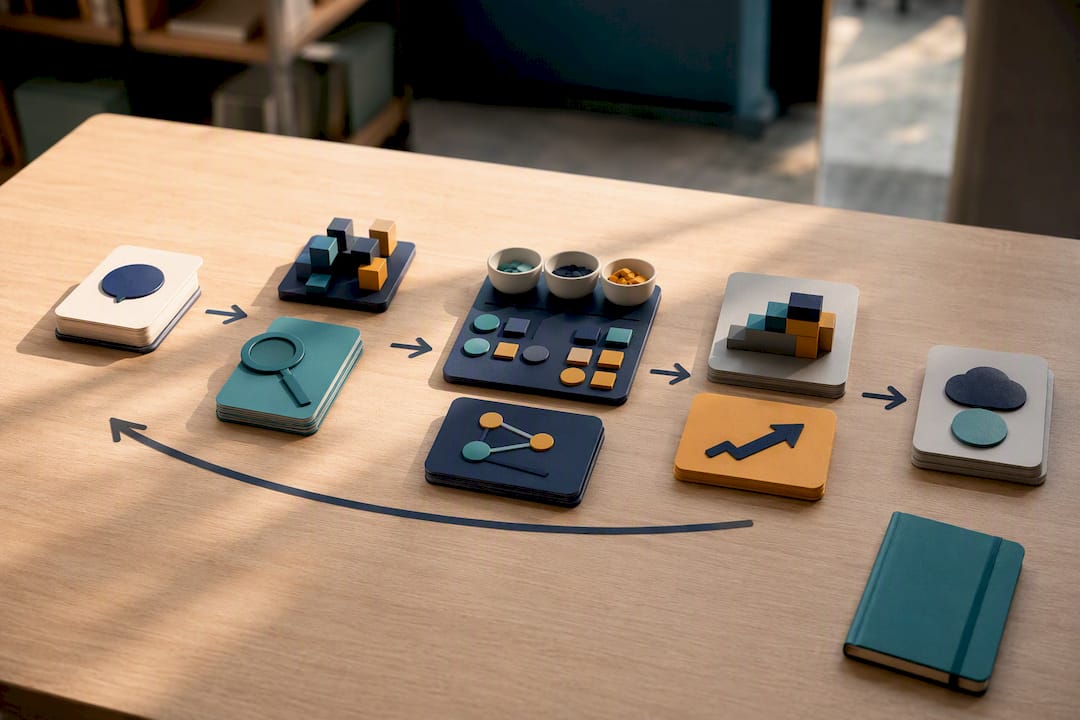
Younger primary students need shorter, more concrete cycles. A five-year-old sorting leaves by shape is doing real inquiry work, just compressed. Older primary students can sustain multi-week research tasks with independent source evaluation.
Assessment tools should shift with the phase rather than cluster at the end:
Observation checklists during Tuning In and Finding Out, when thinking is verbal and messy.
Learning journals through Sorting Out, tracking how understanding shifts.
Exit tickets after Going Further, checking whether conclusions hold up.
Kuhlthau’s research on the emotional side of inquiry found predictable shifts from uncertainty toward clarity as students move through a cycle, and scaffolding that emotional arc matters as much as teaching research skills.
What Do Teachers Get Wrong About the Inquiry Cycle?
The most common mistake is treating the cycle as a fixed recipe with a required order and a required length. Murdoch’s own writing pushes back on this directly, noting that the core moves repeat across models even when their order or labels shift.
A second myth: inquiry always means a long-form project. A 20-minute science provocation can complete a full, valid cycle. A third: every subject runs the cycle identically. A math inquiry into patterns looks different from a history inquiry into causes, even though both use the same underlying phases.
Watch for students disengaging during Finding Out. It often signals the research task is too open or too narrow.
Watch for premature conclusions. Students sometimes skip Sorting Out entirely and jump to an answer.
Build a formative check before Making Conclusions to catch surface-level “finding out” before it hardens into a weak conclusion.
Pro Tip: If a student seems stuck in confusion rather than curiosity during Tuning In, that discomfort is not a failure state. Research on coping with uncertainty suggests it’s a normal, even necessary, part of getting to a real question.
How Astor Turns the Inquiry Cycle Into Classroom Practice
Templates only earn their place if teachers actually use them daily. Astor’s downloadable inquiry activity template gives primary teachers eight ready-to-run inquiry activities mapped to the 5E structure, which cuts prep time without flattening the inquiry into a worksheet.
Small class sizes change what’s possible during the uncertain middle stages. When a teacher has eight or nine students instead of thirty, individual scaffolding during Sorting Out becomes routine rather than exceptional, and that closer attention tends to sharpen the quality of the questions students bring to Finding Out.
Explore how inquiry-based learning works in practice for a fuller look at classroom rationale.
See how enquiry-based teaching shapes daily lesson design.
Read how inquiry pedagogy supports a child’s learning from a parent’s vantage point.
A Teacher’s Honest Take on Sitting With Uncertainty
The best inquiry lessons I have watched had a stretch where nothing seemed to be happening. A child stared at three contradictory facts and said nothing for a full minute. Resist the urge to rescue that silence too fast.
— Elena
See Inquiry-Based Learning in Action at Astor
Reading about the inquiry cycle only gets you so far. Seeing it running in a real classroom, with a teacher who has time to notice which child is stuck at Sorting Out and which one is ready to move on, is a different thing entirely. Small classes across preschool and primary programs for children ages 1.5 to 12 allow inquiry to stay individualized instead of generic.
Astor’s Primary Years-aligned curriculum builds inquiry into daily lesson design rather than treating it as an occasional project. If you want to see how the stages covered here translate into a weekly timetable, the curriculum overview walks through how classroom time is structured across subjects. Families weighing enrolment can also browse enrichment courses that extend inquiry into arts, sports, and language learning. Book a visit to see a Tuning In session or a Sorting Out discussion firsthand, and judge for yourself whether the small-class approach fits your child.
Sources
FAQ
What Are the Five Stages of Inquiry-Based Learning?
The five commonly used practitioner stages are Tuning In, Finding Out, Sorting Out, Going Further (or Making Conclusions), and Taking Action. Pedaste et al.'s research framework names an equivalent set: Orientation, Conceptualization, Investigation, Conclusion, and Discussion.
What Are the Steps of the Inquiry Cycle?
The steps move from activating curiosity and prior knowledge, through research and investigation, to organizing evidence, drawing conclusions, and acting on or reflecting on what was learned. The cycle is recursive, so students often loop back to earlier steps as new questions arise.
What Are the Stages of Kath Murdoch’s Inquiry Cycle?
Murdoch’s model names Tuning In, Finding Out, Sorting Out, Going Further, Making Conclusions, and Taking Action, and she explicitly warns against treating this sequence as a fixed, one-way recipe.
What Are the Four Levels of Inquiry?
Inquiry is often described across four levels of learner independence: confirmation inquiry (the answer is known and demonstrated), structured inquiry (teacher-set question and procedure), guided inquiry (teacher-set question, student-designed procedure), and open inquiry (student-generated question and procedure).
Recommended
Comments