

Plan for 10–18% Extra: International School Fees Singapore for Parents

International school tuition in Singapore typically falls into four bands: budget (roughly S$20,000 to S$28,000 a year), mid-tier (S$28,000 to S$38,000), premium (S$38,000 to S$50,000), and ultra-premium (up to S$59,000 or more). The budgeting rule that matters most: headline tuition is never your real first-year cost. Add one-off entry fees, annual levies, and extras, then request the school’s fee PDF and a written first-year all-in quote before you commit.
TL;DR:
Singapore international schools’ actual first-year costs can be significantly higher than headline tuition due to entry fees, levies, and extras, often adding 10% to 18%.
Fee structure details such as GST inclusion, deposit refund conditions, and levy frequency vary between schools and should be verified via official fee PDFs.
Sibling discounts are often complex, requiring written confirmation of how they are calculated and whether they apply to tuition, levies, or both.
High-end schools with extensive facilities and boarding options can charge S$59,000 or more annually, with actual total costs rising considerably when all fees are considered.
Comparing schools effectively requires requesting detailed, itemized quotes for first-year total and ongoing annual costs, rather than relying on marketing brochures.
Table of Contents
What Are International School Fees In Singapore, By Tier?
Verified fee tables covering 14 Singapore international schools show annual tuition running from about S$24,000 to S$59,000, inclusive of GST, once you factor in grade level and school positioning. That’s a wide spread, and it exists for a reason: campus size, teacher-to-student ratios, facilities, and curriculum accreditation all pull tuition in different directions.
A useful way to think about it is in four rough tiers.
Budget tier (roughly S$20,000 to S$28,000 a year): Smaller campuses, leaner facilities, often strong academic outcomes without the large capital levies that premium schools carry.
Mid-tier (roughly S$28,000 to S$38,000 a year): Established curricula, moderate class sizes, and a broader range of enrichment options built into or alongside tuition.
Premium (roughly S$38,000 to S$50,000 a year): Larger campuses, extensive sports and arts facilities, and often heavier development or building levies layered on top.
Ultra-premium (up to S$59,000 and beyond): Flagship international brands with sprawling campuses, boarding options in some cases, and the highest facility levies in the market.
Tuition also climbs with grade level. Primary years sit at the lower end of a school’s range, and upper-secondary years (particularly IB Diploma or IGCSE exam years) sit at the top, since exam-board fees and specialized teaching get folded in. Cost guides tracking multiple schools confirm this pattern holds across nearly every institution in the market.
Some quote GST-inclusive headline numbers; others list a base fee and add GST as a separate line. Never assume. Open the school’s actual fee PDF and look for the words “inclusive of GST” or “before GST” printed next to the tuition figure. If it isn’t stated clearly, that’s your first question to admissions.
Where a school sits within these bands also tells you something about its cost structure long-term. A lower sticker price doesn’t always mean lower total cost once you factor in recurring development levies, and a school with modest headline tuition can sometimes carry surprisingly high annual charges once those levies are added in. That’s exactly why the next section matters more than the tuition number itself.
What Fee Line Items Will You See On A Fee Schedule?
Every Singapore international school fee schedule is built from the same basic categories, even though the labels vary. Learning to read them saves you from budgeting surprises later.
Tuition fee is the recurring core charge for instruction, usually billed annually or per term. This is the number every marketing brochure leads with, and it’s also the number that tells you the least about your actual first-year cost.
Application fee is a small, non-refundable charge (often S$100 to S$500) paid simply to have your child’s application reviewed. It’s one-time, and you pay it whether or not your child is offered a place.
Registration or enrolment fee is charged once a place is confirmed, separate from the application fee. This locks the seat and is typically non-refundable once paid.
Refundable deposit is exactly what it sounds like: a security deposit, commonly equal to one term or one year of tuition, held against the account and returned (often with conditions) when a child withdraws with proper notice. The word “refundable” does a lot of work here, and the actual refund conditions vary enormously between schools. A detailed look at how deposits work across Singapore schools is worth reading before you sign anything, since notice periods and deductions differ school to school.
Development, building, or capital levy is a recurring or semi-recurring charge tied to campus facilities and expansion. This is the line item that most often gets left off marketing materials and shows up as a surprise on the actual invoice.
Technology or facility fee covers device programs, learning platforms, or specialized labs and is usually billed annually alongside tuition.
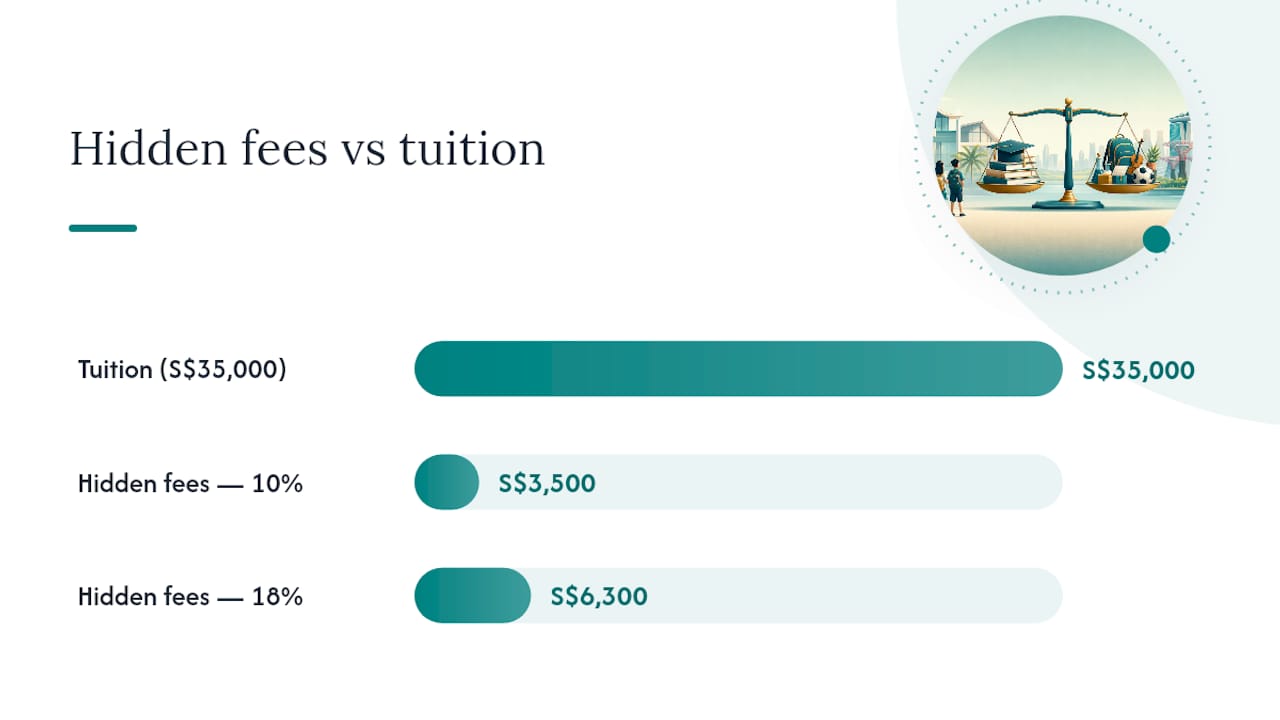
Here’s a quick statistic worth keeping in your back pocket: market summaries estimate that hidden fees like these, development levies, transport, and exam charges, typically add another 10% to 18% on top of headline tuition once you total everything for the year. On a S$35,000 tuition bill, that’s an extra S$3,500 to S$6,300 you need to plan for, every single year, not just in year one.
Before you accept any offer, run through this checklist with the school’s finance office:
Is the tuition figure GST-inclusive or does GST apply on top?
Which fees are one-time (application, registration) or recurring (tuition, levies)?
Under what conditions is the deposit refundable, and how much notice is required?
Are development or building levies charged annually, or only in specific years?
Do levies apply per family or per child?
What Does A Real First-Year Bill Actually Look Like?
Numbers on a website are abstract. A worked example isn’t. Here’s how a single mid-tier enrolment plays out in practice.
A detailed example of a mid-tier enrolment shows that first-year costs include tuition plus various one-time and recurring fees, which can significantly increase the cash requirement beyond the headline tuition figure. The ongoing annual cost from the second year onward is considerably lower after removing one-time fees.
Now widen the lens to two children. Say a family enrolls a Primary 3 and a Kindergarten 2 sibling at a premium school with S$42,000 tuition per child. Combined tuition alone is S$84,000. But the second, third, and even first-year one-off levies can shift with sibling enrolment. Sibling discount structures differ by school, some apply a flat percentage to the second child’s tuition only, others stack discounts across enrolment or development fees. Ask for the actual arithmetic in writing rather than trusting a general “we offer sibling discounts” line on a brochure.
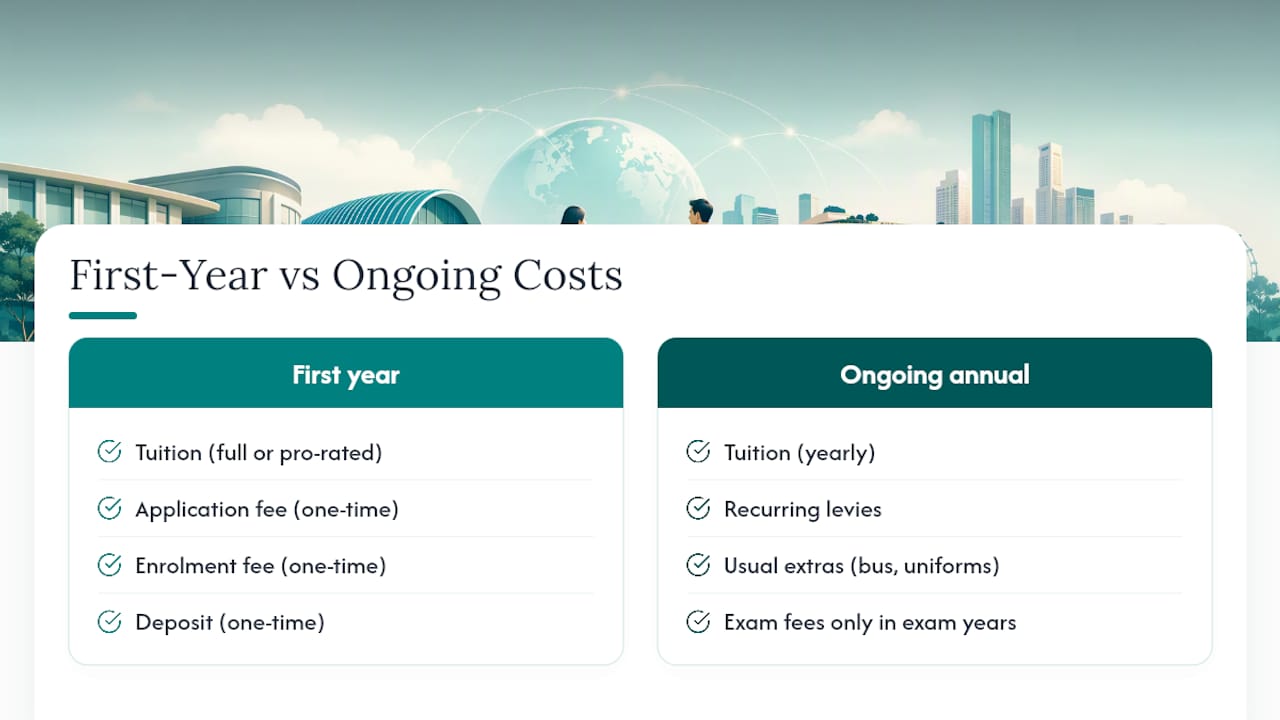
The reusable formula looks like this: First-year all-in = tuition (pro-rated if applicable) + application fee + enrolment fee + deposit + annual levies + bus + uniforms + exam fees. Ongoing annual cost = tuition + recurring levies + usual extras, minus the one-time items you already paid.
Pro Tip: Ask admissions to show you the arithmetic for a sibling discount on paper, not just the stated percentage. Whether it applies to the lower-fee child, stacks across both, or only touches tuition and not levies can shift your household total by several thousand dollars a year.
Where does variability creep in most? Bus distance (zones vary in price), children needing EAL or ESL support (often a separate paid program), and exam-entry fees for IGCSE, IB, or AP years, which can add S$500 to S$1,500 per subject in the exam years alone, per the same cost breakdowns tracking common extras.
How Do You Compare Fee Quotes Across Schools?
Two schools rarely present their fee schedules the same way, which makes side-by-side comparison harder than it should be. The fix is to normalize every quote into the same two numbers before you compare anything else: first-year all-in and ongoing annual.
Before requesting a formal quote, verify these lines on each school’s published fee PDF:
Whether tuition is quoted GST-inclusive or GST-exclusive
Which fees are one-off versus recurring, and how they’re labeled
Deposit refund conditions and required withdrawal notice
Whether development or building levies are charged every year or only certain years
Bus fees by zone or distance band
Meal plan costs if not bundled into tuition
Uniform costs, including PE and formal sets
Exam fees for IGCSE, IB, AP, or other board-specific charges
EAL or learning-support program costs if your child may need them
When you call admissions, ask directly: “Can you send me the current fee PDF and a written first-year all-in estimate for my child’s grade, including every one-off and recurring charge?” A school confident in its pricing will hand this over without hesitation. If a school seems reluctant to itemize, ask about that reluctance in the calculation, too.
Once you have two or more quotes, lay them out like this:
That kind of table only works when every figure is real, so don’t fill in a placeholder if a school won’t disclose a number. Push admissions until you have it in writing, or leave that school off your comparison until you do.
On timing: most Singapore international schools run open-house season between January and March for the following academic year, with waitlists for popular grade levels filling months in advance. Admissions research consistently shows that seat availability, not small tuition differences, is usually the more decisive constraint. If you’re set on a specific school, applying early matters more than shaving a few thousand dollars off the fee comparison.
On payment: most schools bill tuition termly or annually, with GIRO or bank transfer the standard methods, and many offer installment plans across two or three terms rather than requiring one lump sum. Fee increases typically happen annually, often announced midway through the prior academic year, and tend to track in the low single digits percentage-wise, though premium schools with major campus investments can see sharper jumps. Ask each school directly what their historical increase pattern has looked like, since this varies by institution and isn’t something regulators standardize.
On withdrawal: read the enrolment contract for notice periods (commonly one full term) and what happens to your deposit and any pro-rated tuition if you withdraw mid-year. Missing the notice window is one of the most common, and most expensive, mistakes families make.
If a fee seems inconsistent with what a comparable school charges, ask why, directly. Sometimes the answer is a legitimate service difference (smaller class sizes, more learning support staff). Sometimes it’s simply that the levy structure hasn’t been updated on the published PDF. Either way, you’re entitled to a clear answer before you pay a deposit.
Why Fee Transparency Should Be Non-Negotiable For Parents
Here’s what years of comparing school fee schedules across this market makes obvious: the schools that publish clear, itemized fee PDFs are almost always the ones with nothing to hide in the arithmetic. The ones that make you call three times to get a straight answer on levies are usually the ones where the levies are doing the most damage to your annual budget.
Astor operates on the belief that a family shouldn’t need a finance degree to understand what a school year will actually cost. That’s part of why Astor International School, recognized as a best small school and best affordable international school in Singapore, keeps its class sizes small by design rather than by accident, and why the Astor Education Network extends from its Holland-area preschool through primary education at its Tanglin campus. Small schools have fewer hidden costs to bury in the fine print, largely because there’s less campus infrastructure generating levies in the first place.
Parents planning multi-child enrolment should look closely at how sibling discounts are structured and calculated in writing, not just promised verbally. And if you’re weighing admissions timing against your budget planning, start that process early. Open-house season fills seats faster than most families expect, and the schools worth choosing rarely have empty waitlists for long.
— Elena
Get A Real Number: Requesting Your Astor Fee Quote
Cost-conscious families deserve a fee structure they can actually plan around, not one that reveals its true price only after enrolment. Certain schools aim to offer clear, published, itemized fees rather than a headline number that grows once you’re already committed.
Astor’s fees page lays out tuition and levies clearly, so you can see the real first-year total before you apply, not after. If you’re comparing across schools, request Astor’s current fee PDF alongside a written first-year all-in quote for your child’s grade, and ask directly about sibling discount arithmetic and instalment options if you have more than one child enrolling. It’s also worth reviewing Astor’s IPC curriculum page so you understand exactly what that tuition is funding academically, not just what it costs. Bring your child’s birth certificate, current school records, and passport or residency documents when you reach out to admissions. A quote request takes one email, and you’ll have a real number to budget against within days.
Where To Verify These Numbers Yourself
Don’t take any single article’s word for it, including this one. Cross-check figures against primary sources before you budget or sign anything.
TPGateway’s EduTrust certification resources/edutrust-certification-scheme) explain how private education institutions in Singapore are certified and what consumer protections apply.
The Baby Bonus scheme overview from Singapore’s Ministry of Social and Family Development is worth reviewing for broader household financial planning alongside school fees.
Every specific school figure you’re quoted should ultimately trace back to that school’s own published fee PDF, since aggregator tables are only as accurate as their last update.
Sources
FAQ
What Are The Fees For Singapore International Schools?
Annual tuition typically runs from about S$20,000 at the budget end to S$59,000 at ultra-premium schools, before adding one-off entry fees and annual levies that commonly add another 10% to 18% to your total cost.
Which International School In Singapore Is The Most Affordable?
Smaller, boutique-model schools in the budget tier generally offer the lowest headline tuition, often because they carry fewer large capital or development levies than sprawling flagship campuses. Some schools are recognized for affordability alongside small class-size models, making them worth comparing if a lean, transparent fee structure matters to your budget.
What Is The Most Expensive International School In Singapore?
Ultra-premium schools with flagship campuses, extensive facilities, and sometimes boarding options sit at the top of the market, with headline tuition approaching or exceeding S$59,000 a year before extras.
Do Published Fees Already Include GST?
It depends on the school, so always check the fee PDF directly.
How Much Should I Budget On Top Of Headline Tuition?
Plan for headline tuition plus one-off entry fees, annual levies, and common extras like transport, uniforms, and exam fees, which together typically add 10% to 18% to your total annual cost beyond the sticker tuition figure.
Recommended
Comments