


Personalized learning: A parent's guide for expat kids
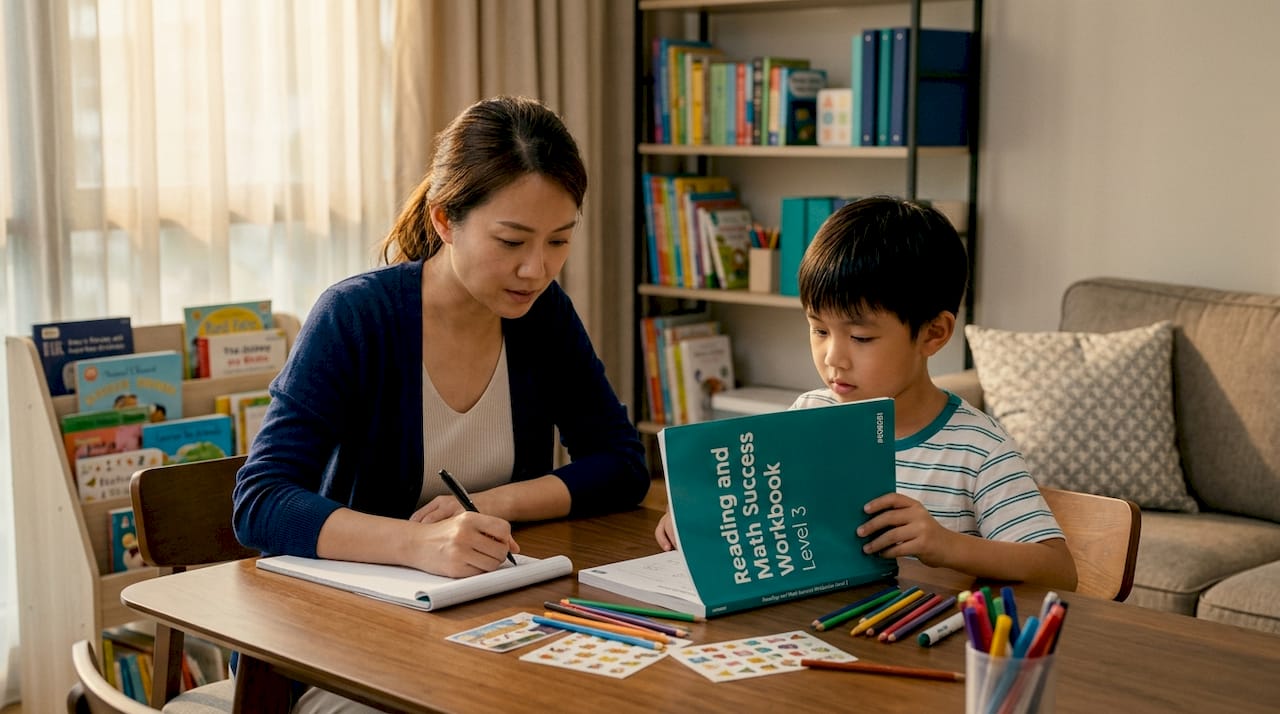
Every child learns differently. That truth becomes especially vivid when your child arrives in Singapore from another country, adjusts to a new culture, navigates a fresh language environment, and steps into a classroom that may look nothing like the one they just left. Traditional teaching, built around a single pace and a shared curriculum, simply cannot adapt fast enough for children facing that kind of transition. Personalized learning research shows measurable gains in math and reading across K-12, making it one of the most compelling educational approaches available to expat families today. This guide explains what personalized learning is, how it works for expat children, what the research actually confirms, and how you can start putting it into practice right now.
Table of Contents
Key Takeaways
Point | Details |
Personalized learning defined | It means adapting teaching to each child’s unique abilities, interests, and needs. |
Benefits for expat families | Hybrid approaches help expat children transition, learn languages, and boost motivation. |
Backed by research | Studies show improved academic outcomes, especially in math and reading for K-12. |
Quality and balance matter | Success depends on thoughtful implementation and balancing tech with teacher support. |
Start with small steps | Create a learner profile, involve teachers, and adjust strategies for best results. |
What is personalized learning?
Personalized learning means tailoring instruction to each child’s unique strengths, interests, learning pace, and goals rather than delivering the same lesson to every student in the same way at the same time. Think of it as the opposite of a one-size-fits-all classroom. A child who already reads fluently should not sit through basic phonics drills. A child who struggles with number concepts should not be rushed past foundational math just because the calendar says it is time to move on.
At its core, personalized learning includes four interconnected elements:
Learner profiles: A clear picture of each child’s skills, interests, cultural background, and learning preferences.
Individual goals: Targets that reflect where the child is now and where they need to grow, rather than where the average student is expected to be.
Adaptive content: Resources and activities that adjust in difficulty and style as the child progresses.
Real-time feedback: Ongoing assessment that informs the teacher and the child about what is working and what needs to change.
As personalized learning explained describes it, the approach is not about replacing structure. It is about making structure responsive. Teachers still guide learning. Classrooms still follow curricula. The difference is that every decision within that framework is informed by the individual child.
“Personalized learning is most effective when technology supports rather than drives the process, and when teachers remain central to interpreting data and building relationships with students.”
It is worth noting that personalized learning is not a simple plug-and-play solution. Research indicates special education benefits significantly from reinforcement-based personalized strategies, achieving 89% accuracy in matching instructional approaches. However, the same research cautions that young children sometimes show limited long-term motivation gains, and AI-driven math personalization can produce artificial scenarios that do not actually boost student engagement. The method works best when it is thoughtfully designed and teacher-guided.
How does personalized learning help expat children?
With a clear definition in mind, let’s explore why personalized learning holds special value for expat children. Moving to Singapore often means your child enters a new school mid-year, in a new language environment, with peers who have entirely different educational backgrounds. A child from Germany, Japan, or Brazil all in the same classroom is not unusual in Singapore’s international school community. Traditional teaching is not designed to accommodate that breadth of experience.
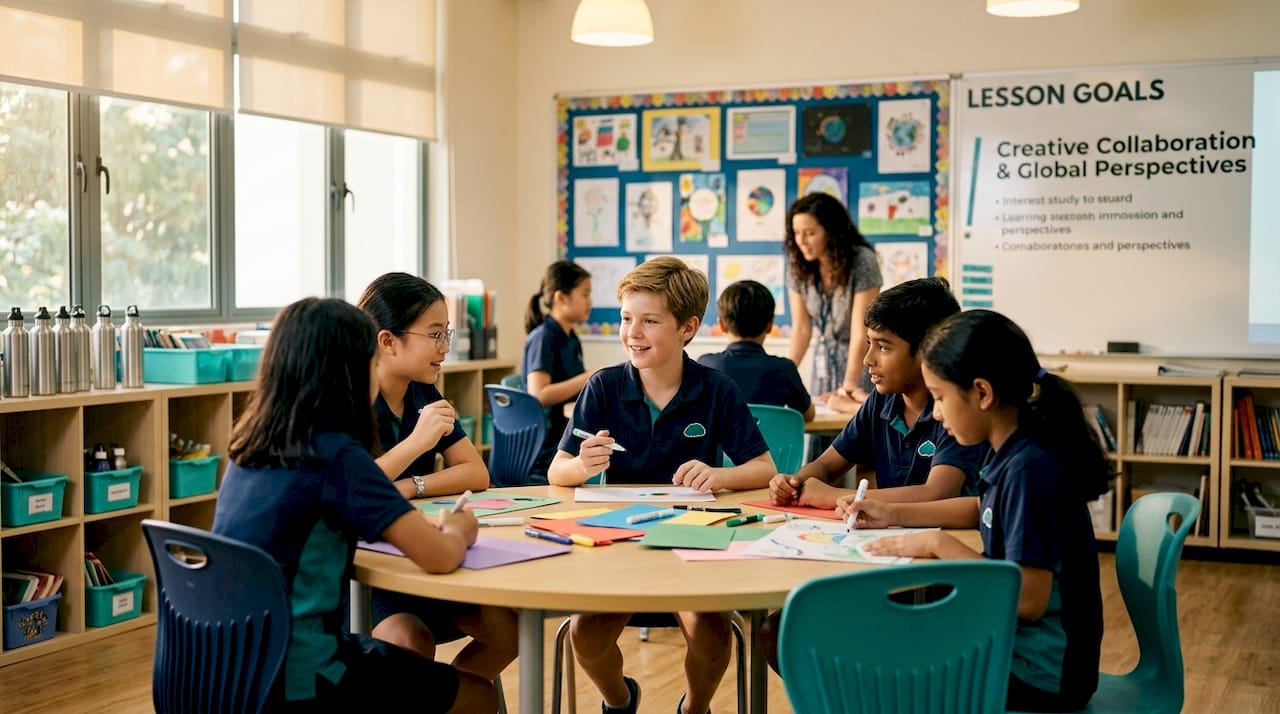
Personalized learning directly addresses this challenge. Adaptive platforms can meet a child at their current level regardless of where they came from academically. Teacher-led responsive teaching picks up on cultural and emotional cues that technology cannot. Together, they form a hybrid model that research finds especially effective for expat families navigating these transitions.
Here is what personalized learning specifically offers expat children:
Language-aware pacing: Children who are still building English proficiency can progress through content at a pace that does not leave them overwhelmed.
Cultural responsiveness: Lessons can draw on a child’s home culture, making content feel relevant and familiar rather than foreign.
Motivation through agency: When children have some choice in how they learn, their engagement improves significantly.
Smoother transition support: Learner profiles help new teachers quickly understand a child’s background without relying entirely on paper records from a previous school.
For children in Singapore’s multilingual environment, the connection between bilingual education and personalized learning is especially strong. Children who are learning in a second or third language benefit enormously from instruction that adjusts to their language needs in real time rather than expecting uniform comprehension.
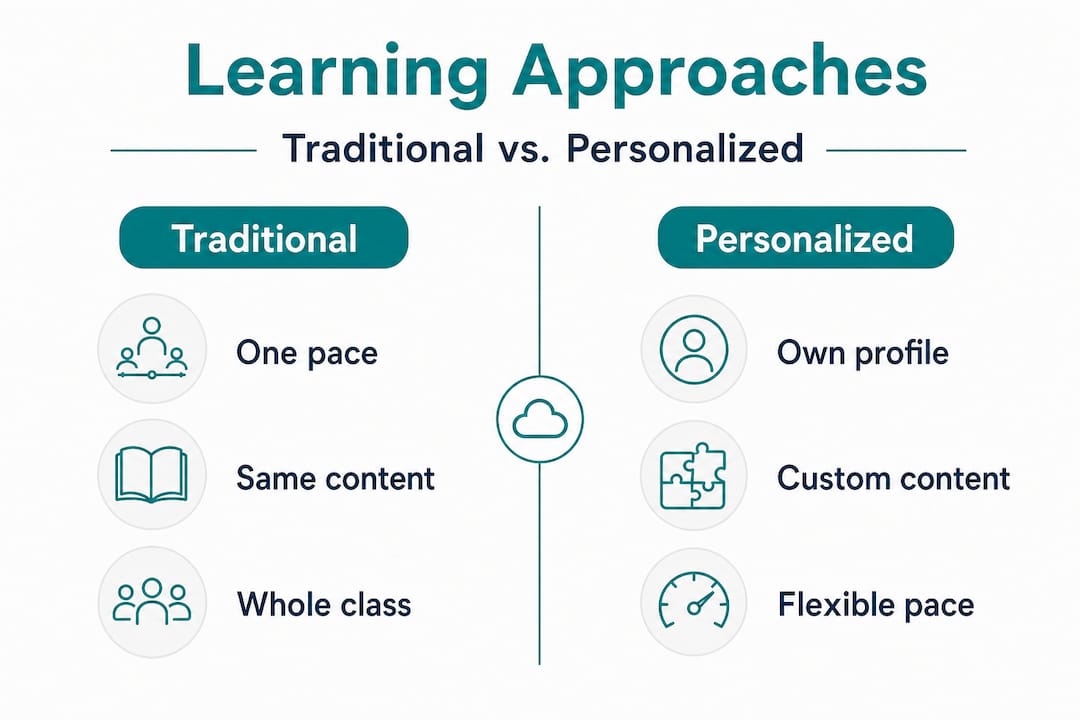
Traditional approach | Personalized approach |
Same lesson for all students | Adapted content per learner |
Progress by calendar | Progress by demonstrated mastery |
One language of instruction | Language-responsive adjustments |
Annual assessments | Ongoing, real-time feedback |
Teacher-led only | Teacher and technology in partnership |
Pro Tip: When you meet your child’s teacher, ask specifically about learner profiles. A school that builds detailed profiles at the start of the year is one that takes personalized learning seriously, not just as a technology feature but as a genuine teaching philosophy.
It is equally important to watch for over-reliance on screens. Hybrid models that blend adaptive technology with teacher guidance and social activities produce better outcomes than purely digital programs. If your child’s school personalizes learning primarily through screen time, that warrants a closer conversation.
The science: What does research show about effectiveness?
You’ve heard the theory. Now let’s look at what actual research and evidence reveal about learning outcomes. The good news is that personalized learning has meaningful research support, though the results are more nuanced than many promotional materials suggest.
A large-scale meta-analysis found medium effect sizes of g=0.43 to 0.455 in STEM and reading for K-12 students, with the strongest benefits appearing in high school. That is a genuinely meaningful result in educational research terms. Even a modest effect size, when applied consistently over a school year, can translate into significant academic gains.
Key research findings worth understanding:
Math achievement gains: The Exact Path adaptive learning program produced an effect size 0.08 higher in math achievement for students in grades 3 through 8 compared to traditional instruction.
Spelling and literacy: Personalized interventions improved both math and spelling performance in children aged 7 to 12 across multiple studies.
Metacognition improvements: Younger children using personalized digital tools showed improvements in metacognitive skills, meaning they became better at understanding their own thinking and learning processes.
ICT competence: Children who engaged with personalized technology-based learning developed stronger digital literacy skills as a byproduct.
Engagement variability: Results on intrinsic motivation were mixed, suggesting that engagement depends heavily on how the personalized approach is designed and delivered.
These outcomes matter for your expat child because they represent the kinds of skills that transfer across schools and countries. A child with strong metacognitive skills can adapt to a new learning environment far more easily than one who has only learned to follow a fixed curriculum.
Exploring learning in the digital age reveals how technology enables these outcomes, and examples like class-based personalized projects show how even simple, real-world activities can be structured to support individual learning goals in creative, memorable ways.
Limits, caveats, and myths: What personalized learning can’t do
While results are promising, it is also crucial to understand the natural limits of personalized approaches. The most damaging thing that can happen to a genuinely useful educational method is excessive hype. When expectations are inflated, parents feel disappointed when results are modest, and schools abandon approaches that were actually working.
Here are the most important caveats to keep in mind:
Personalized learning is not a cure-all. Its success depends almost entirely on the quality of implementation. A poorly designed personalized learning program can be less effective than a well-run traditional classroom.
AI “black boxes” reduce transparency. Many AI-driven learning platforms cannot explain why they recommend a particular lesson or pace. That opacity is a real problem when teachers and parents need to understand a child’s learning trajectory.
Data privacy is a genuine concern. Personalized platforms collect detailed behavioral data about your child. Parents should ask schools directly about their data storage and privacy policies.
Algorithmic bias exists. Systems trained on majority-culture data may not serve children from different linguistic or cultural backgrounds as fairly as they serve others.
Teacher and student agency can be undermined. When platforms become too prescriptive, teachers lose their professional judgment and children lose the chance to make meaningful choices about their own learning.
“Personalized learning risks becoming reductionist when it fragments learning into isolated skills, losing the coherent and inspiring whole that great teaching provides.” Critical perspectives on ed-tech remind us that technology should serve the learning, never define it.
For young children specifically, research cautions against over-reliance on tiered worksheets as a personalization method. Pre-set tiered paths can actually cap a child’s potential by assuming they belong in a particular band. Real-time adjustments based on what a child is actually doing in the moment are far more valuable.
Pro Tip: If your child’s school describes personalized learning primarily in terms of different worksheets or groups, ask how teachers adjust those plans based on what they observe each week. Genuine personalization is dynamic, not pre-sorted.
Exploring differentiated learning at home offers practical strategies that avoid these pitfalls while still honoring your child’s individual needs.
How to implement personalized learning for your expat child
Knowing both the benefits and the pitfalls, here is how you can bring personalized learning to life for your child in Singapore, both at school and at home.
Start at home with observation. Before talking to teachers, spend a week watching how your child engages with different activities. What do they choose to do when given free time? Where do they show frustration and where do they show excitement? These observations form the beginning of an informal learner profile.
Follow these steps to build a working approach:
Build a learner profile together. Write down your child’s interests, their strongest subjects, their current language abilities, and any specific challenges. Share this with their teacher at the first opportunity.
Set collaborative goals with the school. Ask the teacher to help you identify two or three specific learning goals for the term. These should be tailored to your child, not just copied from a class-wide list.
Choose technology tools deliberately. International schools in Singapore often adopt adaptive edtech that complements individual education plans. Ask which tools your child’s school uses and what data those tools collect.
Balance screens with real-world learning. For every hour of adaptive digital practice, aim for an equivalent amount of hands-on, social, or outdoor learning. This balance is especially important for children aged 1.5 to 6.
Review and adjust every few weeks. Check in with the teacher monthly. Ask whether your child’s goals still feel relevant and appropriately challenging. Personalized learning only stays personalized if it keeps evolving.
Supporting your child’s development means thinking about the full picture. A holistic education approach ensures that academic personalization sits within a broader framework of emotional, social, and creative growth. And if you are still in the process of finding the right school, navigating school choices in Singapore offers practical guidance for families at that stage.
Our perspective: What most guides miss about personalized learning for expat kids
Having walked through all the practical details, let’s step back for a broader view of what really makes personalized learning work, especially for expat families.
Most articles about personalized learning focus on technology. They describe adaptive platforms, learning analytics, and AI-driven recommendations as though the tools themselves are the solution. We think that misses the point entirely.
The most powerful form of personalized learning is not algorithmic. It is relational. It happens when a teacher notices that a child is quiet on Monday because the weekend was emotionally hard, not because they did not understand the lesson. It happens when a parent shares that their child is grieving the friends they left behind, and the teacher weaves comfort and connection into the week’s activities. Technology cannot do any of that.
For expat children specifically, the emotional and cultural dimensions of learning are not secondary concerns. They are often the primary ones. A child who does not feel safe, seen, or welcomed in their classroom will not benefit meaningfully from even the most sophisticated adaptive learning platform. Belonging comes first. Personalization follows.
This is why we believe the teacher-parent partnership is the single biggest differentiator in successful personalized learning for expat kids. When parents stay actively involved, sharing what they know about their child’s emotional state, cultural identity, and home learning habits, teachers can make genuinely informed adjustments. That loop of shared knowledge is what turns a good learning approach into a great one.
We also believe that small class sizes are not a luxury for expat families. They are a necessity. In a class of 30 students, even the most committed teacher cannot build the deep individual knowledge that personalized learning requires. In a smaller class, personalized learning shifts from an aspiration to a daily reality.
Explore personalized learning at Astor International School
Personalized learning is not a program you add to a school. It is a philosophy that shapes how every classroom operates, how teachers build relationships, and how children experience their own growth. At Astor International School in Singapore’s Tanglin area, every classroom is deliberately kept small so that no child ever becomes invisible.
Astor International School has been recognized as the best small international school in Singapore and the best affordable international school in Singapore, and those awards reflect a genuine commitment to seeing every child as an individual. Our IPC program is designed to support diverse, international learners through inquiry-based, personally meaningful learning experiences. You can explore our full approach to learning and review our curriculum to see how personalized learning is woven into every aspect of life at Astor. We warmly invite you to reach out and learn more about how we can support your child’s unique learning journey.
Frequently asked questions
Does personalized learning work for all age groups?
Personalized learning shows positive effects across K-12, with the strongest outcomes in high school, but younger children benefit when approaches are developmentally appropriate and teacher-guided rather than technology-driven.
Will my child fall behind in social skills with more screen-based learning?
Over-reliance on screens can reduce opportunities for social interaction, so effective personalized learning always balances digital tools with collaborative, real-world activities and teacher-led discussions.
Does personalized learning replace the need for teachers?
No. AI-driven tools lack transparency and cannot replicate the relational intelligence that teachers bring, making human guidance essential for personalized learning to truly succeed.
Are international schools in Singapore already using personalized learning?
Most international schools in Singapore adopt adaptive edtech tools that support personalization, especially to address the diverse linguistic and academic backgrounds of expat children.
How can I start supporting personalized learning at home?
Begin by observing your child’s interests and strengths, share those insights with their teacher, and blend technology with hands-on social and creative activities to support well-rounded development.
Recommended
Comments