


Parents: Primary Reading Programs with 20–30 Min Daily Phonics

Choose a structured literacy program that pairs explicit phonics instruction with decodable texts, regular progress monitoring, and teacher training. That combination, grounded in the Science of Reading, has the strongest evidence behind it for primary-grade readers. Before comparing options, ask about phonics scope and sequence, decodable text sets, teacher professional development, and how the program tracks each child’s progress.
TL;DR:
Effective programs provide explicit, systematic phonics instruction with a clear scope and sequence, along with decodable texts that match taught patterns.
Ongoing teacher training and support are critical, with many programs offering coaching rather than one-time workshops to ensure fidelity.
Programs should include regular assessment and progress monitoring that directly inform instruction and grouping decisions.
High-quality decodable texts should reach a decodability level of at least 75% in early texts and be paired with trade books to build background knowledge.
Class size, teacher support, and implementation fidelity often outweigh program branding or marketing claims in achieving reading success.
Table of Contents
What Should Parents and Educators Look for in Reading Programs Primary Schools Use?
Every strong program shares a handful of traits, and you can check for them in an afternoon of research.
Structured literacy comes first. Look for explicit, systematic instruction in phonemic awareness and phonics rather than incidental exposure to print.
Decodables plus real books. A good program blends decodable readers with knowledge-building trade texts so kids practice decoding while learning about the world.
Daily, short, consistent lessons. Expect a foundational literacy block, not a once-a-week phonics lesson bolted onto a broader curriculum.
Real teacher training. Ask whether teachers get ongoing coaching, not a single orientation session.
Clear scope and sequence. Vendors and schools should be able to show, in writing, what gets taught and in what order.
Built-in assessment. Progress monitoring should connect directly to what’s being taught, not sit as a separate add-on.
Vague promises like “we use phonics” or “we focus on literacy” mean little without a published sequence and sample materials behind them. If a school or vendor can’t produce those on request, treat that as a warning sign rather than an oversight.
What Makes a Reading Program Effective?
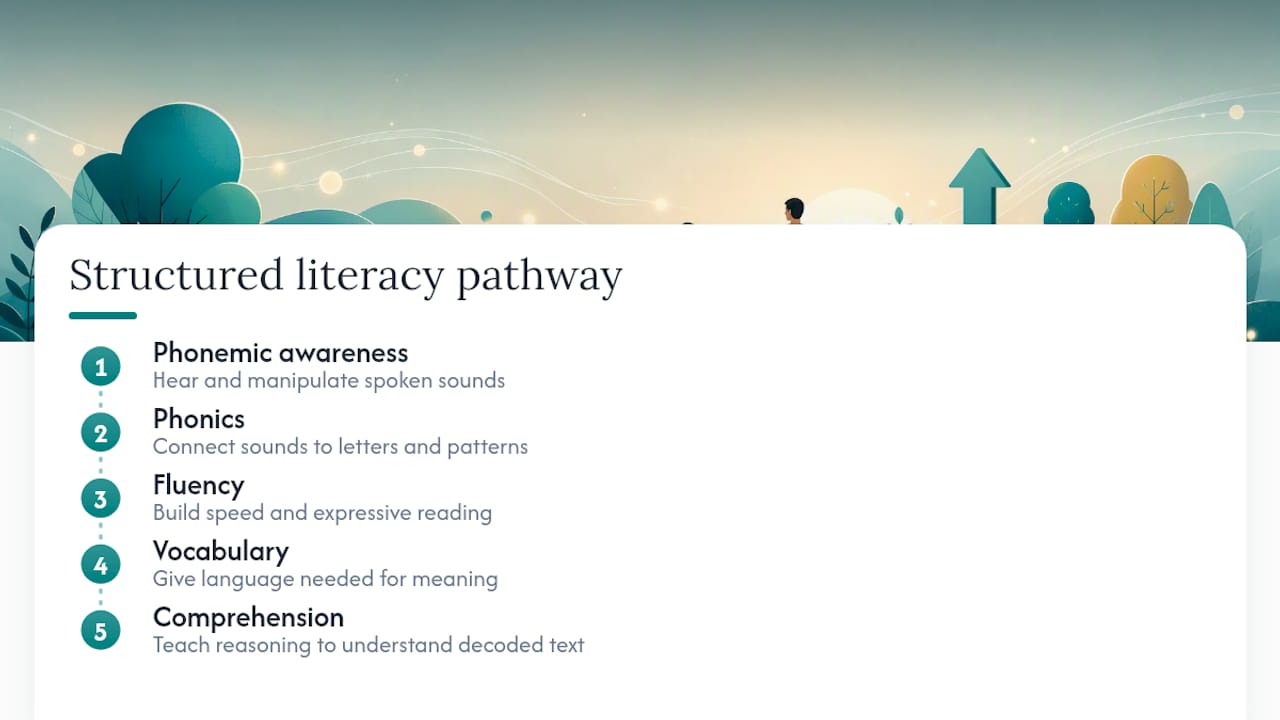
Structured literacy is an approach to teaching reading built on explicit, systematic instruction in the skills that predict reading success: phonemic awareness, phonics, fluency, vocabulary, and comprehension. Each piece does distinct work. Phonemic awareness trains children to hear and manipulate the sounds in spoken words. Phonics connects those sounds to letters and letter patterns. Fluency builds the speed and expression that free up mental energy for meaning. Vocabulary and comprehension instruction give children the language and reasoning skills to understand what they’ve decoded. Miss one piece, and the whole structure wobbles.
Effective, evidence-based reading programs for primary-aged children deliver this instruction through short, systematically sequenced sessions rather than scattering skills across the week. That’s what distinguishes structured literacy programs like Fundations from looser, exposure-based approaches. Fundations, developed by Wilson Language Training, is one widely referenced example of this model. It sequences phonics skills explicitly and pairs them with multisensory practice, rather than expecting children to absorb spelling patterns through repeated reading alone.
This matters most as prevention, not remediation. Tier 1 instruction, the core teaching every child receives in the regular classroom, works best when it’s explicit enough that most students never need pulled-out intervention at all. Schools that wait until a child struggles before introducing systematic phonics are working uphill. Front-loading the skills reduces how many children need Tier 2 small-group support later, which is a better outcome for kids and a lighter lift for teachers.
Pro Tip: If a school describes its reading approach as “balanced literacy” without mentioning explicit phonics or a phonics sequence, ask directly whether decoding skills are taught systematically or picked up through exposure to books. The answer tells you a lot.
Dosage matters as much as content. Many Tier 1 structured literacy blocks run 20 to 30 minutes daily for kindergarten through third grade, with small-group Tier 2 sessions adding two to four additional 20 to 30 minute sessions per week for children who need more support. That’s a useful benchmark when a school describes its literacy block as “embedded throughout the day” without giving you a number. Embedded can mean rich and constant. It can also mean nothing measurable happens on a given day.
Program examples help make this concrete. Ready4Reading, Scholastic’s K-3 supplemental phonics program, pairs explicit phonics instruction with knowledge-building decodable texts and lays out a clear scope and sequence for each grade. HMH Into Reading takes a broader approach, integrating structured literacy, decodable readers, and trade text sets across a full K-6 curriculum with built-in teacher supports. Neither program is presented here as a rival to weigh against a school. They’re evidence of what the components actually look like when a publisher builds a program around them, and they give you a reference point for judging any curriculum, whether it’s a purchased product or a school’s own literacy framework.
How Do You Choose the Right Reading Program?
A rubric beats a gut feeling, especially when several programs all claim to be “evidence-based.” For a helpful cross-cultural perspective on structured reading and language acquisition, see The Role of Reading in Japanese Learning: A Practical Guide. Score any option against these dimensions:
Evidence alignment. Does the program explicitly cite structured literacy or the Science of Reading, or does it use vaguer language like “balanced” or “eclectic” without naming its instructional approach?
Scope and sequence clarity. Can the school produce a document showing what’s taught, week by week, for each grade?
Decodable text quality. Are decodable readers matched to what’s been taught so far, with a stated decodability level?
Teacher training and support. Is professional development ongoing and specific, or a one-time workshop?
Dosage. How many minutes per day, and how many sessions per week for children needing extra help?
Assessment and progress monitoring. Does the program include screeners and regular check-ins tied to instruction?
Cultural and classroom fit. Do the texts and examples reflect the children being taught, and does the pacing suit small or mixed-ability classes?
Bring these questions directly to a program rep or school leader:
Can you show me the scope and sequence for my child’s grade?
How many hours of professional development do teachers receive each year, and is it ongoing or front-loaded?
Can I see a sample decodable text and its stated decodability percentage?
How often is reading progress assessed, and what tool do you use?
How is assessment data shared with parents, and how often?
What happens if a child isn’t progressing? What does the intervention pathway look like?
Is small-group instruction available, and how is group size determined?
How does the program build vocabulary and background knowledge alongside decoding?
Who checks that teachers are delivering lessons as intended?
How does the program adapt for children learning English alongside their home language?
Watch for red flags. A vendor or school that can’t produce a written scope and sequence, that uses “phonics” as a buzzword without showing you a sequence, or that has no clear assessment or intervention plan is asking you to take a lot on faith. Instruction Partners has documented common implementation pitfalls that derail otherwise sound programs, and lack of professional development tops the list, followed by weak fidelity checks and unclear expectations for teachers.
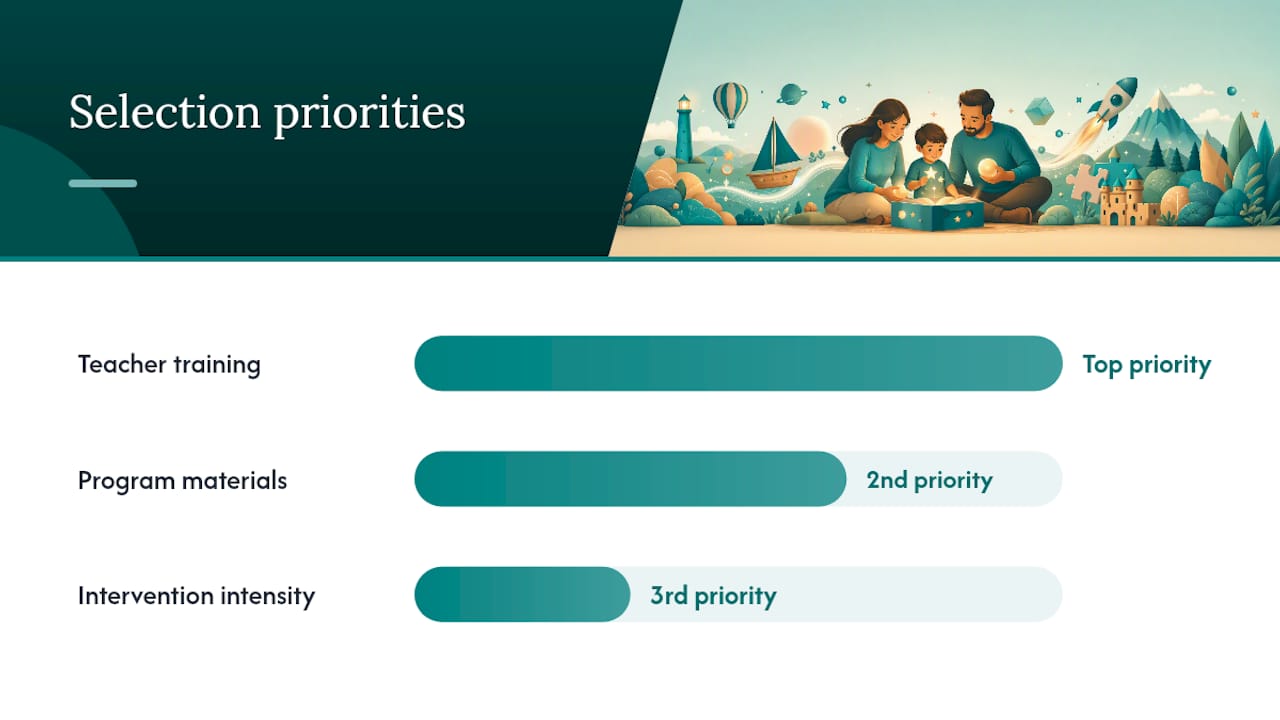
If you have to prioritize, put teacher training first, program materials second, and intervention intensity third. A mediocre set of texts delivered by a well-trained, well-supported teacher will usually outperform excellent materials handed to a teacher with no coaching. Materials are easier to fix retroactively than habits formed without guidance.
What Program Features Signal Real Quality?
The details inside a program matter more than its marketing copy, and decodable texts are a good place to start. A quality decodable set is built to match a specific phonics sequence: children only encounter letter patterns they’ve already been taught. Some programs publish a decodability percentage, meaning the share of words in a given text that follow already-taught patterns. Scholastic’s Ready4Reading reports more than 75% decodability in its early text sets, which helps children transition from sounding out words to reading connected text without guessing from pictures or context alone.
Decodables shouldn’t stand alone, though. High-quality programs deliberately pair decodable readers with knowledge-building trade texts, so children apply fresh decoding skills while also encountering richer vocabulary and background knowledge they can’t get from a controlled-vocabulary decodable. A program heavy on decodables but light on real literature risks producing technically accurate readers with thin general knowledge. A program heavy on trade books but light on decodables risks leaving struggling readers to guess.
Assessment should feel like an extension of instruction, not a separate event. Most solid programs include three layers:
Universal screeners, given a few times a year, to flag which children may need closer attention.
Progress monitoring, brief and frequent, tracking specific skills like letter-sound fluency or word reading.
Oral reading fluency checks, timed readings that reveal both accuracy and pace.
Ask how the results loop back into instruction. A screener that never changes a teacher’s grouping decisions or lesson focus is just paperwork.
Teacher support varies more than most parents expect. Some programs hand teachers fully scripted lessons, word for word, to reduce variability in delivery. Others give teachers a sequence and objectives but leave room for professional judgment in pacing and delivery. Neither approach is automatically better, but teachers need explicit, step-by-step guidance and real professional development to deliver structured literacy well, and programs offering scripted lessons alongside solid PD tend to reduce the gap between a strong teacher’s classroom and a newer teacher’s classroom. PD formats range from on-site workshops to virtual coaching to embedded classroom observation. Ask which format a program or school actually uses, and how often. A one-day training in August followed by silence for the rest of the year is a much weaker commitment than ongoing coaching.
How Do You Judge Decodables and Digital Reading Tools?
Not every decodable reader or reading app deserves a place in your child’s routine, and it’s worth applying real scrutiny before adding one to the mix.
For decodable texts, check for:
A clear match between the words in the text and the phonics patterns already taught.
A stated decodability level, ideally in writing, rather than a vague claim of being “phonics-based.”
Content connected across a set, so children build both skill and knowledge as they move through it, rather than jumping between unrelated topics every few pages.
Genuine engagement. Decodables can be dull if the vocabulary is artificially constrained. Look for ones that manage both constraint and interest.
Digital tools deserve a different kind of scrutiny. Games and apps work best as targeted practice, reinforcing specific skills like phoneme blending or grapheme recognition, rather than as a stand-in for teacher-led instruction. Digital games can be effective for this kind of narrow, repeated practice, but they shouldn’t replace the systematic, teacher-delivered instruction that introduces new skills in the first place. Think of apps as the practice field, not the coach.
Teach Your Monster to Read is a useful reference point here. It offers staged phonics games and decodable practice explicitly designed to complement, rather than substitute for, a structured phonics program, and it includes simple progress tracking so a parent or teacher can see which skills a child has mastered. For a broader list of vetted options, Common Sense Education curates reading apps and websites for elementary learners, which is a reasonable starting point before trusting an app store rating alone. At home, pairing screen practice with hands-on activities keeps the balance right. Resources like easy phonics activities you can try at home give parents a low-tech complement to whatever digital tool a classroom uses, and material on the importance of phonics explains why that skill deserves priority over flashier features.
How Does Astor Put Structured Literacy Into Practice?
Evidence-based frameworks only matter if a school can actually deliver them, which is why implementation details are worth asking about directly.
At Astor, that means small class sizes designed so a teacher can track exactly where each child sits in the phonics sequence, not just where the class average sits. It means blended learning that pairs classroom-based, teacher-led instruction with outdoor and hands-on activities, so decoding practice isn’t confined to worksheets. The school’s small-school model helps keep foundational literacy blocks personalized rather than generic.
The best learning happens when every child is truly seen and supported, not when a curriculum is simply delivered at a room full of students.
Operationally, that shows up as a daily foundational literacy block for primary-grade students, built around explicit phonics teaching, decodable practice matched to what’s already been taught, and teacher coaching that keeps instruction consistent across classrooms. None of that replaces the specifics you should ask about directly. If you want to see the actual scope and sequence, sample decodable texts, or the professional development calendar behind a given grade, that’s a conversation for admissions, not a marketing page. Families are welcome to request curriculum details and speak with the team directly about how a particular child’s reading development would be supported.
What Does the Research Say About Program Effectiveness?
The evidence behind structured literacy isn’t a single study. It’s a convergence of findings across decades of reading research, consistently pointing to the same conclusion: explicit, systematic instruction in phonemic awareness and phonics outperforms incidental or purely meaning-based approaches for the majority of learners, including those at risk for reading difficulty.
What the research doesn’t support is treating any single branded program as inherently superior by name alone. The label “Science of Reading” gets attached to a lot of marketing, and not every program that uses the phrase actually delivers explicit, systematic instruction with fidelity. That’s why implementation quality shows up again and again as the deciding factor. Programs that publish a clear scope and sequence and provide on-site or coaching-based professional development show better implementation fidelity in practice than programs that hand teachers materials with minimal support.
The practical takeaway for parents and educators is to treat “evidence-based” as a starting filter, not a final answer. Two programs can both claim alignment with the Science of Reading and produce very different classroom experiences depending on how well teachers are trained, how closely materials are followed, and how consistently progress gets monitored. The program matters. The delivery matters just as much.
How Do Popular Primary Reading Programs Compare?
Comparing programs works best against consistent categories rather than brand names alone. Here’s how the components stack up across common evaluation dimensions.
Dimension | Strength to look for | Common weakness |
Evidence alignment | Explicit phonics sequence, named structured literacy approach | Vague “balanced literacy” language with no defined sequence |
Scope & sequence | Published, grade-by-grade document available on request | Sequence exists internally but isn’t shared with families |
Decodable texts | Matched to taught patterns, stated decodability level | Decodables that skip ahead of what’s been taught |
Teacher training | Ongoing coaching, not a single workshop | One-time training with no follow-up support |
Dosage | Daily block, clearly timed (roughly 20 to 30 minutes for K-3) | “Embedded throughout the day” with no measurable minutes |
Assessment | Screeners tied directly to instructional decisions | Assessment data collected but not acted on |
Programs like Fundations lean heavily into scripted, multisensory phonics delivery, which reduces variability between teachers but requires substantial initial teacher training. Ready4Reading pairs a strong decodable percentage with a clear K-3 sequence, useful as a supplemental phonics layer. HMH Into Reading spans a wider K-6 range and integrates trade texts more deliberately, which suits schools wanting one curriculum across more grades. None of these is a universal best fit. The right choice depends on classroom size, teacher training capacity, and how a school wants to balance decodables against richer literature.
What Gets in the Way of Successful Implementation?
Even a well-designed program fails if it’s poorly implemented, and the failure points are predictable enough to plan around.
The most common pitfall is insufficient professional development. Schools buy new materials, hand them to teachers, and expect fidelity without investing in the coaching that makes fidelity possible. Instruction Partners’ research on curriculum implementation identifies this as a leading driver of inconsistent outcomes, alongside weak fidelity checks and unclear expectations for what teachers should actually be doing day to day.
A second pitfall is treating adoption as a one-time event rather than a multi-year process. Teachers need time to internalize a new scope and sequence, and schools that expect full fluency in year one often abandon strong programs prematurely when early results look mixed.
A third is skipping the fidelity check entirely. The most practical early test of any adoption is whether the school can produce a grade-level scope and sequence, sample decodable texts, and a professional development schedule for the coming term. If those three things exist and are visible to teachers and families, implementation is on solid ground. If they don’t exist yet, that’s a planning gap worth naming early rather than discovering a year in.
Successful adoption tends to share three traits: leadership that protects the daily instructional block from being crowded out by other priorities, coaching that continues well past the initial rollout, and a willingness to adjust pacing based on actual classroom data rather than the original calendar.
How Should You Interpret Reading Assessment Data?
Assessment data means little without context, and the most common mistake parents and educators make is reading a single score as a verdict rather than a data point.
Screener results flag which children may need closer attention. They aren’t diagnoses. A child who scores below benchmark on a fall screener might catch up with a few weeks of targeted small-group support, especially if the gap is narrow and the skill involved is discrete, like letter-sound fluency. Progress monitoring data matters more over time than any single score, since it shows trajectory: is a child closing the gap, holding steady, or falling further behind despite instruction?
Oral reading fluency checks combine two numbers that need to be read together: accuracy and rate. A child reading quickly but inaccurately hasn’t mastered the text. A child reading slowly but accurately may need more fluency practice, not more phonics instruction. Conflating the two, or looking only at words-per-minute without accuracy, leads to the wrong intervention.
The most useful question to ask a teacher isn’t “how is my child scoring,” but “what does this score change about instruction.” If a data point doesn’t lead to an adjustment in grouping, pacing, or focus, it’s not being used the way it should be. Ask how often data gets reviewed as a team, not just recorded, and how quickly a struggling reader gets moved into more targeted support once a pattern shows up across two or three data points rather than one.
An Editorial Take on Picking the Right Program
The industry’s biggest blind spot isn’t curriculum content. It’s the assumption that a well-designed program survives contact with an under-trained teacher or an oversized classroom. Plenty of schools buy genuinely strong, evidence-aligned materials and still get mediocre results, because the missing ingredient was never the phonics sequence. It was the coaching, the class size, and the consistency of delivery.
Conventional advice tells parents to ask “does this program use the Science of Reading?” That question is necessary but not sufficient. The sharper question is whether a school can actually deliver explicit instruction with fidelity, week after week, to every child in the room, not just the ones who’d learn to read almost regardless of method.
If I had to rank priorities, teacher training and class size come before program branding every time. A smaller class with a well-coached teacher using solid but unglamorous materials will consistently outperform a large class using an expensive, celebrated curriculum delivered inconsistently. Ask about the humans in the room before you ask about the workbooks.
— Elena
How Astor Applies This Evidence to Real Classrooms
A literacy approach based on structured, explicit instruction delivered consistently, in small enough classes that a teacher can track each child’s progress rather than an average, uses a blended model of classroom and outdoor learning to keep the foundational reading block personalized instead of generic. This reflects a commitment to a small-school model.
If you’re comparing programs and want to see how a specific classroom translates a phonics scope and sequence into daily practice, the IPC curriculum framework Astor follows is a good starting point for understanding how literacy fits into the broader academic day. For a fuller picture of how reading instruction connects to the rest of the curriculum, the curriculum overview page walks through Astor’s approach across subjects and age groups. Parents weighing enrichment options alongside core literacy instruction can also browse available courses to see what additional language and reading support looks like beyond the classroom day.
The next step is a conversation, not a brochure. Reach out to Astor’s admissions team to request curriculum details specific to your child’s grade, including sample materials and how progress gets monitored across the term. That direct conversation will tell you more than any comparison chart, including this one.
Sources
Recommended
Comments