


Step by Step Moving to Singapore: Family Guide 2026

Moving to Singapore is a structured relocation process that requires securing legal status before anything else can follow. Families who approach this as a step by step moving to Singapore sequence, rather than a checklist of parallel tasks, consistently avoid the administrative delays that derail most expat moves. The core areas to address in order are: Employment Pass or equivalent visa, family-friendly housing, international school enrollment, and local financial setup. Planning should begin 3 to 4 months before your intended arrival date, since visa approvals unlock every subsequent step.
How to secure the right visa and work permits for your family
The Employment Pass (EP) is the most common work visa for relocating professionals and the legal foundation of your entire move. Without it, you cannot sign a lease, open a bank account, or enroll your children in school. Getting this step right, and getting it first, is the single most important discipline in the relocation process.

In 2026, the EP requires a minimum monthly salary of SGD 5,000 for most sectors, rising to SGD 5,600 for financial services roles. The ONE Pass, designed for top-tier global talent, sets the bar at SGD 30,000 per month. These thresholds are not negotiable, and older professionals face higher requirements under the COMPASS points-based assessment system. Singapore does not offer a digital nomad or freelancer visa, so employer sponsorship is mandatory.
The EP application is submitted by your employer through Singapore’s Ministry of Manpower (MOM) portal. Processing takes 3 to 8 weeks for the EP and approximately 4 weeks for the ONE Pass. You will receive an In-Principle Approval (IPA) letter first. This letter is your entry document and allows you to enter Singapore to complete the remaining formalities. Your dependents, including a spouse and children under 21, can apply for Dependent Pass (DP) or Long-Term Visit Pass (LTVP) once your EP is approved.
After arriving in Singapore, you must complete the SG Arrival Card online within 3 days before entry. Within 2 weeks of arrival, visit the EP Services Centre to submit biometrics and collect your physical pass card. Your dependents follow the same process at the same location.
Here is the visa sequence in order:
Employer submits EP application via MOM portal
Receive IPA letter (3 to 8 weeks)
Apply for Dependent Pass for spouse and children
Complete SG Arrival Card online before entry
Visit EP Services Centre within 2 weeks for biometrics and pass card
Pro Tip: Never sign a housing lease or pay a school registration fee before your IPA letter is in hand. Landlords and schools require proof of legal status, and committing financially before approval creates real risk.
What are the best housing options for families in Singapore?
Singapore offers three main housing categories for expat families: HDB flats (public housing), private condominiums, and co-living or serviced apartments. Most relocating families with children choose private condominiums for the space, facilities, and proximity to international schools. HDB flats are cheaper but come with restrictions on who can rent them and for how long.
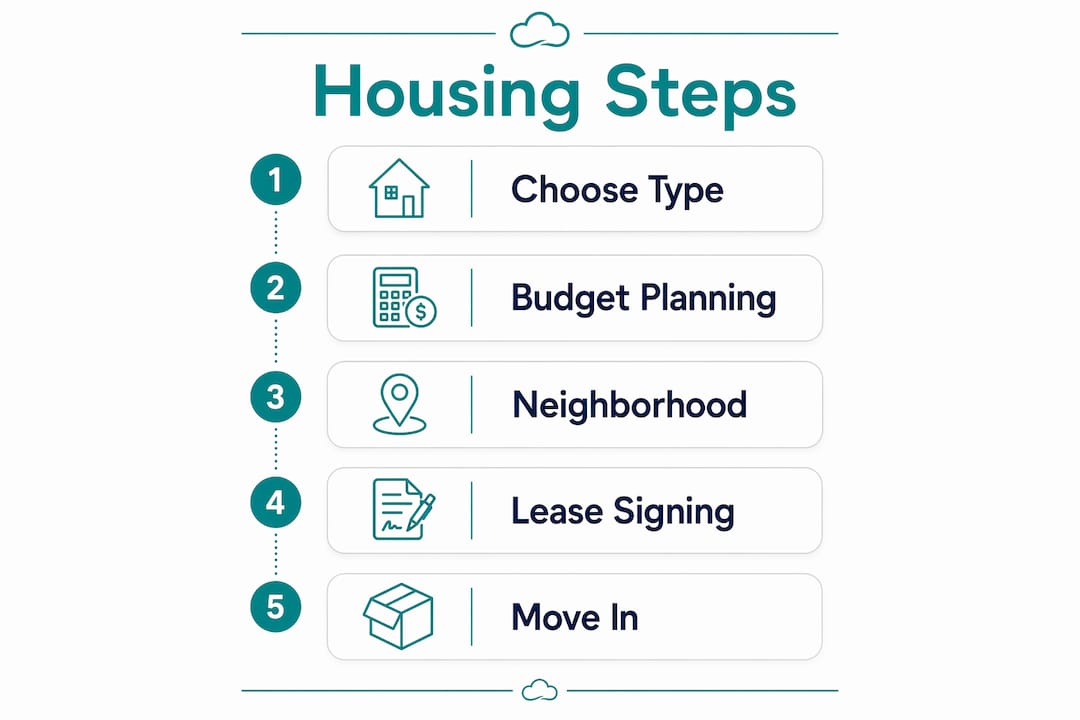
Upfront rental costs are significant. Expect to pay one month’s deposit plus one month’s rent in advance when signing a lease. Agent fees are typically one month’s rent for a 2-year lease. A family renting a 3-bedroom condo in districts like Tanglin, Holland, or Buona Vista will typically spend SGD 6,000 to SGD 10,000 per month, depending on size and building amenities.
Location matters more than living space size. Proximity to the MRT network, your workplace, and your children’s school directly affects daily quality of life in ways that square footage simply does not. Families who prioritize a large apartment in an inconvenient location often regret it within the first school term.
Key factors to evaluate when choosing a home:
MRT access: Singapore’s MRT is fast and reliable, but a 20-minute walk to the nearest station adds up quickly with children in tow.
School proximity: Many international schools in the Tanglin and Holland areas have limited bus routes, making walkable or short-drive distance a genuine advantage.
Lease flexibility: Most leases run 2 years with a diplomatic clause allowing exit after 12 months with proper notice. Always verify this clause is included before signing.
Temporary housing: The setup sequence is circular in a frustrating way. You need a local address to open a bank account, but you need a bank account to pay the housing deposit. The practical solution is a short-term serviced apartment for the first 2 to 4 weeks.
Housing type | Best for | Typical monthly cost |
Private condo | Families with children | SGD 5,000 to SGD 12,000 |
HDB flat | Budget-conscious couples | SGD 2,500 to SGD 4,500 |
Serviced apartment | Arrival transition period | SGD 4,000 to SGD 8,000 |
Pro Tip: When shortlisting neighborhoods, check best districts for families with good MRT access and school proximity. Districts 10 and 11 consistently rank well for expat families with school-age children.
How do you choose the right school for your child in Singapore?
School selection is the decision that most directly shapes your housing choice, so it must happen early in the process. Singapore’s public schools are not open to most expat children, which means international or private schools are the default path. Understanding the differences between these options is the first step in navigating school choices for your family.
International school fees range from SGD 25,000 to SGD 50,000 annually, and waitlists at popular schools can stretch 1 to 2 years. This is the most underestimated timeline challenge in the entire relocation process. Families who begin school applications only after arriving in Singapore often find themselves scrambling for placements mid-year.
When evaluating schools, consider these factors:
Curriculum: British (IGCSE), American, International Baccalaureate (IB), and International Primary Curriculum (IPC) are the most common frameworks. Each suits different learning styles and future academic pathways.
Class size: Smaller schools with lower student-to-teacher ratios give children more personalized attention during what is already a significant transition. This matters especially for younger children aged 5 to 9.
Location relative to housing: Many families choose their neighborhood after confirming a school place, not before. This is the smarter sequence.
Community and support: Schools with active parent communities and dedicated support for new expat families ease the social adjustment for both children and parents.
For families with children aged 5 to 12, boutique international schools offer a genuinely different experience from large campus institutions. The best learning happens when every child is truly seen and supported, and that is harder to achieve in a school of 1,500 students than in one of 300. A guide to international school types can help you compare options across curriculum, size, and ethos before you commit.
Pro Tip: Apply to at least two schools simultaneously and confirm your place in writing before finalizing your housing lease. School location should anchor your neighborhood search, not the other way around.
What do you need to set up finances and daily life after arrival?
Once your EP card is in hand and you have a fixed address, financial setup moves quickly. Opening a bank account at DBS, OCBC, or UOB requires your Employment Pass, proof of local address, and typically takes 1 to 2 weeks to complete. These three banks are Singapore’s dominant retail institutions and all offer English-language services with strong mobile banking platforms.
Health insurance is mandatory in a specific sense. Employers must provide medical insurance with minimum coverage as a condition of the EP. However, this employer-provided coverage is often basic. Many expat families add international private health insurance for access to private hospitals like Mount Elizabeth, Gleneagles, or Raffles Medical, where wait times are shorter and specialist access is broader. Public healthcare in Singapore is subsidized only for citizens and permanent residents, so private coverage is a practical necessity for most expat families.
The steps for financial and daily life setup are:
Register for SingPass, Singapore’s national digital identity system, which gives you access to government portals, tax filing, and financial services
Open a bank account at DBS, OCBC, or UOB once your EP and address are confirmed
Arrange health insurance beyond your employer’s minimum coverage
Set up utilities (SP Group for electricity and water) and internet (Singtel, StarHub, or M1)
Get an EZ-Link card for MRT and bus travel
Hawker centers are not just affordable. They are Singapore’s social infrastructure. A family that eats regularly at hawker centers integrates faster, spends less on food, and connects with the neighborhood in a way that restaurant dining simply does not replicate.
Singapore’s social norms carry real consequences. Eating or drinking on the MRT carries a fine of up to $500. Teaching children these rules before the first commute avoids embarrassment and signals respect for local culture from day one.
Key takeaways
Relocating to Singapore as a family requires completing each step in the correct sequence, starting with visa approval, because every subsequent task from housing to banking to school enrollment depends on it.
Point | Details |
Visa comes first | Employment Pass approval unlocks housing, banking, and school enrollment. |
Start school applications early | Waitlists of 1 to 2 years mean applying before you arrive is not optional. |
Use a serviced apartment on arrival | It solves the bank account and lease deposit chicken-and-egg problem. |
Verify the diplomatic clause | Always confirm lease exit rights after 12 months before signing any 2-year contract. |
Location beats size | Proximity to MRT, school, and workplace matters more than apartment square footage. |
What I’ve learned from watching families relocate to Singapore
I have seen families plan this move meticulously and still stumble, almost always for the same reason: they underestimate how tightly each step depends on the one before it. The visa is not just a formality. It is the key that opens every other door. Families who try to run tasks in parallel, signing leases before IPA approval or applying to schools before confirming their move, create problems that take weeks to untangle.
The school timing issue is the one that surprises families most. Parents assume that a good school will have space. In Singapore, the best international schools do not. Applying 12 to 18 months before your intended start date is not excessive. It is realistic. I would also encourage families to think carefully about school size. A smaller, more nurturing environment gives children the confidence to adapt, and that confidence carries over into friendships, language, and a genuine sense of belonging.
On integration: embrace hawker center culture immediately. It is genuinely one of the best things about daily life in Singapore, and it connects you to the community faster than any organized expat event. The families who thrive here are the ones who lean into the culture rather than recreating their home country experience in a new city.
— Elena
How Astor International School supports your family’s move
Relocating with children is one of the most emotionally complex parts of any international move, and finding the right school makes all the difference. Astor International School, located in the Tanglin area of Singapore, provides education for children aged 5 to 12 through a personalized, engaging curriculum that has earned recognition as both the best small school and the best affordable international school in Singapore. Small class sizes mean every child is genuinely known by their teacher, which is exactly what children need when they are adjusting to a new country and a new classroom.
The school’s International Primary Curriculum is designed to support curious, confident learners across different cultural backgrounds, making it a natural fit for relocating families. Families with younger children will also find a nurturing home at Astor International Preschool in the Holland area, which combines outdoor play across two playgrounds with structured classroom learning. To learn more about the full curriculum and how Astor supports expat families through the transition, visit Astor International School.
FAQ
How long does it take to move to Singapore?
Planning should begin 3 to 4 months before your intended arrival, accounting for EP processing of 3 to 8 weeks plus time to secure housing and school places.
Can my children attend public school in Singapore?
Public schools in Singapore are reserved for citizens and permanent residents. Expat children typically attend international or private schools, with fees ranging from SGD 25,000 to SGD 50,000 annually.
What is the diplomatic clause in a Singapore lease?
The diplomatic clause allows tenants to exit a 2-year lease after the first 12 months by giving 2 months’ written notice. Always confirm this clause is included before signing.
Which banks can expats use in Singapore?
DBS, OCBC, and UOB are the three major retail banks available to expats. Account opening requires your Employment Pass and proof of a local address, and typically takes 1 to 2 weeks.
When should I apply to international schools in Singapore?
Apply as early as possible, ideally 12 to 18 months before your intended start date. Popular international schools carry waitlists of 1 to 2 years, and expat resources for families can help you identify the right options and timeline for your children.
Recommended
This guide really emphasizes the structured, step-by-step approach, which is smart given how complex international moves can be. It sounds like a lot of intense planning and focus is needed to get everything right. When you need a brain break from all the logistics, I sometimes unwind with a quick round of MeowdoKu Game Online – it's a nice way to clear your head.
Wow, the rental prices for a 3-bedroom condo in districts like Tanglin are definitely something to plan for! It makes you really think about how to optimize your living space and find inspiration. If you're looking for ideas for your new place or just want to visualize different decor, the Zeva AI Image Generator can be a fun tool to play around with.
The detail on upfront rental costs and agent fees is a good heads-up, those costs add up fast! Moving itself can be quite a workout, from packing to viewing places. I recently came across some knee brace support that I've been incorporating into my daily routine for extra stability.
Planning 3-4 months ahead for the move sounds about right, especially with all the visa complexities. I can imagine taking so many photos during the packing process and trying to keep track of everything. By the way, if you ever need to convert media files, I've used Heic to MP4 for some video projects.
The step-by-step visa sequence is pure gold, especially clarifying that the Employment Pass is the legal foundation for everything else. It's great to have such a clear guide for the process. If you're outlining your own moving plan or jotting down notes for this process, you might find a Markdown Converter For Free useful for organizing your thoughts.