

Beat Tanglin Waitlists: Tours 12–18 Months Ahead for Singapore Parents
For families weighing a move near Orchard and Holland, the shortlist usually comes down to three names: Tanglin Trust School for a British-curriculum campus, Tanglin Primary School for a Ministry of Education option, and Astor International School for a small, personalized alternative nearby. The right next step depends on your child’s needs and your timeline. Check current availability directly with each school and book a tour before you decide.
TL;DR:
International school places at Tanglin Trust and Astor are highly competitive, with nurseries being the primary entry point due to limited spots in later years.
Small class sizes at Astor, averaging around 15 students, offer more individual attention compared to larger international campuses like Tanglin Trust, which has over 2,800 students.
Applying 12 to 18 months in advance and submitting applications to multiple schools improves chances, especially for popular international options with restricted intake.
Tanglin Primary School follows the national curriculum and admits based on citizenship and residency, whereas Tanglin Trust provides an English-language international curriculum with premium fees.
Visiting schools during weekday mornings and preparing a standardized list of questions helps identify actual differences in support, facilities, and teaching approaches.
Table of Contents
What Does “Tanglin Area” Mean for Primary Schooling?
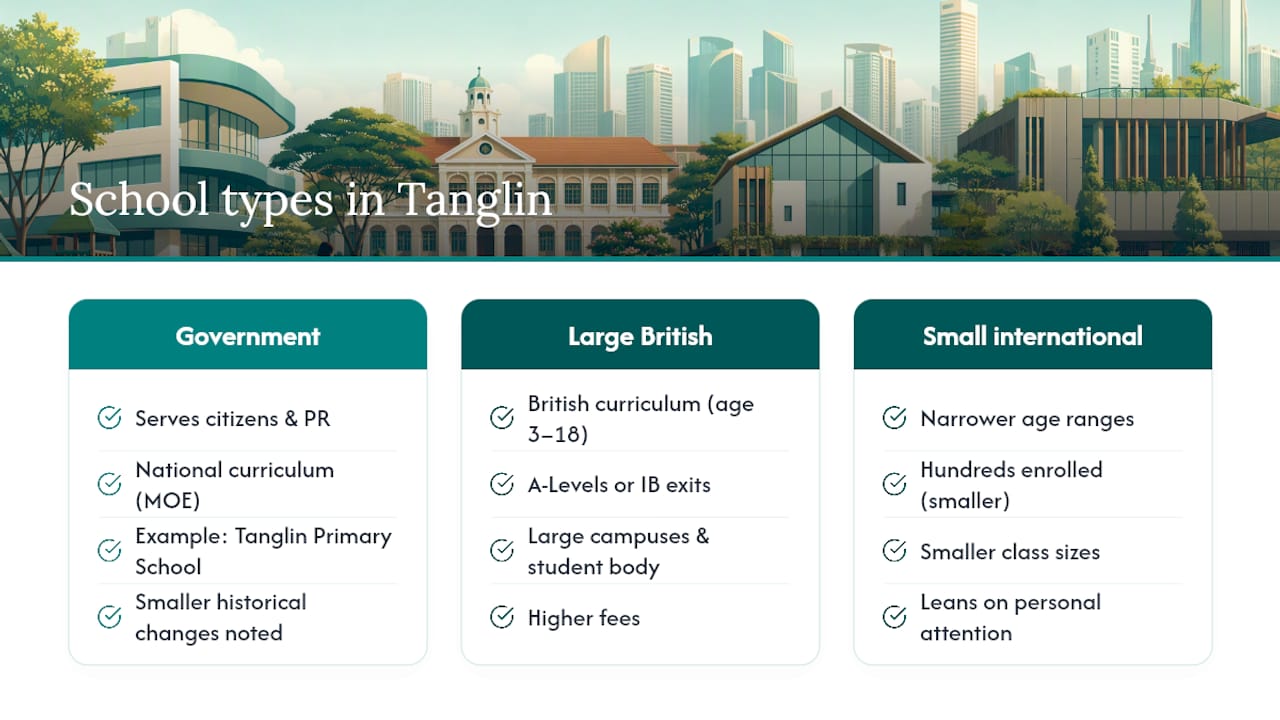
Tanglin sits in Singapore’s central region, bordered loosely by Holland Road, Orchard Boulevard, and the Botanic Gardens. Parents searching for schools “in Tanglin” are usually looking within this pocket, which also touches Bukit Timah and Holland Village. It is one of the more established expat and local family enclaves in Singapore, and school choice here tends to fall into three distinct types.
The first is the government primary school under the Ministry of Education, serving Singapore citizens and permanent residents through the national curriculum. Tanglin Primary School falls into this category, though as this guide’s admissions section explains, the school’s own history has taken some notable turns worth understanding before you assume it operates the way it once did.
The second type is the large British-curriculum international school. Tanglin Trust School anchors this category in the area, teaching a British-based curriculum from age 3 through Sixth Form, with A-Levels or IB as exit qualifications. These schools tend to be substantial operations, with a large student body, extensive campuses, and correspondingly higher fees.
The third type is the small, independent international school, where Astor International School fits. These schools serve a narrower age range, typically keep enrollment in the hundreds rather than thousands, and lean on smaller class sizes as their core selling point rather than scale or facilities.
Demand for the international options in this pocket of Singapore consistently outpaces supply. Tanglin Trust’s Nursery intake, for example, is reported as the main entry point precisely because later-year places rarely open up beyond the occasional withdrawal, according to WhichSchoolAdvisor’s review. If you are building a tanglin primary schools guide shortlist for your own family, timing matters as much as curriculum fit. That pressure shapes almost every recommendation in this guide, from when to apply to how much flexibility you can realistically expect once a school year has started.
Tanglin Trust School vs. Tanglin Primary School: Core Facts
Tanglin Trust School teaches children from age 3 through 18, following a British curriculum until Year 11, when students move into A-Levels or the IB Diploma at Sixth Form. The campus is organized into Infant, Junior, and Senior communities, a structure the school uses deliberately to keep roughly 2,800 to 2,900 students from feeling anonymous, according to the International Schools Guide profile. Parent satisfaction backs up that structural choice: 94% of surveyed parents said they would recommend the school, and more than 70% reported their child has a strong sense of belonging, per WhichSchoolAdvisor. Fees sit in Singapore’s premium international bracket, and published ranges place Tanglin Trust among the costlier options in the area, according to BrightKey’s school profile.
Tanglin Primary School operates under the Ministry of Education, and its official history is documented on MOE’s school histories page. As a local primary, it follows the national curriculum, and admission runs through MOE’s Primary One registration framework rather than a private application process. That means eligibility ties to citizenship or residency status, catchment distance, and registration phase, not to a fee-paying enrollment model.
The practical differences that matter most: language of instruction and support (Tanglin Trust runs in English throughout, with limited English as an Additional Language provision at some entry points), class size expectations (international schools generally advertise smaller ratios than government primaries), and cost. A family choosing between the two isn’t really choosing between two similar schools. They’re choosing between two entirely different systems, and that decision usually gets made well before a tour ever happens.
How Should You Evaluate a Tanglin Primary School?
Choosing well means separating marketing language from what actually happens day to day. Before you visit, build a short checklist you can score every school against on the same terms.
Curriculum fit: Does the school’s academic pathway match your child’s current stage and your long-term plans (staying in Singapore, moving again, university destination)?
English as an Additional Language support: Confirm whether EAL is offered at all, since some British-curriculum schools expect fluent English at entry and don’t provide it, per BrightKey.
Class size and staffing ratio: Ask for the actual number, not a marketing range.
Pastoral care structure: How does the school support a child who is struggling socially or academically?
Co-curricular activities: What’s genuinely available versus what’s listed on a brochure?
Total cost: Tuition plus admission fees, capital levies, and incidental charges like trips or exam fees.
Commute: Realistic travel time from your home, not the straight-line distance on a map.
On the tour itself, ask pointed questions rather than open-ended ones. Good ones include: What is your current EAL waiting list, if any? How many children are typically in a Year 3 classroom, and how many adults? What happens if my child needs extra academic support mid-year? How do you handle transitions for children joining outside the normal intake point? What does a typical week of co-curricular activities actually look like for this age group?
Watch for vague answers to specific questions. If a school can’t tell you its actual class size or EAL policy without checking with someone else, that’s worth noting.
Pro Tip: Bring a notebook and ask the same five questions at every school you visit. Comparing identical answers side by side reveals gaps that a single glowing tour never will.
When Should You Apply, and How Competitive Is It?
Application timing in the Tanglin area follows a predictable but tight rhythm, and missing the window can mean waiting a full year.
Identify your entry point first. Nursery is the primary gateway for most international schools in the area, with Reception and Year 1 places far more limited once the Nursery cohort has filled, based on patterns WhichSchoolAdvisor has documented for Tanglin Trust.
Apply well before you need a place, ideally 12 to 18 months ahead for popular international schools, since availability for the 2025/26 year was reported as undisclosed pending demand.
Understand how waitlists actually work now. Admissions at top international schools have shifted toward holistic applicant pools rather than strict chronological order, meaning sibling priority is less guaranteed than it used to be.
Gather documents early: birth certificates, passport copies, immunization records, and previous school reports, if applicable.
Book tours before submitting an application, not after, so you can adjust your shortlist based on what you actually see.
Submit applications to more than one school if your top choice has an undisclosed or limited intake, and track deadlines separately for each.
For families considering a mid-year move, Astor’s guide on mid-year school intake in Singapore walks through how transfer windows work outside the standard January start. If you’re arriving from overseas, Astor’s broader Singapore school enrollment guide covers the paperwork sequence in more detail.
British Curriculum vs. MOE Primary: What Actually Happens in Class
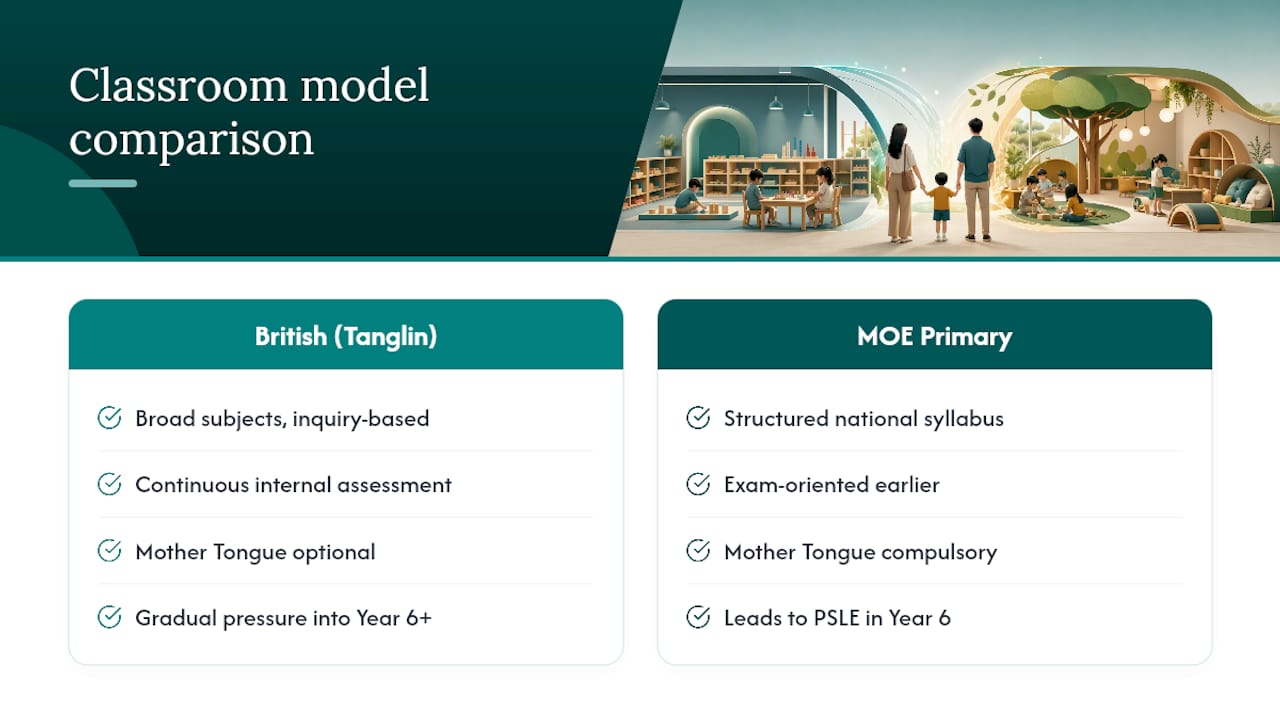
British-curriculum primary years, the model Tanglin Trust follows, build around broad subject exposure, inquiry-based projects, and continuous internal assessment rather than one high-stakes national exam. Children typically move through Key Stage 1 and Key Stage 2 with regular teacher-set assessments feeding into reports, and the pace of academic pressure builds gradually toward Year 6 and beyond.
MOE primary schools, including Tanglin Primary School, follow Singapore’s national syllabus, with structured subject teaching in English, Mother Tongue, Mathematics, and Science, building toward the Primary School Leaving Examination in Year 6. The rhythm is more exam-oriented earlier, and Mother Tongue language study is compulsory rather than optional.
Co-curricular activities vary sharply by school size. Larger international schools can offer hundreds of options, with parent reviewers citing Tanglin Trust’s breadth of CCAs and newer arts and sports facilities as a genuine differentiator. Smaller schools generally offer a tighter, curated set of activities. Before assuming “more is better,” check whether the specific activity your child wants is actually staffed by a specialist coach, not just listed. Language offerings also differ: expect Mandarin and sometimes French or Spanish at international schools, and compulsory Mother Tongue study at MOE primaries.
What Do Fees and Logistics Actually Look Like?
International school fees in the Tanglin area cover more than tuition. Expect an admission fee, an annual material or resource fee, and separate charges for field trips, exams, or uniforms depending on the school. Tanglin Trust’s published fee ranges place it in Singapore’s premium bracket, per BrightKey, while MOE primaries like Tanglin Primary School carry no comparable tuition fee for citizens and permanent residents, only nominal miscellaneous fees set by the ministry.
Transport matters more than most parents expect going in. School bus services are common at larger international campuses but often carry their own separate fee and route restrictions, so confirm whether your address falls on an existing route before assuming door-to-door pickup is guaranteed. MOE primaries typically rely on walking, public transport, or parent drop-off, since bus services are less standardized.
On a visit, walk the actual play areas, not just the reception lobby. Check outdoor space relative to enrollment, sightlines for supervision, and whether facilities look used or simply staged for tours.
What Should You Verify About Astor International School?
Astor International School sits in the Tanglin area and takes a deliberately different approach from the large campuses nearby: it serves ages 5 to 12 with small class sizes and an IPC (International Primary Curriculum) built around inquiry-based learning rather than exam-first pacing. Astor positions itself as a best small school and affordable international school in Singapore, claims worth verifying in person rather than taking at face value.
On a tour, ask to see or confirm:
The actual current class roster count, not an advertised maximum
Sample lesson plans showing how inquiry-based topics translate into daily activities
Staff qualifications and teacher-to-student ratios by year group
How the school documents progress without relying on a single high-stakes exam
You can review Astor’s curriculum details and book a Tanglin campus tour directly to compare these claims against what you see on-site.
Where Does Astor Fit for After-School Care?
Extended-hours coverage is one of the more practical gaps in Tanglin-area school planning, since many working parents need supervised time beyond the regular school day. Astor addresses this directly through structured support options rather than leaving families to arrange private care independently.
The school offers Support After School 1-on-1 and Support After School in a Small Group, both aimed at children who need continued academic help or supervised structure once regular classes end. Pricing for these programs is available on request rather than published as a flat rate, so ask directly when you enquire. Separately, Astor runs Fixed Fee Enrichment Classes five days a week for 6,070 SGD per year, giving families a predictable, all-in cost rather than a per-session bill that adds up unpredictably over a term.
For families at larger international campuses, after-school coverage tends to be bundled into CCA blocks that run on a fixed schedule with less flexibility to swap days. Smaller schools can generally accommodate ad hoc changes more easily, simply because there are fewer children and staff to coordinate around. If your work schedule is unpredictable, ask any school you’re considering how much notice they need to adjust a pickup time or add a supervised day, and get the answer in writing before you commit.
How Do Class Sizes Compare Across Tanglin Schools?
Class size is the single number parents underestimate most when comparing schools, and it shapes almost everything else, from how much individual attention a child gets to how quickly a teacher notices a struggling student.
Tanglin Trust School enrolls roughly 2,800 to 2,900 students across ages 3 to 18, spread across Infant, Junior, and Senior communities specifically designed to prevent that scale from feeling impersonal, according to the International Schools Guide. Even with that structure, individual class sizes at a school of this size will run larger than at a boutique campus, simply because of staffing ratios needed to serve that many families.
Astor positions its small class sizes as a core differentiator, with a maximum of 20 students per class and an average closer to 15. That’s a meaningful gap from a large international campus, and it changes the classroom dynamic in concrete ways: more individual reading time, faster feedback on written work, and a teacher who genuinely knows every child’s name by the second week.
Tanglin Primary School, as an MOE institution, follows the ministry’s standard class size guidelines for government primaries, which generally run larger than boutique international schools but are staffed to national ratios rather than a premium model. When you tour any school, ask for the actual headcount in the specific year group your child would join, not a school-wide average, since ranges can vary significantly between grades.
How Do You Book a Tour or Attend an Open House?
Booking a visit is the single most useful step in this entire process, and it’s the one families most often delay too long.
Start by contacting each school’s admissions office directly rather than relying on secondhand reviews for current availability. For Tanglin Trust School, reach out through the school’s own admissions contact, given that places, particularly beyond Nursery, are reported as limited and subject to change without notice. For Tanglin Primary School, MOE’s registration exercise has fixed phases each year, so check the ministry’s published registration calendar rather than assuming rolling admissions.
For Astor International School, families can book a Tanglin campus tour directly through the school’s own booking page, which lists available slots for prospective families.
Weekday mornings tend to be the most revealing time to visit any school, since that’s when you’ll see actual classroom activity, staff interaction, and pickup logistics rather than a staged after-hours showcase. If a school only offers evening or weekend tours, ask whether a weekday visit can be arranged, since seeing a school empty tells you far less than seeing it running.
Small School or Large Campus: Which Fits Your Family?
Small schools like Astor tend to make sense for families prioritizing individual attention, flexible scheduling, and manageable fees over sheer scale. Larger campuses like Tanglin Trust earn their place when a family wants an extensive CCA roster, a clear A-Level or IB exit pathway, and the reassurance of a school with decades of track record. Many families land on a practical middle ground: enrolling in a smaller primary school while adding targeted enrichment or after-school support to fill any gaps, then reassessing before secondary transition.
— Elena
Ready to See a Tanglin-Area Small School in Person?
If the comparisons above left you weighing scale against personal attention, Astor International School offers a genuinely different starting point: real small classes, capped at 20 students and averaging closer to 15, inside a Tanglin-area campus built around the IPC’s inquiry-based approach rather than exam-first pacing.
Astor’s primary program covers ages 5 to 12 under two fee structures, Option A – Flexi Fees at 17,580 SGD per year and Option B – Fixed Fees at 23,650 SGD per year, alongside enrichment classes and summer camps starting at 108 SGD per day for families who want a taste of the school before committing to a full term. Every claim in this guide, from class size to curriculum approach, is worth checking against what you see in person. Ask to review inspection notes, sample lesson plans, and current class rosters when you visit. The most useful next step is simple: book a Tanglin campus tour and compare what Astor shows you against every other school on your list.
Where to Verify These Facts Yourself
For the most current details, go directly to primary sources rather than relying solely on secondhand guides. MOE’s official school histories page for Tanglin Primary covers the school’s institutional record. Independent reviews at WhichSchoolAdvisor and International Schools Guide offer parent-sourced detail on Tanglin Trust. Always confirm current fees, availability, and admissions timelines by contacting each school’s admissions office directly, since published figures can shift between academic years.
Sources
FAQ
What Are the Top Primary Schools Near Tanglin?
The main options are Tanglin Trust School for a large British-curriculum campus, Tanglin Primary School for a Ministry of Education route, and Astor International School for a small, personalized international alternative nearby. Each suits a different family profile, so the right fit depends on curriculum preference, budget, and how much individual attention your child needs.
Is Tanglin Trust the Best School in Singapore?
“Best” depends on what a family values, but Tanglin Trust ranks among Singapore’s most established international schools, with 94% of surveyed parents saying they would recommend it. It suits families wanting a large campus, extensive CCAs, and a clear A-Level or IB pathway, though its scale and premium fees won’t fit every family.
Is Tanglin a Good Area in Singapore for Families?
Tanglin is a well-established residential pocket near Orchard and the Botanic Gardens, popular with both expat and local families for its central location and school access. It sits within easy reach of multiple primary school types, from MOE institutions to international campuses, making it a practical base for families still finalizing school choice.
What Happened to Tanglin Secondary School?
Tanglin Primary School’s own institutional history, including any changes in structure or naming, is documented on MOE’s official school histories page. Details on any related secondary school changes vary, so families should check the ministry’s record directly rather than relying on secondhand summaries.
How Much Does Astor International School Cost?
Astor’s primary program offers Option A – Flexi Fees at 17,580 SGD per year or Option B – Fixed Fees at 23,650 SGD per year, plus a one-off Admission Fee of 1950 SGD and a 180 SGD annual material fee. Additional costs like ESL support or after-school programs are quoted separately, so ask the admissions team for a full breakdown before enrolling.
Recommended
Comments