


What Is a Learning Journey? A Guide for Parents

A learning journey is defined as a planned, multi-stage progression of connected learning experiences designed to build skills and knowledge over time toward a clear goal. Unlike a single class or workshop, it links orientation, study, practice, and reflection into one cohesive path. In early childhood education, this takes the form of Learning Notes, dispositions tracking, and personalized goals reviewed regularly. Structured learning paths reduce time to proficiency by 30–50%, which means children and learners reach real competence faster when their development is planned rather than left to chance. For parents and educators, understanding what a learning journey means is the first step toward supporting every child more intentionally.
What is a learning journey in education?
A learning journey is an architecture connecting learning experiences over time, rather than isolated content delivered in one sitting. The term comes from instructional design, where it describes a deliberate sequence of events that moves a learner from starting point to confident application. In early childhood settings, the same principle applies: a child’s growth is mapped through regular observations, documented milestones, and personalized next steps.
The learning journey definition matters because it shifts the focus from “what did we teach today?” to “where is this child going, and how are we supporting that path?” That shift changes everything about how teachers plan and how parents engage. It also distinguishes a learning journey from a learning path, which tends to focus on a specific sequence of content modules, or a learning track, which targets a narrow skill set.

At Astor International School in Singapore, this philosophy is woven into daily practice. Teachers observe, document, and plan with each child’s individual strengths and curiosity in mind. The result is a school experience that feels personal, not generic.
What are the key phases of a learning journey?
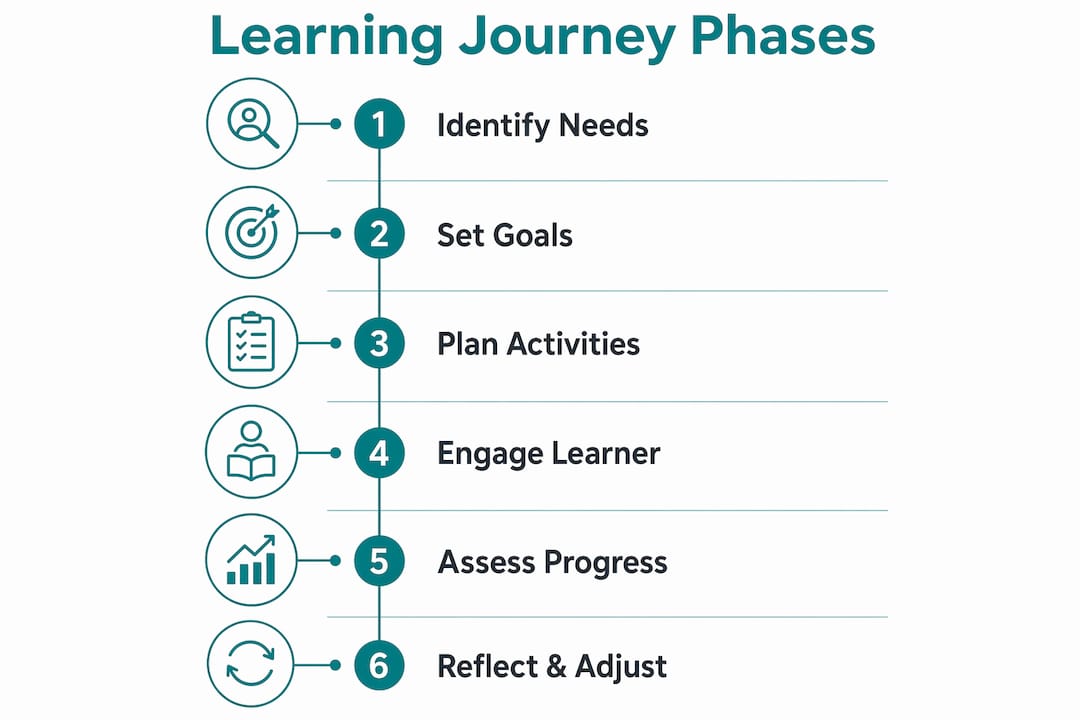
An effective learning journey follows cyclical phases: a starting point, initial study, practical application, and reflection that feeds the next cycle of development. Each phase builds on the last. Skipping any one of them is where most educational efforts fall short.
Here is how those phases typically unfold for a child in a structured school setting:
Starting Point (Orientation): The child’s current knowledge, interests, and strengths are assessed. For young learners, this happens through observation and Learning Notes rather than formal tests.
Initial Knowledge Acquisition: New concepts, skills, or ideas are introduced through lessons, play, inquiry, or guided activities. This phase works best when content connects to what the child already knows.
Practical Application: The child uses new knowledge in real contexts. This is where modular learning with real-world application produces lasting behavioral change. A child who learns about measurement in math, then uses it to build a model, retains that skill far longer.
Reflection and Review: The educator and child (and ideally the family) look back at what was learned, what clicked, and what needs more attention. In early childhood, this review happens every four months through structured goal-setting conversations.
Next Cycle: New goals are set based on the reflection. The process starts again, but at a higher level of understanding.
This cyclical structure is what separates a learning journey from a one-off training event. Breaking learning into these bite-sized, connected steps prevents overwhelm and supports long-term retention.
Pro Tip: Avoid the “seminar effect,” where a child attends an enriching workshop but returns to routine with no follow-through. The fix is simple: after any new learning experience, plan one concrete activity within the next week that lets your child apply what they discovered.
Why are learning journeys important for child development?
Learning journeys matter because they focus on what a child can do and where they are headed, not on gaps or deficits. This strength-based approach is central to modern early childhood education. Frequent Learning Notes focus on dispositions of learning such as confidence, curiosity, and resilience, rather than solely on academic benchmarks. That distinction is significant. A child who is documented as “curious and persistent” receives very different support than one labeled “behind in reading.”
The benefits of a learning journey in child development include:
Sustained skill development: Skills build on each other over months, not weeks. Children develop genuine competence rather than surface familiarity.
Personalized goals: Personalized learning journeys are designed around each child’s role, context, and goals. No two children follow the exact same path.
Stronger engagement: When children see their own progress documented and celebrated, they become more motivated. Shifting control toward the learner accelerates skill-building and deepens engagement.
Family involvement: Regular documentation gives parents a window into their child’s development that monthly report cards simply cannot provide.
Resilience and confidence: Tracking dispositions rather than just grades builds a child’s belief in their own ability to grow.
“The best learning happens when every child is truly seen and supported.” This is not just a warm sentiment. It is the operating principle behind every well-designed learning journey.
Regular documentation improves accuracy in assessing a child’s strengths and interests over deficits. That accuracy leads to better teaching decisions and more meaningful conversations between educators and families.
How can parents and educators create effective learning journeys?
Creating a learning journey for a child does not require a specialist degree. It requires consistency, curiosity, and a clear process. Here is a practical framework any parent or educator can follow:
Start with strengths and interests. Observe what your child gravitates toward naturally. A child obsessed with building blocks is showing you their entry point for spatial reasoning, engineering, and math.
Set clear, specific goals. Vague goals like “improve reading” are hard to track. Specific goals like “recognize 20 new sight words by the end of term” give you something to measure and celebrate.
Document frequently. Educators capture daily milestones through Learning Notes written multiple times weekly, not just at report card time. Parents can do the same with a simple notebook or app.
Plan review cycles. Set a calendar reminder every four months to sit down, review your notes, and ask: What has changed? What is the next goal? This rhythm keeps the process alive.
Incorporate varied experiences. A strong learning journey includes play, inquiry, and structured activities alongside formal lessons. Variety prevents boredom and reaches different learning styles.
Collaborate with your child. Even young children can tell you what they enjoy and what feels hard. Including their voice makes the process more meaningful and builds ownership.
Use tools that support sharing. Platforms that allow teachers and parents to view the same documentation create a genuine partnership. At Astor, this collaboration is built into the school’s approach to personalized learning.
Pro Tip: Review your child’s Learning Notes or observation records before every parent-teacher conference. Coming in with specific questions (“I noticed she’s been very interested in storytelling. How is that showing up in class?”) transforms the conversation from a report to a real dialogue.
Learning journey vs. learning path vs. single training: what’s the difference?
These three terms are often used interchangeably, but they describe very different things. Understanding the distinction helps parents and educators choose the right approach for the right situation.
A learning path provides a structured sequence focused on outcomes, breaking goals into manageable steps for improved skill acquisition. A learning track focuses on a specific skill or module. A learning journey maps broad, long-term development across multiple domains and time periods.
Term | Focus | Time Frame | Best Used For |
Learning Journey | Whole-child or whole-learner development | Months to years | Long-term growth, dispositions, life skills |
Learning Path | Outcome-based sequence of content | Weeks to months | Specific subject mastery or skill progression |
Learning Track | Narrow skill or topic focus | Days to weeks | Targeted practice on one competency |
Single Training Event | One topic, one session | Hours | Awareness or introduction to a concept |
The single training event is the weakest format for lasting change. Continuous support phases lead to faster skill application and more measurable results than standalone sessions. This is why a well-designed learning journey always outperforms a one-day workshop, no matter how engaging that workshop is.
For children in particular, the learning journey framework is the most appropriate structure. Children develop across social, emotional, physical, and cognitive domains simultaneously. A narrow learning track cannot capture or support that breadth.
Key takeaways
A learning journey is the most effective structure for child development because it connects every learning experience to a long-term, personalized plan that builds real skills over time.
Point | Details |
Clear definition matters | A learning journey is a planned, multi-stage path connecting learning events from orientation to confident application. |
Cyclical phases drive retention | Orientation, study, application, and reflection form a repeating cycle that builds lasting competence. |
Dispositions over deficits | Effective journeys track confidence, curiosity, and resilience, not just academic scores. |
Frequent documentation is key | Learning Notes written multiple times weekly give a far more accurate picture than monthly reports. |
Journeys outperform single events | Continuous, connected learning produces faster skill application than any standalone training or workshop. |
What i’ve learned from watching learning journeys in action
After years of observing children in structured educational environments, the pattern that surprises most parents is this: the children who thrive are rarely the ones who attend the most enrichment classes. They are the ones whose learning is connected. When a child’s teacher, parent, and the child herself are all looking at the same documented path and asking the same questions, something shifts. The child starts to see herself as a learner with a direction, not just a student completing tasks.
The hardest part of creating a learning journey is not the planning. It is the patience. Parents often want to see results in weeks. Real development in dispositions like resilience or curiosity takes months to become visible in documentation. I have seen families abandon a beautifully designed process at the three-month mark, right before the four-month review would have shown them meaningful progress.
My honest recommendation: commit to one full review cycle before you judge whether the process is working. Read your child’s learning support resources alongside their teacher’s observations. You will almost always find growth you did not notice in the day-to-day.
The other thing worth saying plainly: small schools do this better. When a teacher has 28 students, weekly Learning Notes become impossible. When a class has 15 or fewer, they become a natural part of the rhythm. That is not a coincidence. It is a structural advantage.
— Elena
How astor builds learning journeys into every child’s day
At Astor International School in Singapore, the learning journey framework is not a program add-on. It is the foundation of how teachers plan, observe, and communicate with families. Small class sizes at both the Tanglin campus for ages 5–12 and the Holland preschool make frequent, personalized documentation genuinely possible. Every child has a learning plan that reflects their strengths, interests, and next goals, reviewed and updated throughout the year. Families receive regular insight into their child’s development, not just at report card time. If you want to see how this looks in practice, explore Astor’s IPC curriculum approach and discover how structured, personalized learning journeys shape every stage of a child’s education.
FAQ
What is a learning journey in simple terms?
A learning journey is a planned series of connected learning experiences that moves a child or learner from their starting point toward a specific goal over time. It is broader and longer than a single lesson or course.
How is a learning journey different from a learning path?
A learning path is a structured sequence focused on a specific outcome or subject, while a learning journey maps whole-person development across multiple skills and dispositions over a longer period.
How often should a child’s learning journey be reviewed?
Early childhood educators typically review Learning Notes and reset goals every four months. This rhythm gives enough time for genuine development to become visible before adjustments are made.
What are dispositions of learning and why do they matter?
Dispositions of learning are qualities like curiosity, confidence, and resilience that shape how a child approaches new challenges. Tracking these gives a fuller picture of development than academic scores alone.
Can parents create a learning journey at home?
Yes. Parents can document observations, set specific goals based on their child’s interests, and review progress every few months. Collaborating with the child’s teacher to align home and school goals makes the process significantly more effective.
Recommended

Comments