


Why Play Based Education Works: A 2026 Guide
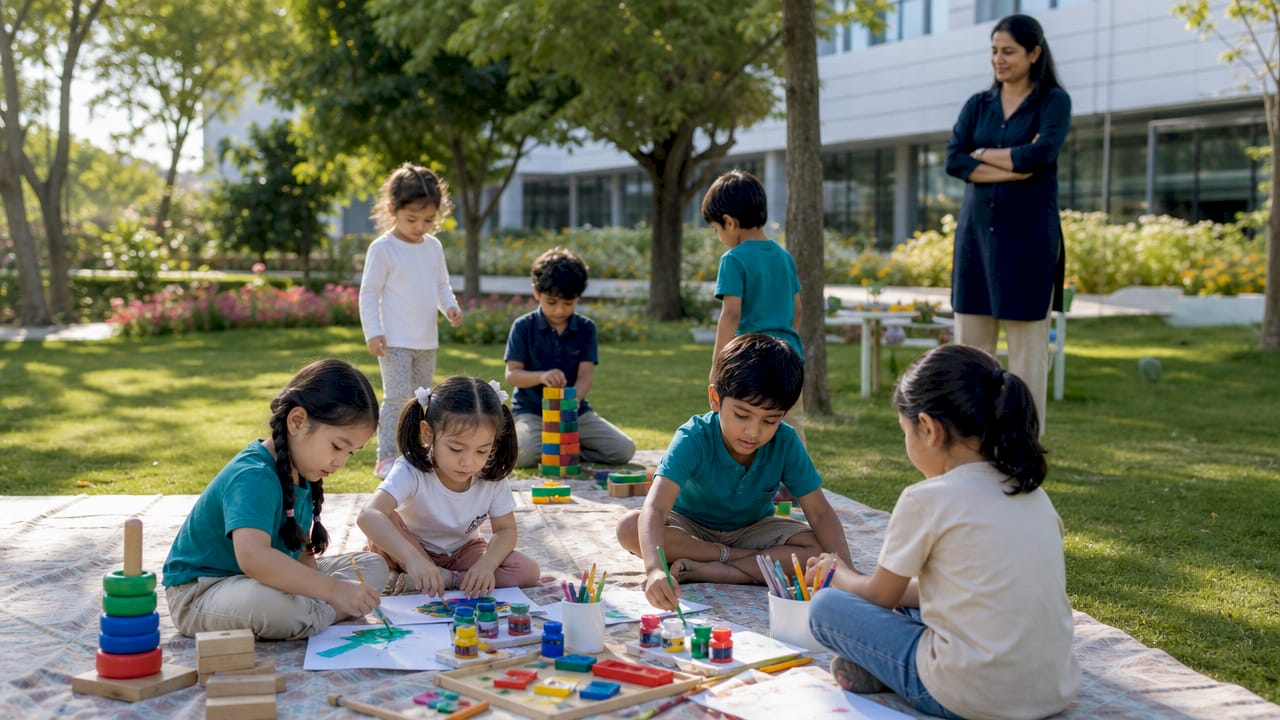
Play-based education is defined as a learning approach where children build foundational academic, social, and emotional skills through purposeful, engaging play experiences. Research confirms that this method is not a soft alternative to formal instruction. It is one of the most effective ways to prepare children aged 1.5 to 12 for lasting academic and life success. A 2022 analysis of 39 studies by the University of Cambridge PEDAL Centre found that guided play matches or surpasses traditional teaching for literacy, numeracy, and social skills in children aged 3–8. That finding alone reframes the entire conversation about what rigorous early education looks like. At Edu, we see this evidence play out every day in the way children grow in confidence, curiosity, and capability.
Why play based education works: the science behind it
Play-based education works because it activates the parts of the brain children need most for learning. Play stimulates the prefrontal cortex, the region responsible for planning, impulse control, and flexible thinking. These are the executive functions that underpin every academic skill a child will ever use. When a child negotiates roles in a pretend game or figures out how to balance blocks, they are literally building the neural pathways for problem-solving and self-regulation.
The industry term for this approach is “play-based pedagogy,” which covers both free play and guided play. Free play is child-directed with no adult agenda. Guided play is structured by an adult with a learning goal in mind, but the child still leads the experience. Both forms matter, and the research distinguishes clearly between them. Understanding that distinction helps parents and educators make intentional choices about how children spend their time.
What skills do children develop through play-based education?
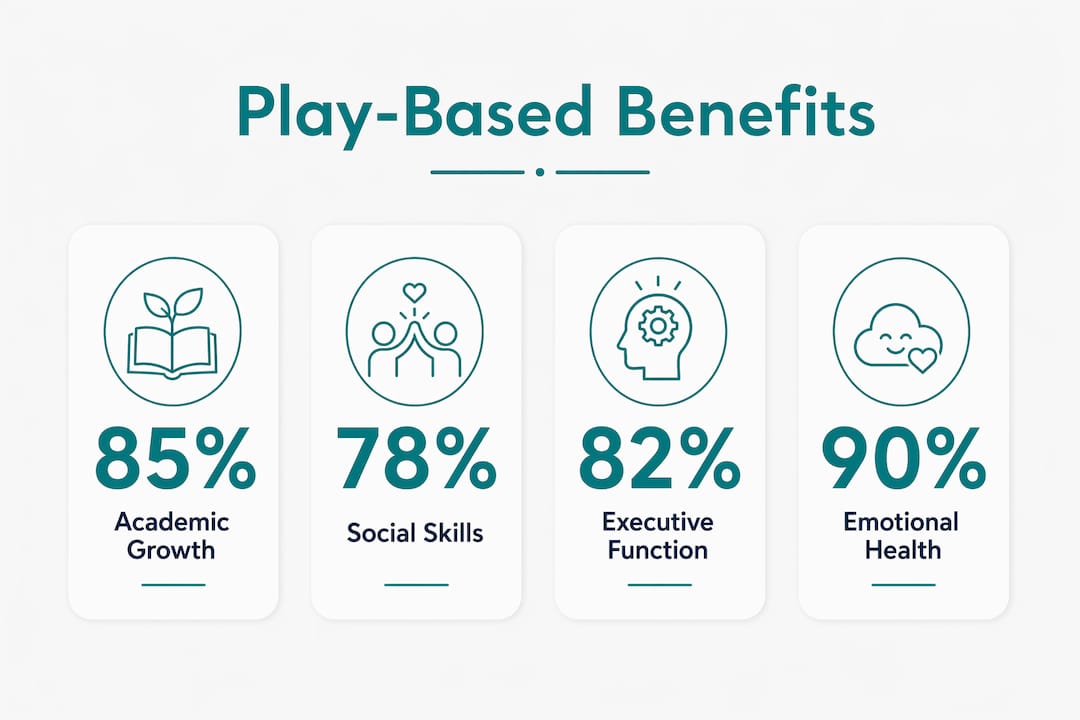
Play builds a wider range of skills than most parents expect. A 2026 scoping review of 51 international studies found that play-based learning develops independence, problem-solving, cognitive resilience, and socio-emotional health in children aged 4–6. These are the exact predictors of long-term academic success. The skills fall into four clear categories:
Critical thinking and creativity. Children who play with open-ended materials practice generating and testing ideas. A child building a ramp for a toy car is running a physics experiment.
Social skills. Cooperative play requires negotiation, turn-taking, and reading social cues. Prof. Paul Ramchandani, LEGO Professor of Play at the University of Cambridge, states that children develop resilience and negotiation primarily through play rather than passive instruction.
Emotional regulation. Play gives children a safe space to experience frustration, disappointment, and excitement, and to manage those feelings in real time.
Physical and fine motor development. Cutting, threading, building, and outdoor climbing all develop the coordination children need for writing and focused desk work.
Object-based play deserves special attention. A 2023 analysis of 102 studies by the University of Cambridge found that blocks and puzzles improve spatial reasoning, literacy, and mathematical planning in primary-age children. This is why open-ended math activities using physical materials are so effective in the primary classroom.
Pro Tip: When your child plays with blocks or puzzles, ask them to explain what they built and why. That one question shifts the activity from play to guided learning without removing any of the joy.
How does guided play improve outcomes over traditional methods?
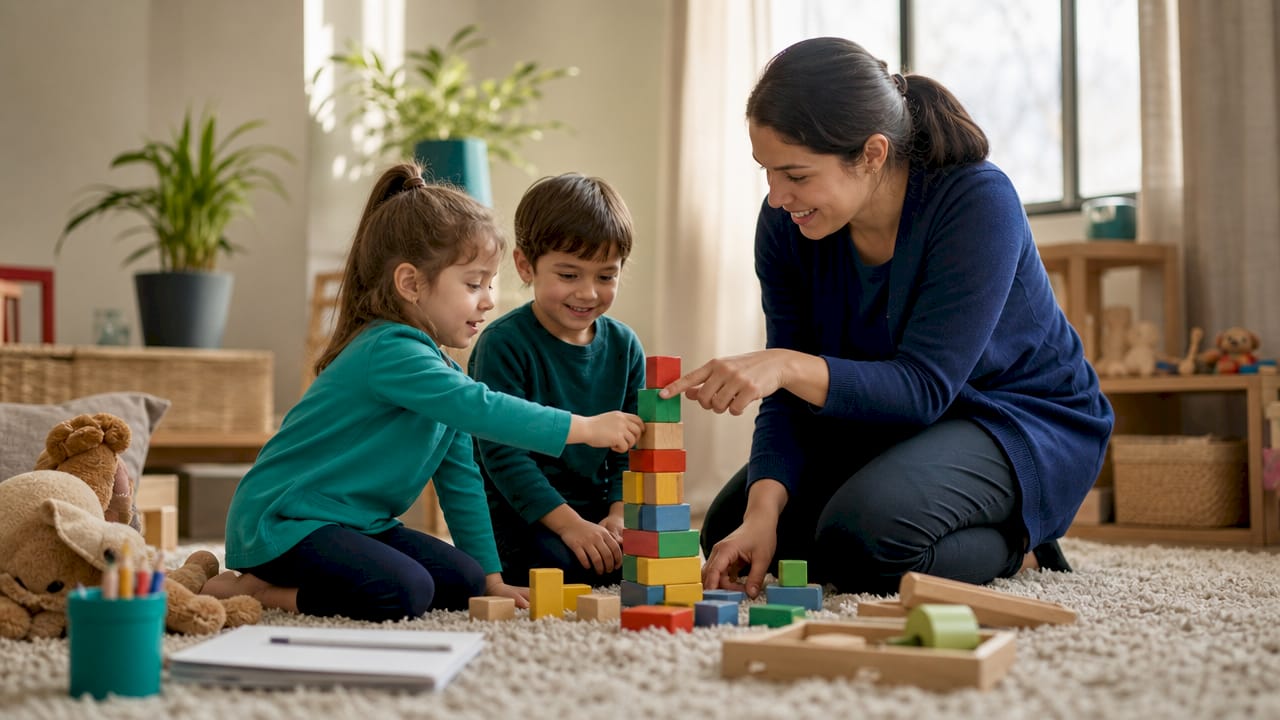
Guided play is the most effective form of play-based pedagogy for measurable academic outcomes. The University of Cambridge PEDAL Centre’s analysis of 39 studies confirmed that guided play outperforms direct instruction for math concept understanding, particularly for shapes and spatial reasoning. That result surprises many educators who assume structured lessons are always more efficient. The reality is that children retain concepts longer when they discover them through experience rather than receive them through instruction.
Here is how guided play works in practice:
Set a clear learning goal. Decide what concept or skill you want the child to encounter, such as counting, sorting, or letter sounds.
Prepare the environment. Lay out materials that naturally invite the target skill. Sorting colored objects invites classification. Sand and water invite measurement.
Observe before intervening. Let the child engage freely first. Note what they already understand and where their thinking stalls.
Scaffold with questions, not answers. Ask “What do you think will happen if…?” rather than explaining the outcome. This extends thinking without removing agency.
Name the learning. At the end, briefly label what the child did. “You sorted by color. That’s called classifying. Scientists do that too.”
Intentional teacher scaffolding embedded in play deepens understanding more than free play alone. The adult’s role is not to direct the play but to extend it at the right moment. Joy and motivation are not incidental to this process. They are the mechanism. Children who enjoy learning return to it willingly, which compounds their growth over time.
Does play-based learning support long-term academic success?
Play-based learning produces stronger long-term outcomes than early formal instruction alone. Research by Weisberg, Zosh, Hirsh-Pasek, and colleagues confirms that play-based environments yield stronger motivation, conceptual understanding, and self-regulation than traditional instruction. Self-regulation, in particular, is one of the strongest predictors of academic achievement across a child’s entire school career.
“Children’s play is their work in early years, literally building brain connections and practicing executive function and emotional regulation skills.” — Harvard Health
The importance of play in education extends well beyond the early years. Children who develop strong executive function through play enter primary school with the capacity to focus, persist through difficulty, and manage their emotions in a classroom setting. Those skills matter more than early reading or number knowledge at school entry.
Long-term benefit | How play builds it |
Executive function | Play activates planning, flexible thinking, and impulse control in the prefrontal cortex |
Conceptual understanding | Discovery through play creates deeper, more durable knowledge than memorization |
Self-regulation | Managing emotions and impulses during play transfers directly to classroom behavior |
Motivation to learn | Joyful early learning experiences build a positive association with school and effort |
NAEYC research syntheses confirm that play-based learning promotes school readiness across language, executive function, social skills, and physical coordination simultaneously. No single formal lesson covers that range at once.
How can parents and educators implement play-based learning well?
Effective implementation requires intention, not improvisation. The most common mistake is treating play as a break from learning rather than as the learning itself. Here is how to get it right:
Design the environment deliberately. Stock spaces with open-ended materials: blocks, art supplies, natural objects, and loose parts. Playgrounds that mix outdoor and indoor spaces give children the physical and sensory variety their development requires.
Balance child choice with adult purpose. Children need to feel ownership of their play. Adults need to have a learning goal in mind. Both can coexist when the adult sets up the environment and then steps back.
Use collaborative activities to build social skills. Group play teaches negotiation, shared responsibility, and perspective-taking. These are skills that formal instruction rarely develops as naturally.
Communicate learning to families clearly. Sharing specific photos or artifacts with captions that name the underlying skill bridges the gap between what play looks like and what it actually teaches. A photo of a child sorting shells with the caption “practicing classification and one-to-one correspondence” changes how a parent sees the activity.
Address the rigor question directly. Dr. Nicol Russell of Teaching Strategies states that true rigor means deep, meaningful, joyful learning, which play-based pedagogy delivers better than rote instruction.
Pro Tip: Keep a simple learning journal with photos from play sessions. Label each photo with one skill the child practiced. Over a term, that journal becomes powerful evidence of growth for both families and school administrators.
Key takeaways
Play-based education works because it builds cognitive, social, and emotional skills simultaneously through experiences children find genuinely engaging, producing outcomes that outlast those of early formal instruction.
Point | Details |
Guided play outperforms direct instruction | A 2022 Cambridge analysis of 39 studies found guided play matches or surpasses traditional teaching for literacy and numeracy. |
Object-based play builds math skills | Blocks and puzzles improve spatial reasoning and mathematical planning, per a 2023 Cambridge analysis of 102 studies. |
Executive function is the key outcome | Play activates the prefrontal cortex, building planning, impulse control, and flexible thinking central to school success. |
Adult scaffolding deepens learning | Intentional questions and well-timed guidance extend children’s thinking beyond what free play alone achieves. |
Communicate learning artifacts to families | Labeled photos from play sessions make learning visible and build parent confidence in the approach. |
Play-based learning: what I’ve learned after years in the classroom
The biggest misconception I encounter is that play-based learning is what you do before the real teaching starts. Parents worry their child is falling behind while classmates in more formal programs are drilling phonics or memorizing number facts. I understand that worry completely. But the research is unambiguous, and so is what I have seen with my own eyes.
Children who learn through guided play do not just match their peers on academic measures. They arrive at those outcomes with something extra: they actually want to keep learning. That internal motivation is the thing that formal drilling rarely builds and almost never sustains. A child who discovers that adding blocks makes a tower taller has understood a mathematical relationship. A child who memorized “2 plus 2 equals 4” has stored a fact. Those are not the same thing.
The other thing I would tell every parent is this: play is not easy for children. Negotiating with a friend over who gets the red crayon, managing the frustration of a tower that keeps falling, figuring out how to include a shy classmate in a game. These are genuinely hard problems. Children are working hard when they play. We just need to learn to see it.
— Elena
Play-based learning at Edu’s international schools in Singapore
Edu’s Astor International School in Singapore’s Tanglin area has been recognized as both the best small school and the best affordable international school in Singapore. Small class sizes mean every child is genuinely seen and supported, which is exactly what play-based pedagogy requires.
The school’s IPC curriculum integrates play-based learning principles across all year groups for children aged 5–12, connecting subjects through engaging, inquiry-led units that reflect the latest research on how children learn best. Astor’s preschool at Holland, with its two playgrounds and mix of outdoor and classroom learning, extends that same philosophy to children from 18 months. If you are looking for a school where your child’s curiosity is treated as a strength, Edu is a natural place to start.
FAQ
What is play-based education?
Play-based education is a learning approach where children develop academic, social, and emotional skills through purposeful play experiences, both child-directed and adult-guided.
How does guided play differ from free play?
Guided play is structured by an adult with a specific learning goal, while free play is entirely child-directed. Research shows guided play produces stronger outcomes for literacy and numeracy.
What age group benefits most from play-based learning?
Children aged 1.5 to 12 benefit from play-based learning, with the strongest evidence for children aged 3–8 where guided play matches or surpasses traditional instruction for core academic skills.
Does play-based learning meet academic standards?
Play-based learning meets and often exceeds academic standards. Dr. Nicol Russell of Teaching Strategies defines true rigor as deep, meaningful, joyful learning, which play-based pedagogy delivers effectively.
How can parents support play-based learning at home?
Parents can set up open-ended play environments with blocks, art supplies, and natural materials, then ask open questions like “What do you think will happen?” to extend their child’s thinking during play.
Recommended
Your work is very good and I appreciate you and hopping for some more informative posts Aanleg zwembad
Thanks for your post. I’ve been thinking about writing a very comparable post over the last couple of weeks, I’ll probably keep it short and sweet and link to this instead if thats cool. Thanks. Zwembad bouwen tuin
I like viewing web sites which comprehend the price of delivering the excellent useful resource free of charge. I truly adored reading your posting. Thank you! Garten Schwimmbecken
This is my first time i visit here and I found so many interesting stuff in your blog especially it's discussion, thank you. Zwembad op maat
Super site! I am Loving it!! Will return once more, Im taking your food likewise, Thanks. Schwimmbecken polypropylen